

January 13, 2026
•
5 min read
The Top 10 Best Countries to Retire in 2026: Your Ultimate Guide
Discover the best countries to retire in 2026. Compare costs, healthcare, and visas in Portugal, Mexico, Spain, and more for your ideal retirement.

Choosing where to spend your retirement is one of life's most significant and exciting decisions. As the world becomes more connected, a growing number of retirees are looking beyond their home borders for a destination that offers a better quality of life, a lower cost of living, and new adventures. The idea of trading snow for sunshine or a high-stress environment for a relaxed, culturally rich community is more attainable than ever. However, navigating the complexities of international relocation, from visas and healthcare systems to local tax laws and property purchases, can be a formidable task.
This guide is designed to cut through the noise and provide clear, actionable information. We've analyzed the critical factors that matter most to prospective retirees, including healthcare quality, residency pathways, expat community strength, and estimated monthly budgets, to identify the best countries to retire in 2026. Whether you dream of a sun-drenched European village, a vibrant Latin American city, or a tranquil Southeast Asian retreat, this detailed comparison will provide the practical insights you need to make an informed choice. Many retirees also consider purchasing a home to establish roots in their new country. To successfully navigate the process, it's crucial to consult a strategic guide to buying property abroad.
Our comprehensive roundup covers everything from specific visa requirements to the nuances of local life. For each destination, we will delve into the crucial step of securing international health insurance, ensuring your health and peace of mind are protected no matter where you ultimately call home. This list will equip you with the essential knowledge to confidently plan the next chapter of your life.
1. Portugal - The European Retiree Haven
Portugal consistently ranks among the best countries to retire, offering a compelling blend of affordability, high quality of life, and a welcoming atmosphere. Its appeal lies in a unique combination of a mild Mediterranean climate, stunning coastlines, and historic cities, all at a cost significantly lower than many other Western European nations. Retirees are drawn to its relaxed pace of life, rich cultural heritage, and modern infrastructure, making it an ideal destination for those seeking a comfortable and enriching retirement.

The country's healthcare system, the Serviço Nacional de Saúde (SNS), is highly regarded and accessible to legal residents, often at little to no cost. While public healthcare is robust, many expats also opt for private health insurance for faster access to specialists and English-speaking providers.
Key Considerations for Retiring in Portugal
- Visa and Residency: The D7 Visa, often called the "passive income visa," is a popular route for retirees. Applicants must demonstrate a stable passive income (such as pensions or social security) of at least €820 per month for a single applicant.
- Cost of Living: A retired couple can live comfortably on an estimated budget of $2,200 to $2,800 per month, depending on the city and lifestyle. Lisbon and Cascais are more expensive, while cities like Porto or the Algarve region offer more affordable options.
- Tax Incentives: The Non-Habitual Resident (NHR) program has been a major draw, previously offering a 10-year tax exemption on foreign pension income. While the original NHR program has ended for new applicants, a new version exists for specific professions and pensioners from countries with a Double Taxation Agreement, offering a 20% flat tax rate. It's crucial to consult a tax advisor for the latest regulations.
Actionable Next Steps
- Start the D7 Visa Application Early: Gather financial documents and begin the application process at your local Portuguese consulate at least four to six months before your planned move.
- Secure Health Insurance: Obtain comprehensive international health insurance before arriving. This is a requirement for the visa and provides peace of mind while navigating the local SNS registration.
- Explore Different Regions: Spend time in various locations before settling. The vibrant city life of Lisbon, the coastal charm of Cascais, and the relaxed pace of the Algarve each offer a distinct retirement experience.
2. Mexico - Affordable North American Retirement
Mexico offers an appealing combination of proximity to the United States and Canada, a dramatically lower cost of living, and a vibrant cultural tapestry. Its diverse landscapes range from sun-drenched beaches to cool colonial mountain towns, providing a retirement setting for every preference. For many North Americans, Mexico is an accessible and familiar choice, making it one of the best countries to retire for those who want to stay close to home while embracing a new way of life.
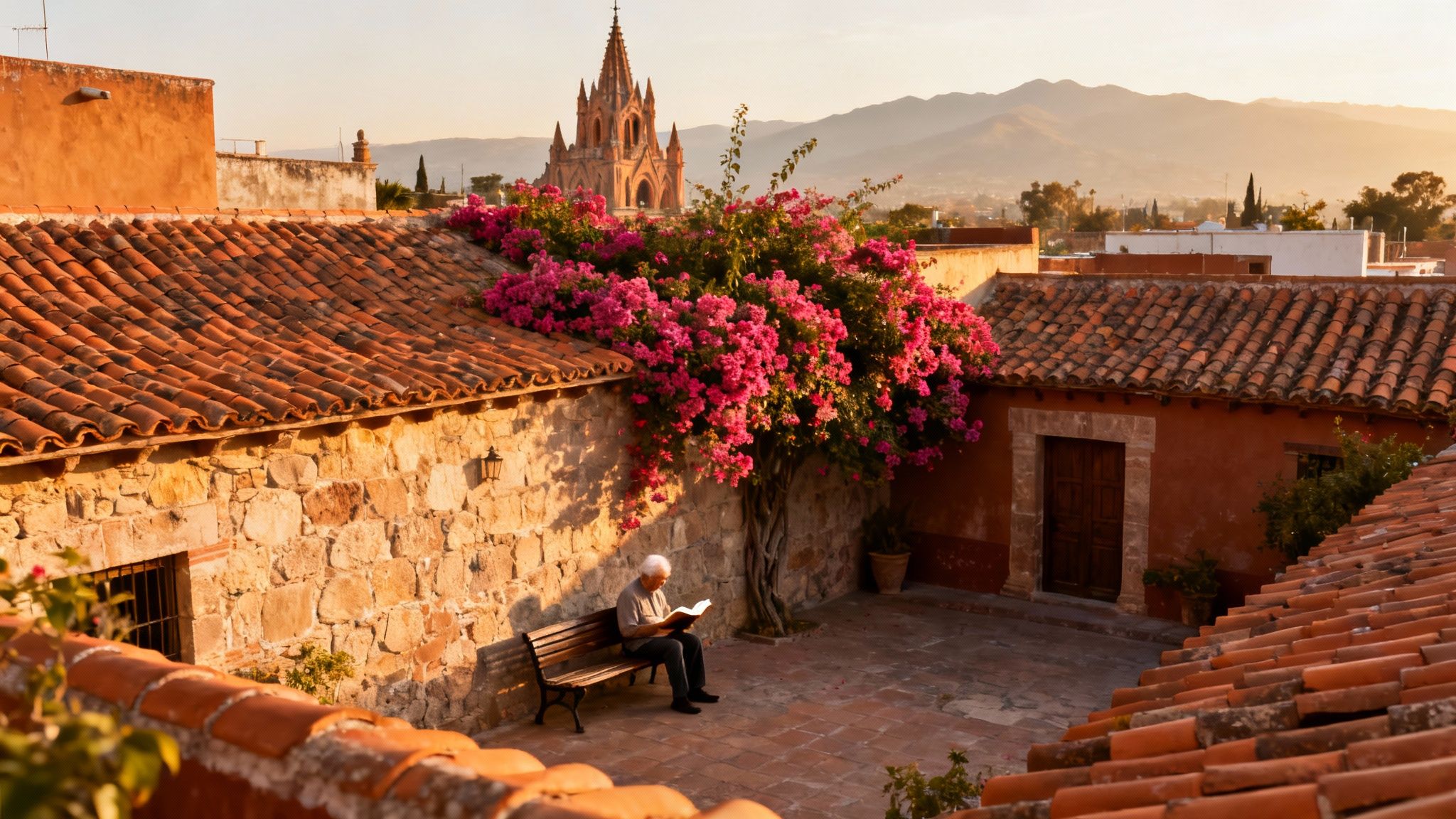
The country features a two-tiered healthcare system. Legal residents can join the public systems, IMSS or INSABI, for very low-cost care. However, many expats prefer the private healthcare system, which offers excellent facilities, English-speaking doctors, and immediate access to specialists at a fraction of U.S. costs. Destinations like San Miguel de Allende and Lake Chapala are renowned for their large expat communities and top-tier medical services.
Key Considerations for Retiring in Mexico
- Visa and Residency: Mexico provides straightforward residency options. The Temporary Resident Visa is for those intending to stay from six months to four years, requiring a monthly income of approximately $4,350 or savings of around $72,500. The Permanent Resident Visa requires a higher monthly income of about $7,250 or savings near $290,000.
- Cost of Living: A retired couple can live very comfortably on a budget of $2,000 to $2,800 per month. This covers housing, utilities, healthcare, and entertainment in popular expat areas like Puerto Vallarta or the Lake Chapala region.
- Healthcare Quality: Private hospitals in major cities and expat hubs are often internationally accredited and equipped with modern technology. Many retirees find that paying out-of-pocket for routine care or securing a local private insurance plan is highly affordable and efficient.
Actionable Next Steps
- Organize Financial Documents: Before applying for a visa, gather at least six to twelve months of bank statements showing consistent passive income deposits, as this is a key requirement.
- Research and Secure Health Coverage: Evaluate both public and private healthcare options. Obtain a comprehensive international or Mexico-specific private health insurance policy to ensure access to top facilities without waiting periods.
- Join Expat Communities Online: Connect with established expat groups for your target regions (like Lake Chapala or Playa del Carmen) on social media before your move. These communities offer invaluable, on-the-ground advice for a smooth transition.
3. Costa Rica - Tropical Retirement Paradise
Costa Rica's famous "Pura Vida" (pure life) philosophy extends deeply into its retirement appeal, making it one of the best countries to retire for those seeking nature, stability, and well-being. The country combines a lush, biodiverse landscape with a stable political environment and one of Central America's highest safety ratings. Retirees are drawn to its tropical climate, friendly locals, and a strong emphasis on environmental preservation and a healthy, active lifestyle.

The country's healthcare system is a major draw, with both public and private options available. The public system, known as the Caja Costarricense de Seguro Social (CAJA), is accessible to legal residents and provides comprehensive, low-cost care. Many expats supplement CAJA with private insurance for faster access to specialists, elective procedures, and English-speaking doctors in major hubs like San José.
Key Considerations for Retiring in Costa Rica
- Visa and Residency: The Pensionado (Retiree) Visa is the most popular path for retirees. Applicants must prove a stable, lifetime monthly income of at least $1,000 USD from a pension, Social Security, or similar source. This visa allows a retiree to claim a spouse and dependents.
- Cost of Living: A retired couple can live comfortably on a budget of $2,000 to $3,000 per month. Areas like the Central Valley (including San José and Atenas) offer a mix of urban amenities and affordability, while coastal regions in the Southern Zone may have a slightly higher cost.
- Expat Communities: Costa Rica has well-established expat communities, making for a smooth transition. The Central Valley is popular for its spring-like climate and access to top-tier healthcare, while areas like Arenal and the Southern Zone attract those seeking immersion in nature with the comfort of English-speaking neighbors.
Actionable Next Steps
- Verify Pensionado Income Requirements: Check the official Costa Rican immigration website or consult an immigration attorney before applying, as the specific income threshold and documentation rules can be adjusted.
- Plan for Healthcare Coverage: Purchase a comprehensive international health insurance policy before you move. This is often required for the residency process and will cover you while you wait to enroll in the local CAJA system.
- Establish Local Banking Relationships: Open a local bank account as soon as you arrive. This is essential for daily life and managing expenses, but be prepared for a process that requires patience and significant documentation.
4. Spain - Mediterranean European Lifestyle
Spain presents an irresistible mix of sunny Mediterranean climate, rich cultural history, and an energetic yet relaxed lifestyle, making it one of the best countries to retire. From the cosmopolitan streets of Madrid and Barcelona to the sun-drenched coasts of Andalusia, Spain offers diverse settings to suit any preference. Its appeal is bolstered by a high standard of living, excellent infrastructure, and a cost of living that is often more affordable than in other major Western European nations.
The country boasts one of Europe’s most efficient public healthcare systems, the Sistema Nacional de Salud (SNS), which is accessible to all legal residents. Renowned for its quality, the SNS is a major draw for retirees. Many expats also choose to supplement this with private health insurance for faster access to specialists and a wider choice of English-speaking doctors, particularly in popular expatriate regions.
Key Considerations for Retiring in Spain
- Visa and Residency: The Non-Lucrative Visa is the primary pathway for non-EU retirees. Applicants must prove sufficient financial means to support themselves without working, requiring an annual passive income of at least €28,800 for an individual, plus an additional €7,200 for a spouse.
- Cost of Living: A retired couple can live comfortably on a budget ranging from $2,300 to $3,000 per month. Major cities like Madrid and Barcelona are more expensive, while regions like Valencia and Andalusia offer a significantly lower cost of living.
- Healthcare Access: Once residency is established, retirees can register with the SNS. It’s important to note that access may vary by region (comunidad autónoma), and some expats may initially need private insurance to cover the gap before becoming eligible for public healthcare.
Actionable Next Steps
- Initiate the Non-Lucrative Visa Process: This visa must be applied for from your home country's Spanish consulate. Start gathering financial records, a police clearance certificate, and proof of health insurance at least six months prior to your intended move.
- Secure Compliant Health Insurance: Purchase a comprehensive private health insurance policy from a company authorized to operate in Spain. This is a non-negotiable requirement for the visa application and ensures you have coverage upon arrival.
- Explore Regional Lifestyles: Before committing to a location, visit different regions. The cultural depth of Madrid, the coastal urban feel of Valencia, and the traditional charm of Seville each offer a unique retirement experience with varying costs and climates.
5. Thailand - Budget Retirement in Southeast Asia
For budget-conscious retirees seeking an exotic and vibrant lifestyle, Thailand stands out as a top contender. The "Land of Smiles" offers an incredibly low cost of living, a warm tropical climate year-round, and a culture rich in history and cuisine. Retirees are drawn to its stunning beaches, bustling cities, and serene mountain towns, all while enjoying modern amenities and a welcoming atmosphere that make it one of the best countries to retire in.
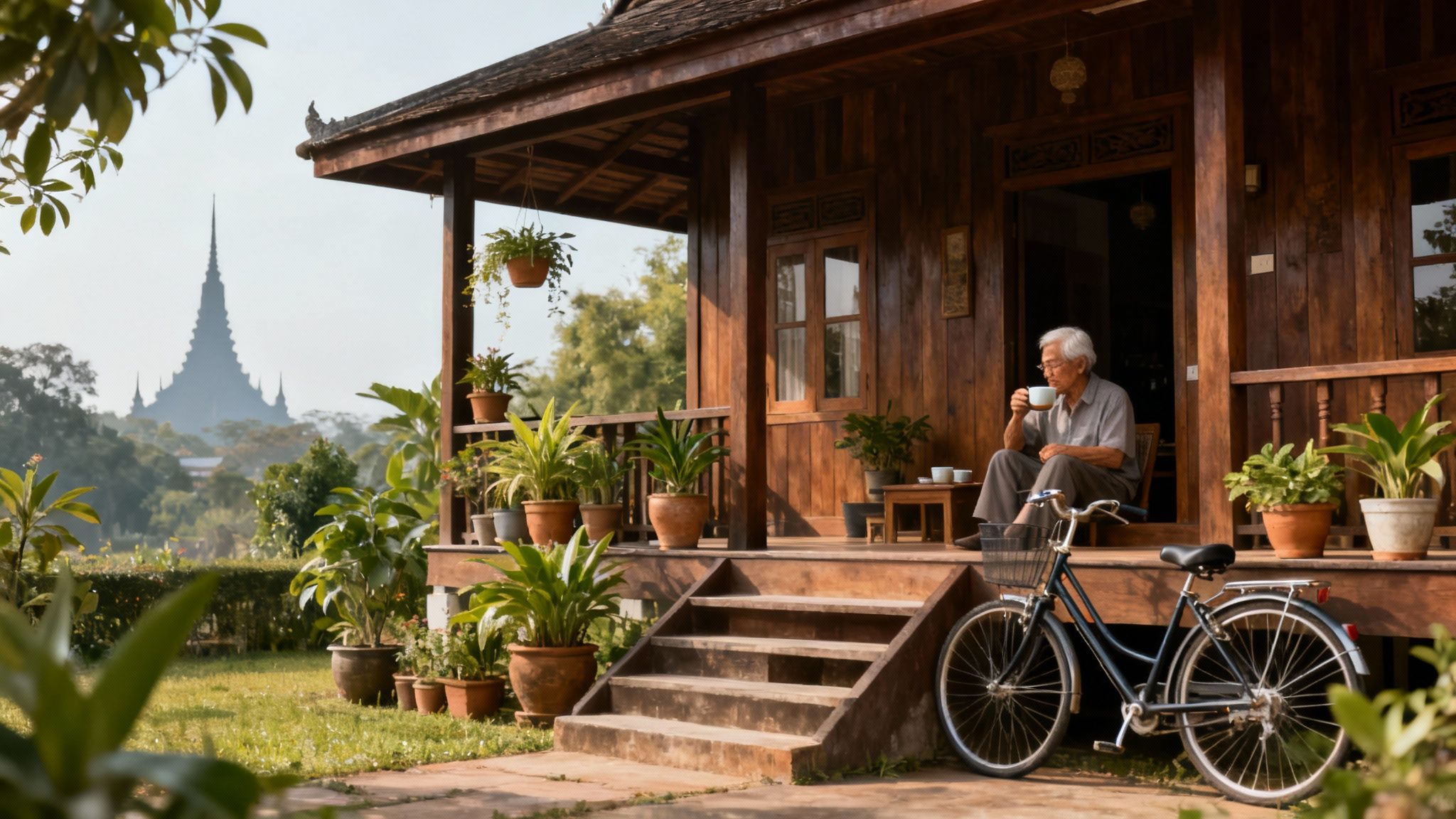
Thailand is also a world-renowned medical tourism hub, featuring state-of-the-art, internationally accredited hospitals, particularly in Bangkok. This provides retirees with access to high-quality healthcare at a fraction of the cost found in Western countries. While the public healthcare system is available, most expats prefer private facilities for their English-speaking staff and superior service.
Key Considerations for Retiring in Thailand
- Visa and Residency: The Non-Immigrant O-A (Retirement) Visa is the primary pathway for retirees aged 50 and over. Applicants must show proof of a monthly income of at least 65,000 THB (approx. $1,800 USD) or a deposit of 800,000 THB (approx. $22,000 USD) in a Thai bank account.
- Cost of Living: A retired couple can live comfortably on a budget of $1,500 to $2,500 per month. Destinations like Chiang Mai or Hua Hin are very affordable, while cosmopolitan Bangkok or the island of Phuket will be on the higher end of the scale.
- Healthcare and Insurance: While healthcare is affordable, comprehensive international health insurance is mandatory for the O-A visa application. This ensures coverage for both routine care and major medical events at Thailand’s excellent private hospitals.
Actionable Next Steps
- Meet the Financial Requirements: Begin consolidating funds to meet the 800,000 THB bank deposit requirement or gather documentation for your monthly pension. Open a Thai bank account as soon as you arrive to facilitate this process.
- Secure Mandatory Health Insurance: Research and purchase a health insurance policy that meets the specific coverage minimums required by Thai immigration for the O-A visa (currently at least 3,000,000 THB).
- Explore Retirement Hotspots: Plan an extended visit to test out different locations. Experience the cultural immersion of Chiang Mai, the coastal relaxation of Hua Hin, or the vibrant city life in Bangkok before making a final decision.
6. Ecuador - Affordable Andean and Coastal Retirement
Ecuador offers one of Latin America's most affordable and geographically diverse retirement experiences. Its primary appeal is an exceptionally low cost of living combined with the stability of using the U.S. dollar as its official currency, which simplifies financial planning for American retirees. From the high-altitude, spring-like climate of the Andes to the warm Pacific coastline and the lush Amazon basin, retirees can choose a lifestyle and environment that perfectly suits their preferences.
The country provides accessible and affordable healthcare. Residents can join the public Social Security healthcare system (IESS) for a small monthly fee, which provides comprehensive coverage. Many expats also purchase private health insurance for access to modern hospitals and English-speaking doctors in cities like Quito and Cuenca, with costs remaining significantly lower than in the U.S.
Key Considerations for Retiring in Ecuador
- Visa and Residency: The Pensioner (9-I) Visa is a straightforward path for retirees. Applicants must prove a stable, monthly income from a pension or Social Security of at least $800, plus an additional $100 per dependent.
- Cost of Living: A retired couple can live very comfortably on a budget of $1,500 to $2,200 per month. Cities like Cuenca are renowned for their high quality of life and low costs, while coastal areas like Manta offer beach living at a similar price point.
- Geographic and Climate Diversity: Choose your ideal climate. Cuenca’s high-altitude location provides a temperate, spring-like climate year-round. For those who prefer the heat and ocean breezes, coastal cities are an excellent option. Vilcabamba, in the "Valley of Longevity," attracts wellness-focused retirees.
Actionable Next Steps
- Plan an Exploratory Trip: Visit different regions before deciding. Spend time in Cuenca, Quito, and a coastal town like Manta to experience the varied climates, altitudes, and lifestyles firsthand.
- Consult with an Immigration Lawyer: While the visa process is direct, using a local, reputable lawyer can help navigate the bureaucracy smoothly and ensure all paperwork is correctly filed.
- Secure Region-Appropriate Health Insurance: Research healthcare facilities in your target region. Obtain a comprehensive international health plan that covers your chosen city and establishes relationships with accredited local hospitals early on.
7. Uruguay - South American Stability and Quality of Life
Uruguay stands out as a beacon of stability and progressive governance in South America, making it a top contender for retirees seeking a high quality of life. Often compared to European nations for its safety, strong institutions, and social programs, it offers a tranquil environment with beautiful coastlines and a temperate climate. Retirees are drawn to its first-world infrastructure, low crime rates, and a welcoming culture that combines Latin American warmth with a European sensibility.
The country's healthcare system is one of the best in the region, with excellent public options like the Fondo Nacional de Salud (FONASA) and high-quality private "mutualista" plans. These private plans are hospital-specific and offer affordable, comprehensive coverage, making top-tier medical care accessible to foreign residents.
Key Considerations for Retiring in Uruguay
- Visa and Residency: Uruguay offers a specific Rentista (Retirement) Visa. Applicants must prove a stable monthly income of at least $1,500 from a guaranteed source like a pension. The process is known for being straightforward, reflecting the country's welcoming immigration policy.
- Cost of Living: While more expensive than many Latin American neighbors, Uruguay is still affordable by North American or European standards. A retired couple can live comfortably on a budget of $2,500 to $3,500 per month, especially outside the upscale coastal resort of Punta del Este.
- Tax Incentives: New residents can benefit from a "tax holiday," choosing either to be exempt from taxes on foreign-sourced income for 11 years or to pay a flat 7% rate indefinitely. This makes it an attractive option for preserving retirement savings.
Actionable Next Steps
- Initiate the Residency Process In-Country: Unlike many nations, Uruguay's residency application is typically started after you arrive. Schedule an appointment with the Dirección Nacional de Migración (National Directorate of Migration) as soon as you land.
- Evaluate Healthcare Plans: Research the different "mutualista" providers in your chosen city. Visiting facilities like the British Hospital in Montevideo can help you choose a plan that fits your needs before committing.
- Secure International Health Insurance: Obtain comprehensive travel and health insurance to cover you during the initial months while your residency and local healthcare enrollment are being processed. This ensures you have no gaps in coverage.
8. Greece - Mediterranean Retirement with EU Benefits
Greece offers retirees a chance to immerse themselves in ancient history and a classic Mediterranean lifestyle at a surprisingly affordable price point. Its appeal is a powerful combination of thousands of sun-drenched islands, a rich cultural tapestry, and the benefits of European Union membership. Retirees are drawn to its world-renowned cuisine, slower pace of life, and the genuine hospitality of its people, making it one of the best countries to retire for those seeking both beauty and value.
The Greek National Healthcare System (ESY) provides universal coverage to residents, including foreign retirees who are legally registered. While major cities like Athens and Thessaloniki have excellent public and private hospitals, the quality of care on smaller islands can be limited. For this reason, many expats maintain comprehensive private health insurance to ensure access to a wider range of facilities and English-speaking doctors.
Key Considerations for Retiring in Greece
- Visa and Residency: The Financially Independent Person (FIP) visa is the most common path for non-EU retirees. Applicants must prove a stable, recurring income of at least €2,000 per month. Greece also offers a "Golden Visa" program for those who invest a minimum of €250,000 in real estate.
- Cost of Living: A retired couple can live comfortably on a budget of $2,000 to $2,700 per month. Living on an island like Crete can be very affordable, while popular destinations like Mykonos or Santorini will be significantly more expensive.
- Tax Incentives: Greece has a favorable tax program for foreign pensioners. Retirees who move their tax residency to Greece can benefit from a flat 7% tax rate on their entire foreign-source income, including pensions, for up to 15 years.
Actionable Next Steps
- Consult an Immigration Lawyer: Greek visa regulations can be less standardized than in other EU countries. Engaging a local lawyer can help navigate the FIP or Golden Visa application process smoothly.
- Research Island-Specific Healthcare: If you dream of island living, thoroughly investigate the medical infrastructure. Determine the location of the nearest major hospital and confirm what services are available locally versus what would require a trip to the mainland.
- Invest in Greek Language Lessons: While English is common in tourist areas, learning basic Greek is essential for daily life, navigating bureaucracy, and integrating into the local community, especially for healthcare interactions.
9. Panama - Central American Gateway with Modern Infrastructure
Panama stands out as one of the best countries to retire, offering a unique blend of first-world infrastructure, a dollarized economy, and attractive benefits for retirees. It combines the ease of modern city living in Panama City with the natural beauty of tropical coastlines and cool mountain highlands. This Central American hub appeals to those who value financial stability and convenience alongside a lower cost of living and a warm climate.
The country is renowned for its high-quality, private healthcare, with major hospitals in Panama City affiliated with prestigious U.S. institutions. While public healthcare is available, most expatriates choose private insurance to access top-tier facilities and English-speaking doctors. This makes Panama a secure choice for retirees prioritizing accessible, quality medical care.
Key Considerations for Retiring in Panama
- Visa and Residency: The Pensionado Visa is one of the world's most popular retirement programs. It requires a lifetime pension or annuity of at least $1,000 per month from a government or private company. The visa grants significant discounts on everything from medical services to entertainment.
- Cost of Living: A retired couple can live comfortably on a budget of $2,000 to $3,000 per month. While Panama City is more expensive, retiree havens like the mountain town of Boquete or the beach community of Coronado offer a more affordable lifestyle.
- Tax Incentives: Panama operates on a territorial tax system, meaning you are only taxed on income earned within the country. Foreign-sourced income, including pensions and social security, is not taxed by Panama, which is a major financial benefit for retirees.
Actionable Next Steps
- Choose the Right Visa: Evaluate if the Pensionado Visa or the Friendly Nations Visa better suits your financial profile. The Pensionado is ideal for those with a pension, while the latter may be an option for others.
- Establish Healthcare Early: Even if you plan to live in a smaller town, establish relationships with specialists and hospitals in Panama City. Many smaller clinics refer to the capital for serious medical issues.
- Explore Diverse Regions: Visit different areas before committing. The cosmopolitan energy of Panama City, the cooler, spring-like climate of Boquete, and the relaxed beach life in Coronado each offer a very different retirement experience.
10. Colombia - Emerging Retirement Destination with Healthcare Excellence
Colombia is rapidly gaining recognition as an exceptional retirement destination, shedding its past reputation to reveal a country rich in culture, natural beauty, and modern amenities. Retirees are drawn to its spring-like mountain climates, remarkably low cost of living, and vibrant cities. What truly sets Colombia apart is its world-class healthcare system, making it a top contender for those prioritizing quality medical care in their retirement planning.
The country's healthcare is often ranked among the best in the Americas, with many of its top hospitals in cities like Medellín and Bogotá being JCI-accredited. Legal residents can join the national Entidades Promotoras de Salud (EPS) system, which provides comprehensive and affordable coverage. Many expats also maintain private insurance for even faster access and a wider choice of English-speaking doctors.
Key Considerations for Retiring in Colombia
- Visa and Residency: The Migrant (M) Type 11 visa, or "retirement visa," is a popular choice. Applicants must prove a minimum monthly income from a pension or Social Security equivalent to at least three times the Colombian minimum wage (approximately $950 per month as of 2024).
- Cost of Living: A retired couple can live very comfortably on a budget of $1,500 to $2,200 per month. Cities like Medellín and Bogotá offer cosmopolitan amenities at a low cost, while the Coffee Triangle region provides an even more affordable and tranquil lifestyle.
- Healthcare Excellence: Colombia is a global leader in medical tourism. The quality of care, especially in fields like cardiology, cosmetic surgery, and oncology, is exceptionally high, and costs are a fraction of what you would pay in the U.S. or Europe.
Actionable Next Steps
- Learn Basic Spanish: While expat communities are growing, daily life and navigating healthcare are much easier with a foundational knowledge of Spanish. Start with online courses or apps before you move.
- Explore Different Climates and Cities: The climate varies dramatically with altitude. Visit Medellín for its "eternal spring," Bogotá for a cooler, more cosmopolitan feel, or the Coffee Triangle for temperate charm before deciding where to settle.
- Consult with an Immigration Lawyer: Visa requirements can change. Engaging a local immigration lawyer can streamline the M-11 visa application process and ensure all your documentation is correct.
Top 10 Retirement Destinations Comparison
| Destination | Residency complexity | Income / Resource requirements | Expected outcomes (Healthcare & cost) | Ideal use cases | Key advantages |
|---|---|---|---|---|---|
| Portugal | Moderate — D7/NHR straightforward but administrative; Golden Visa higher investment | D7 €1,062/month; NHR tax break (10 yrs); Golden Visa property €280k+ | High-quality EU healthcare; moderate-low cost of living (€1,200–1,800 single) | Retirees seeking EU residency, tax incentives and affordable European lifestyle | NHR tax incentives; strong healthcare; EU access; walkable cities |
| Mexico | Low–Moderate — Temporary/permanent visas common; paperwork required | Temporary visa proof ~$2,700/month (or $1,350 with sponsor); permanent after 4 yrs | Good private healthcare in cities at low cost; living $1,200–1,800 single | US/Canada proximity seekers; budget retirees wanting expat communities | Low healthcare costs; proximity to US; vibrant expat hubs |
| Costa Rica | Low — Pensioner visa simple; CAJA enrollment recommended | Pensioner visa $1,000/month; CAJA contributions $50–100/month | Universal CAJA + private care; living $1,400–2,000 single; very nature-focused | Safety- and nature-focused retirees wanting affordable universal care | Affordable universal healthcare; safety; biodiversity; easy residency |
| Spain | Moderate — Non-Lucrative requires proof and paperwork; Golden Visa investment | Non-Lucrative ≈ €1,080/month; Golden Visa €500,000 property | World-class SNS public healthcare; living $1,300–1,900 single | Retirees seeking high-quality public healthcare and Mediterranean lifestyle | Top-tier healthcare; transport; diverse regional options; EU benefits |
| Thailand | Moderate — O-A requires bank balance/income and annual renewals | $20,000 USD in Thai bank or $12,000/year income; age 50+ | Excellent private healthcare in cities at low cost; living $1,000–1,500 (cities) | Budget retirees prioritizing low living costs and medical tourism | Very low cost of living; quality private hospitals; large expat networks |
| Ecuador | Low — Pensioner visa with modest requirements; simple process | Pensioner visa $1,200/month ($1,600 couples); US dollar currency | Satisfactory healthcare concentrated in Quito/Guayaquil; living $1,200–1,600 single | Retirees wanting dollar stability, low cost, and diverse climates | US dollar economy; very low costs; geographic variety |
| Uruguay | Moderate — Rentista visa with higher income; permanent residency after 3 yrs | Rentista $1,500/month (or $1,000 if property purchase) | First‑world healthcare (FONASA); higher living costs $1,800–2,300 single | Retirees prioritizing stability, safety, and developed services | Exceptional safety and governance; reliable healthcare and institutions |
| Greece | Moderate — Residence for financial independence; rules less standardized | €500/month (financial independence); Golden Visa €250,000 property | Public healthcare underfunded vs Western EU; living $1,200–1,700 single | Retirees seeking Mediterranean/climate and EU residency benefits | Mediterranean lifestyle; EU reciprocity; low cost vs Western Europe |
| Panama | Moderate — Multiple visa paths (Pensioner, Friendly Nations); paperwork and banking | Pensioner $1,000/month (or $120k pension capital); Friendly Nations $2,000/month | Modern healthcare in Panama City; living $1,600–2,200 in city, lower elsewhere | Retirees wanting modern infrastructure, dollar economy and tax perks | Dollar-based economy; modern urban healthcare; retiree tax benefits |
| Colombia | Low–Moderate — V Visa clear income or investment options; growing expat support | V Visa $1,350/month or $40,500 capital investment | World-class healthcare in major cities; very low living costs $1,000–1,500 single | Healthcare-focused retirees seeking spring-like climates and low costs | Excellent medical care at low cost; temperate mountain climates; affordability |
Taking the Next Step: How to Secure Your Health and Future Abroad
Choosing your ideal destination from our list of the best countries to retire is a thrilling milestone. You've explored the sun-drenched coasts of Portugal, the vibrant culture of Mexico, the serene landscapes of Costa Rica, and the modern comforts of Panama. While each nation offers a unique path to an enriching retirement, one critical thread ties them all together: proactive and comprehensive planning, especially regarding your health and long-term security.
The journey from dreamer to successful expat retiree hinges on moving beyond the "what if" and into the "how to." This means translating your research into tangible, actionable steps. You've learned that cost of living, visa requirements, and lifestyle are key pillars, but the true foundation of a worry-free retirement abroad is a robust support system for your well-being.
From Destination to Decision: Your Actionable Checklist
As you transition from researching to preparing, the details matter most. Securing your health coverage isn't just a recommendation; it's often a non-negotiable requirement for obtaining a retirement visa in countries like Spain, Greece, and Portugal. Relying solely on a destination's public healthcare system, even if it's excellent, can leave you exposed to long wait times, coverage gaps, or ineligibility as a new resident.
To build a solid foundation for your move, focus on these critical next steps:
- Finalize Your Budget with Real Numbers: Move from estimated costs to a detailed financial plan. Factor in one-time moving expenses, visa application fees, and the recurring cost of a comprehensive international health insurance plan.
- Initiate the Visa Process Early: Gather all required documentation, including proof of income, background checks, and the mandatory proof of private health insurance. Visa timelines can be unpredictable, so starting months in advance is wise.
- Secure Compliant Health Coverage: Don't just buy any travel insurance plan. You need a policy that meets the specific, often stringent, requirements of your chosen country's immigration authorities. This typically includes zero-deductible, full-coverage plans that are valid for at least one year.
- Organize Your Legal and Financial Affairs: A successful international move involves more than just packing boxes. To truly secure your future abroad, preparing all essential estate planning documents is paramount for clarity and peace of mind. This ensures your assets are managed according to your wishes, no matter where you live.
The Unseen Value of Expert Guidance
Navigating the complexities of international insurance and residency requirements can be overwhelming. Each country has its own rules, and the insurance market is filled with policies that may or may not be suitable for an expat retiree. This is where specialized guidance becomes invaluable.
An experienced advisor can instantly identify which of the hundreds of available plans will satisfy your visa application, cover your specific health needs (including pre-existing conditions), and fit within your retirement budget. This expertise saves you time, prevents costly mistakes, and eliminates the stress of uncertainty.
By partnering with experts who understand the nuances of expat life, you're not just buying a policy; you are investing in a secure and confident transition. You gain a partner who can advocate on your behalf, answer questions in your time zone, and provide support when you need it most. This allows you to focus on the exciting aspects of your move: learning a new language, exploring new cultures, and embracing the retirement you've worked so hard to achieve. Your dream of retiring in one of the world's best countries is within reach, and with the right preparation, it can be a resounding success.
Ready to take the first concrete step towards a secure retirement abroad? The team at Expat Insurance specializes in helping retirees navigate the complexities of international health coverage. We compare plans from over 65 global insurers to find the perfect fit for your visa, health needs, and budget, ensuring you move forward with confidence. Get your free, personalized quote from Expat Insurance today and make your dream a reality.
