

November 26, 2025
•
5 min read
Your Complete Guide to Living in Japan
Discover everything you need to know about living in Japan. Our guide covers visas, housing, banking, healthcare, and cultural tips for a successful move.
For many, living in Japan is the realization of a lifelong dream, a place where ancient traditions coexist beautifully with glowing, futuristic cityscapes. Making that dream a reality is a journey that requires a bit of thoughtful planning—navigating visas, getting your finances in order, and adjusting to a new culture.
But don't let that intimidate you. With the right preparation, relocating and building a new life here is an incredibly rewarding and achievable goal.
Starting Your New Life in Japan
Embarking on a new life in Japan can feel like a huge undertaking, but it really just breaks down into a series of clear, manageable steps. Think of this guide as your practical starting point, designed to demystify the core pillars of expat life—from getting your visa sorted to understanding the cultural landscape and managing your money.
By getting a handle on these key pieces from the get-go, you'll be in a much better position to build a successful and fulfilling life. We'll touch on the big topics like healthcare, banking, and finding a home, all of which we'll dive into with more detail throughout this guide.
Core Pillars of Your Relocation
Your move to Japan hinges on several critical components that demand careful planning. See these as the foundation you'll build your new life upon. When handled correctly, each piece connects smoothly to the next, making for a much easier transition.
- Visas and Immigration: This is your golden ticket. Securing the right visa—whether it's for work, study, or family—is the absolute, non-negotiable first step.
- Cost of Living and Finances: Budgeting is everything. You'll need a solid grasp of expenses for housing, food, and transport, which can vary wildly between a metropolis like Tokyo and smaller regional hubs. For a deeper dive, check out our detailed guide on the cost of living abroad.
- Housing and Daily Life: Finding a place to live has its own unique process in Japan. Getting utilities and transportation set up are the next key steps to settling in comfortably.
Japan is a country where meticulous planning really pays off. From gathering your visa documents months ahead of time to researching neighborhoods before you even arrive, every bit of prep work you do makes the transition smoother and far less stressful.
To give you a clearer picture, here's a quick overview of what your relocation journey might look like.
Japan Relocation Checklist At a Glance
| Phase | Key Task | Primary Consideration |
|---|---|---|
| Pre-Move (3-6 Months Out) | Secure Visa | Work, study, or dependent status |
| Pre-Move (1-3 Months Out) | Budget & Finances | Estimate initial costs and living expenses |
| Pre-Move (1 Month Out) | Arrange Housing | Temporary or long-term accommodation |
| Upon Arrival | Register with Local Ward Office | Obtain Residence Card and My Number |
| Settling In (First Few Weeks) | Set Up Bank Account & Phone | Essential for daily life and contracts |
| Settling In (First Month) | Enroll in Health Insurance | Mandatory for all residents |
This table is just a starting point, but it helps frame the major milestones you'll need to hit along the way.
Understanding the Landscape
One of the first things you'll notice about life in Japan is its population density. With over 332 people per square kilometer, it's one of the most densely populated nations on earth. This simple fact shapes nearly everything, from the compact size of apartments to the incredible efficiency of public transport, especially in major cities where over 90% of the population lives.
The logistics of an international move also require some serious attention. When you're planning how to get your life from one country to another, taking the time for choosing an international removal company is crucial to make sure your belongings arrive safely and on schedule. Making the right choice here can lift a massive weight off your shoulders, freeing you up to focus on the more exciting parts of your new adventure.
Securing Your Visa and Residence Card
 Getting your visa is the first real step in your move to Japan, and while it might seem intimidating, the process is surprisingly straightforward. It really boils down to a two-step dance: getting pre-approved from inside Japan, and then getting the actual visa sticker in your passport from outside Japan.
The absolute key to this whole process for anyone planning a long-term stay is the Certificate of Eligibility (CoE). Think of this document as your pre-approval from the Japanese Ministry of Justice. It basically says, "Yes, this person meets all the requirements to do what they say they're going to do," whether that's working, studying, or joining family.
Most of the time, your future employer or school in Japan handles the CoE application for you. This is the part that requires patience, as it can easily take one to three months. Once that CoE is issued, though, you're on the home stretch.
Common Visa Categories for Expats
Japan has a visa for just about everything, but most expats will find themselves fitting into one of a few main categories. It's crucial to know which one applies to you, as the paperwork and qualifications are completely different for each.
- Work Visas: This isn't just one visa, but a collection of categories for specific jobs. The most common one is "Engineer/Specialist in Humanities/International Services," which is a mouthful but covers most professional roles like office workers, English teachers, and IT specialists. Your eligibility here is tied directly to your university degree and relevant work history.
- Highly Skilled Professional (HSP) Visa: Japan is actively trying to attract top global talent, and this visa is how they do it. It's a points-based system where you get scored on things like your salary, educational background, and career achievements. If you rack up 70 points or more, you unlock some great perks, like a five-year stay from the get-go and a much faster path to permanent residency.
- Dependent Visa: If you're coming over on a work visa, this is how your spouse and children can join you. It's fairly easy to get, but be aware that it comes with strict rules on how many hours your dependents are allowed to work.
From Certificate to Visa Stamp
With your original CoE in hand, it's time to complete the process. You'll need to take the CoE, your passport, and a few other forms to the Japanese embassy or consulate in your home country.
As long as your documents are all in order, this part moves pretty quickly. The embassy staff will verify everything and then place the visa sticker in your passport. That sticker is your official green light to board a plane to Japan.
The Certificate of Eligibility is the hard part; the visa stamp is the formality. The heavy lifting is done by your sponsoring organization in Japan to prove your worth to the immigration authorities. The embassy simply verifies the CoE and your identity.
Your First Steps After Landing in Japan
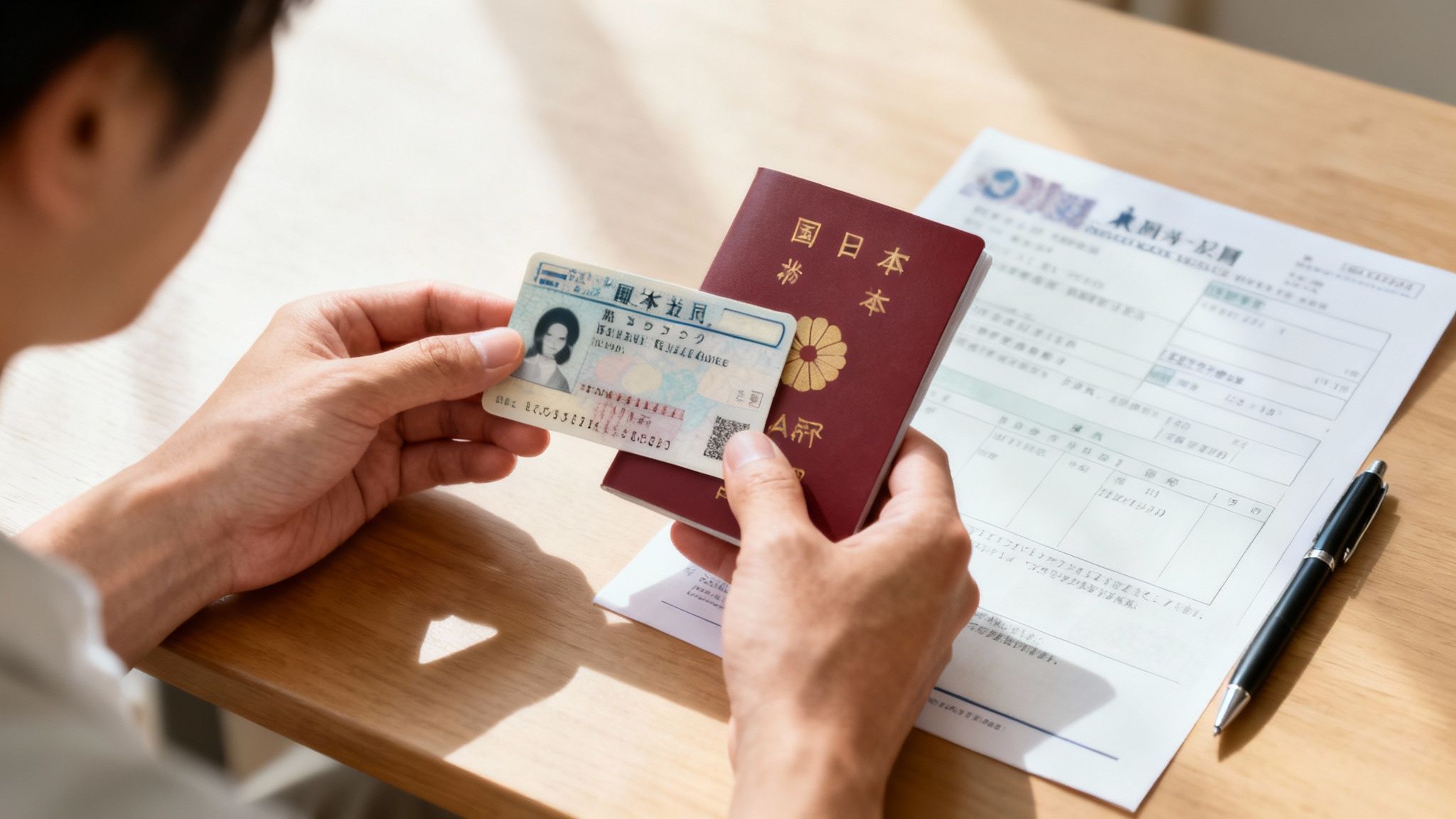
When you touch down at a major airport like Narita or Haneda, you'll find the immigration process is remarkably efficient. An immigration officer will take your photo and fingerprints, stamp your passport, and—most importantly—issue your Residence Card (Zairyu Card) on the spot.
This little credit-card-sized ID is your new best friend in Japan. It displays your photo, name, visa status, and address, and you are legally required to have it on you at all times.
You've got 14 days from the day you secure an apartment to register your address. To do this, you just take your new Residence Card and your passport down to your local municipal office (called a kuyakusho in a city ward or shiyakusho in a city). They'll print your address right on the back of the card. This is a non-negotiable step—you can't open a bank account, get a phone, or enroll in national health insurance without it.
Managing Your Money in Japan
Getting your finances sorted is one of the first things that makes you feel truly settled in Japan. From opening a bank account to figuring out local taxes, a bit of prep work now will save you a world of headaches later. Think of this as your practical guide to the essential money matters you'll face as a new resident.
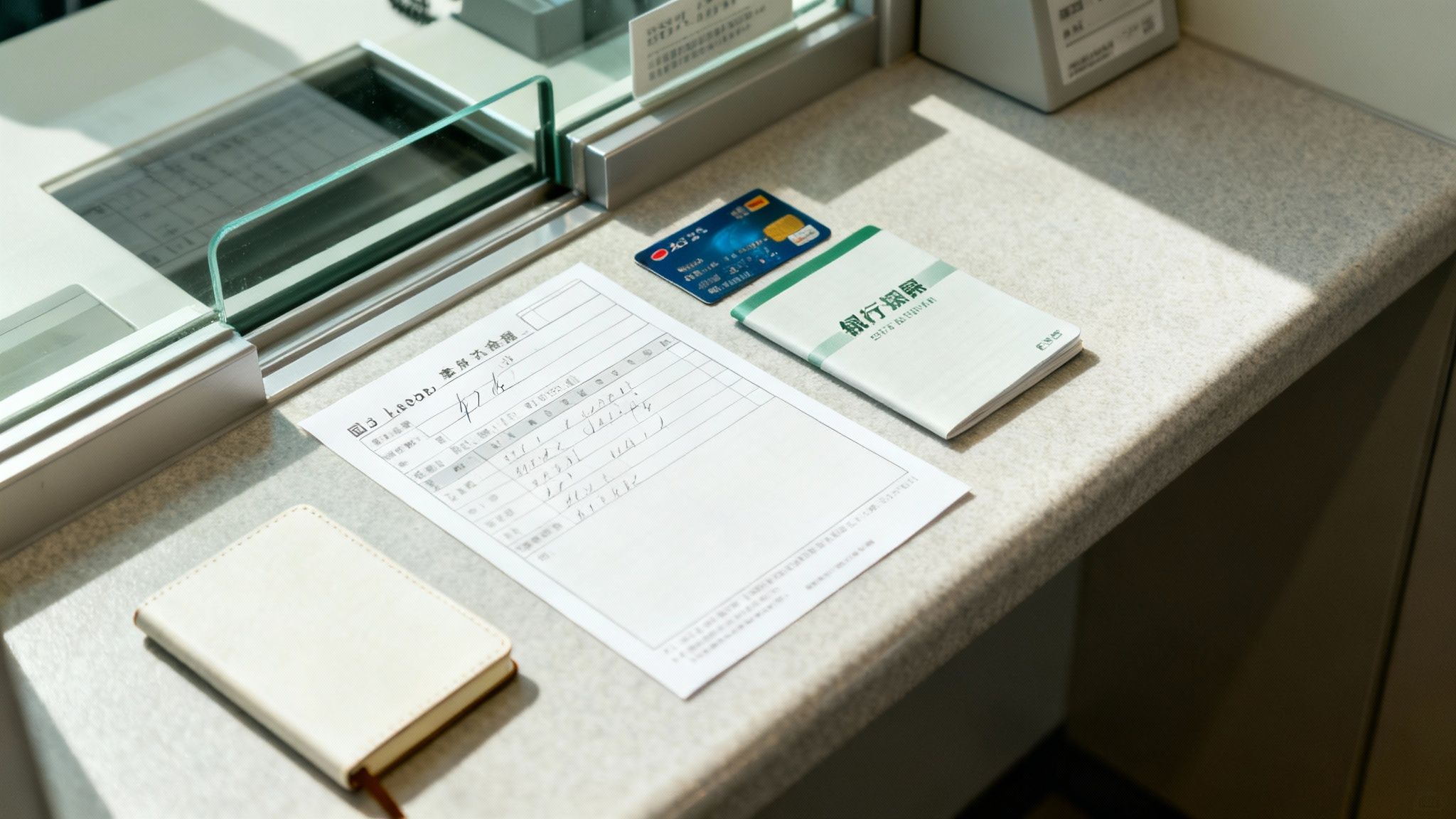
One of your top priorities after registering your address will be opening a Japanese bank account. This is absolutely non-negotiable. You'll need it to get paid, handle your bills, and set up contracts for basics like a mobile phone or an apartment lease.
While Japan is still a very cash-friendly society in many ways, that local bank account is the backbone of your financial life here.
But here's the thing: the process can feel like a classic catch-22. Many banks require a Japanese phone number to open an account, yet the phone companies often demand a Japanese bank account to give you a contract. It's a common frustration, but you can get through it with the right documents and a little persistence.
Opening Your First Bank Account
To get started, you'll need to gather a specific set of documents. Having everything in order before you walk into the bank will make things go much more smoothly.
- Residence Card (Zairyu Card): Make sure it shows your current, registered address on the back. This is key.
- Passport: Your official, government-issued ID.
- My Number: This is your individual social security and tax number, which you'll receive after you register your address.
- Inkan/Hanko (Personal Seal): While some newer banks are moving away from this, many traditional branches still require a personal seal instead of a signature. It's a good idea to have one made just in case.
- Japanese Phone Number: If you can, try to get a temporary number or ask your company if you can use theirs as a contact.
Some of the most foreigner-friendly banks to consider are Japan Post Bank (Yucho Ginko), Shinsei Bank, and Prestia SMBC Trust Bank. They often have English-speaking staff and application processes that are a bit more streamlined for new residents.
For more tips on handling your money across borders, our guide on how to avoid international fees with smart banking has some great insights.
Demystifying the Japanese Tax System
Once you start earning an income, you'll need to get your head around Japan's tax system. The good news is that it's relatively straightforward, consisting of two main taxes you'll be responsible for as a resident.
First up is Income Tax (shotokuzei). This is a national tax that your employer deducts directly from your monthly salary. It's a progressive tax, which just means the rate increases as your income level goes up.
The second is Residence Tax (juminzei), a local tax paid to your prefectural and municipal government. Here's the important part: this tax is calculated based on your income from the previous year. This means you won't have to pay it during your first year in Japan, but you absolutely must budget for it starting in your second year.
A key takeaway for new expats: Your Residence Tax bill will arrive in June of your second year. It's often a nasty surprise for those who haven't planned for it, so make sure you're setting aside funds to cover this significant expense.
Understanding the Cost of Living
The cost of living in Japan can vary wildly depending on where you decide to plant your flag. A massive metropolis like Tokyo will have costs on par with other major global cities. On the other hand, life in a smaller, regional city can be surprisingly affordable.
Rent is, by far, the biggest factor. A small one-bedroom apartment in central Tokyo can easily cost double what a similar place would in a city like Fukuoka or Sapporo. Beyond rent, daily expenses for things like groceries, transportation, and utilities are more consistent across the country, but they're still noticeably lower outside of the big urban hubs.
Let's look at a quick comparison to put things in perspective.
Estimated Monthly Cost of Living Comparison
Here's a breakdown of what you might expect to spend each month, comparing a major hub like Tokyo to a more moderately priced city like Fukuoka.
| Expense Category | Tokyo (Average Cost) | Fukuoka (Average Cost) |
|---|---|---|
| Rent (1-bedroom apt) | ¥120,000 | ¥70,000 |
| Groceries | ¥45,000 | ¥40,000 |
| Utilities | ¥12,000 | ¥11,000 |
| Transportation Pass | ¥10,000 | ¥8,000 |
| Total Estimated Monthly | ¥187,000 | ¥129,000 |
As the table shows, your choice of city has a massive impact on your budget. By getting a handle on these financial pillars—banking, taxes, and living costs—you can plan effectively and build a stable foundation for your new life in Japan.
Navigating Japanese Healthcare and Insurance
Japan's healthcare system is famous for its quality and reach, but if you're new to the country, the insurance side of things can feel a bit tangled. Luckily, it all boils down to one simple rule: every long-term resident has to sign up for a public health insurance plan. This mandatory system is designed to give everyone access to top-notch medical care without the fear of sky-high bills.
Think of it as a nationwide co-op. Everyone chips in through their premiums, and in exchange, the insurance covers the bulk of your medical expenses. This structure not only keeps healthcare affordable but is also a big reason why Japan boasts one of the highest life expectancies in the world.
Your entry into this system starts the moment you register as a resident. Figuring out which plan you belong to is your first, most crucial step.
The Two Pillars of Public Insurance
Japan's public health insurance is neatly divided into two systems. Which one you join is decided entirely by your job.
-
Employees' Health Insurance (EHI): If you're hired by a company as a full-time employee, you'll automatically be enrolled in this plan, known locally as Shakai Hoken. Your employer handles all the paperwork, and the monthly premiums are simply taken out of your salary. It also covers your dependent family members.
-
National Health Insurance (NHI): This plan, or Kokumin Kenko Hoken, is for everyone else—students, freelancers, part-timers, and those who are unemployed. You'll need to enroll yourself at your local municipal office within 14 days of moving in or leaving a full-time job.
Both plans offer the same core benefit: they cover 70% of your medical and dental bills. That means for most doctor's appointments, prescriptions, or hospital stays, you only pay the remaining 30% out-of-pocket at the clinic.
The Role of Supplemental Private Insurance
While Japan's public system is fantastic, it doesn't cover absolutely everything. This is where private insurance steps in—not as a replacement, but as a smart supplement to fill in the gaps and give you an extra layer of security.
Private health insurance offers peace of mind by covering services that fall outside the public system's scope. This can include advanced medical treatments not yet approved in Japan, private hospital rooms, or extensive dental work like orthodontics.
Living in Japan also means being part of one of the world's most rapidly aging societies. The percentage of the population aged 65 and over hit 29.1% in 2022, and that number keeps climbing, putting a real strain on the national healthcare system. You can see more data on Japan's demographic shifts and their implications. This demographic pressure makes having supplemental coverage an even wiser move for expats wanting truly comprehensive care.
Finding Care and Why Expat Insurance Matters
For anyone who doesn't speak Japanese, the thought of finding an English-speaking doctor can be a real worry. The good news is that major cities have plenty of clinics that cater to the international community. Expat forums and online resources are great places to find recommendations.
But what about navigating claims, understanding a complex procedure, or arranging a medical evacuation? That's when things can get overwhelming, and specialized support becomes a lifesaver. For those looking for coverage that understands the unique challenges of living abroad, our guide to health insurance for expats is a great resource for building a complete safety net. A dedicated broker can help you find plans that bridge the gaps left by public insurance, making sure you're protected no matter what happens.
Finding a Home and Setting Up Daily Life
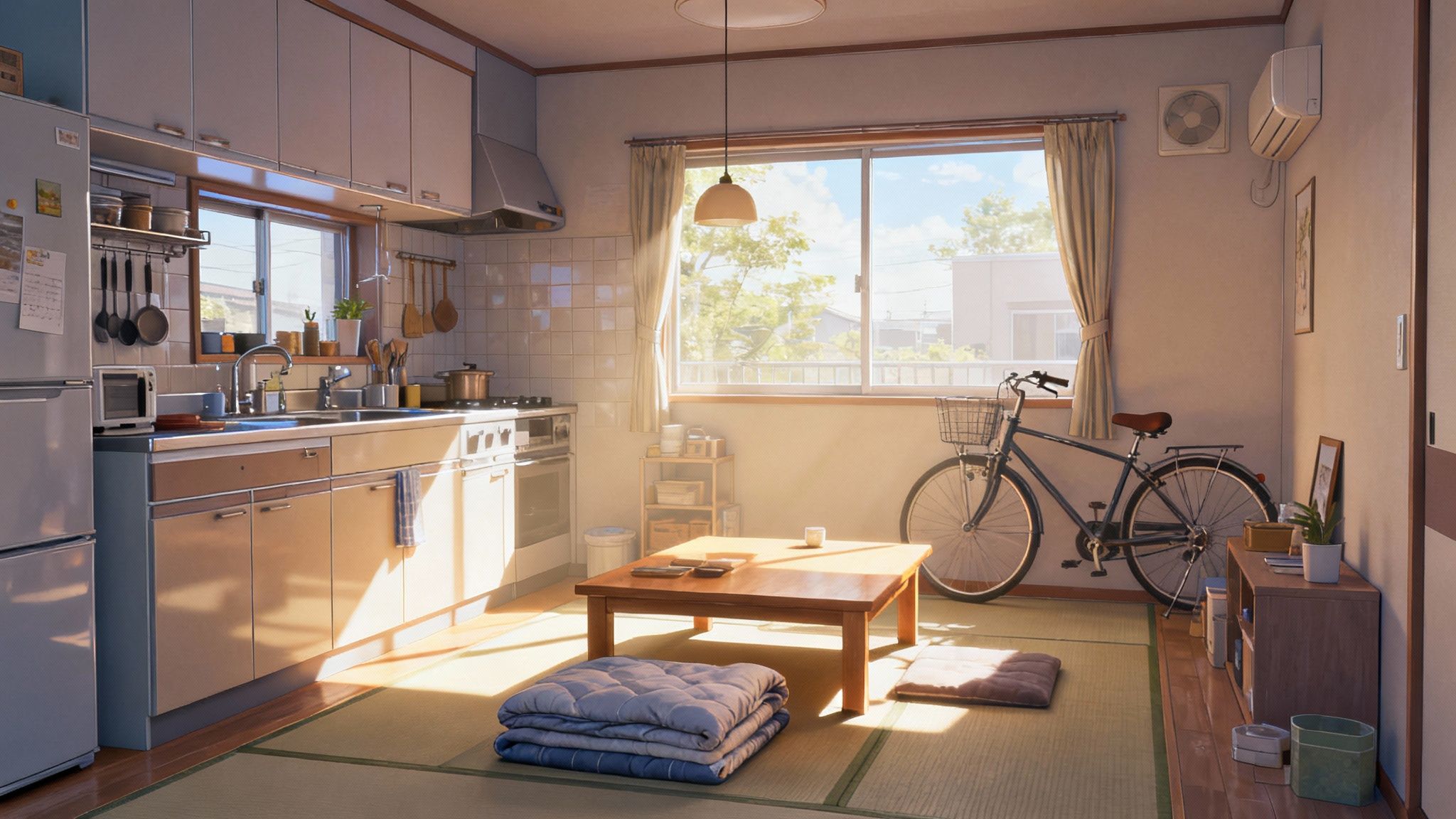
Alright, your visa is sorted and the bank account is open. Now for the exciting part: building your actual life in Japan. This is where everything starts to feel real, and finding a place to call home is the first major step.
The Japanese rental market is its own unique world, with customs and upfront costs that can catch newcomers completely off guard. A little preparation goes a long way here. Getting a handle on these peculiarities is the secret to a smooth apartment hunt.
Of course, it's not just about the apartment. Setting up your daily routine means getting utilities connected, figuring out your phone, and learning to navigate Japan's incredible public transport system. Let's break it down.
Decoding the Japanese Rental Market
Before you even glance at a listing, you need to learn the local lingo. The initial costs of renting in Japan go way beyond a simple security deposit—we're talking several months' worth of rent right out of the gate.
Think of it as the initiation fee for your new home. It feels steep, but knowing what's coming will save you from any last-minute financial panic.
- Shikikin (敷金): This is the security deposit, usually one or two months' rent. It's supposed to be refundable, but expect deductions for cleaning and repairs when you move out.
- Reikin (礼金): This is "key money," a non-refundable gift to the landlord. It's typically one to two months' rent. This custom is slowly fading but still very common, especially in big cities like Tokyo.
- Chukai Tesuryo (仲介手数料): The real estate agent's commission. This is almost always one month's rent plus tax.
So, for an apartment listed at ¥80,000 per month, your move-in costs could easily balloon to ¥320,000 to ¥480,000—and that's before you've even bought a stick of furniture.
Working with Real Estate Agents
For most foreigners, going through a real estate agent (fudousan-ya) is the only way to go. They have access to the real listings and can guide you through the mountain of Japanese paperwork. Thankfully, many agencies now specialize in helping expats.
The biggest hurdle you'll face is the need for a Japanese guarantor (hoshonin). This is someone who promises to cover your rent if you can't pay. If you don't have a willing Japanese friend or employer, you'll have to use a guarantor company, which will charge you a hefty fee for the service.
Finding an apartment is your first real lesson in Japanese culture. It demands patience, meticulous paperwork, and accepting that things are done a certain way for reasons rooted deep in tradition. Stay flexible, be prepared, and the whole process will be far less stressful.
Setting Up Your Daily Essentials
Keys in hand? Congratulations! Now it's time to make that empty space a home, starting with utilities. Your agent can often give you a hand with this, but it's good to know who to call.
You'll need to set up three separate accounts:
- Electricity: Usually just a quick phone call or an online form.
- Gas: A technician will need to visit your apartment to turn on the service and run a quick safety check. Be prepared to schedule this.
- Water: Handled by your local municipal water bureau.
Next up is your mobile phone. The major players are Docomo, au, and SoftBank, but you can find much better deals with budget-friendly Mobile Virtual Network Operators (MVNOs) that offer cheap, data-heavy plans.
Finally, you'll need to master public transport. The train and subway systems are legendary for a reason—they're punctual, clean, and go everywhere. Your new best friend will be a rechargeable IC card like a Suica or Pasmo. You can tap it for trains, buses, vending machines, and even pay for groceries at the convenience store. This little piece of plastic will quickly become an indispensable part of your life in Japan.
Understanding Japanese Culture and Etiquette
Really thriving in Japan goes way beyond just figuring out the logistics of daily life. It's about connecting with the heart of the culture. If you want to move from feeling like a temporary visitor to a truly integrated resident, understanding the social nuances is your key to building genuine, lasting relationships.
Of course, a big piece of this is the language. You can get by with English in the major tourist hubs, sure, but true integration starts when you can handle simple, everyday interactions in Japanese. Making that effort shows a level of respect that opens doors, turning a trip to the corner store or a chat with a neighbor into a real connection.
Embracing Social Harmony
If there's one concept you need to grasp, it's the importance of group harmony. This idea is the invisible framework for almost everything, from how your office operates to the way friends gather for dinner. It's all about encouraging cooperation and putting the collective good before individual desires.
This cultural focus is deeply rooted in the nation's historically uniform society. Ethnic Japanese make up about 98.5% of the population, which has profoundly shaped social norms. While Japan is slowly becoming more diverse—foreign residents now account for around 3% of the population—these core values are still very much alive. You can dive deeper into Japan's demographic landscape and its societal effects for more context.
In Japan, what is left unsaid is often more important than what is spoken aloud. Learning to read the air, or kūki o yomu, is an essential skill for understanding subtle social cues and showing respect in any situation.
This brings us to two crucial ideas: honne (your private feelings) and tatemae (the public face you present). Getting your head around this distinction is vital. It isn't about being two-faced or dishonest; it's a social lubricant that keeps interactions smooth and conflict-free. Realizing that someone's public statements might be a polite formality helps you read situations with far more accuracy and cultural sensitivity.
Essential Etiquette for Daily Life
Mastering a few key customs will make your daily interactions infinitely smoother. These aren't just random rules; they're expressions of respect and consideration that people here take very seriously.
- Bowing (Ojigi): A bow is so much more than a simple "hello." It's a versatile sign of respect, and the depth and duration of the bow signal different levels of formality. It can be anything from a casual nod to a friend to a deep, reverent bow in a business setting.
- Gift-Giving (Omiyage): The act of giving and receiving gifts is steeped in tradition. Presentation is everything—gifts should always be wrapped beautifully. When someone hands you a gift, it's customary to accept it with both hands and express your gratitude sincerely.
- Business Cards (Meishi): In the professional world, exchanging business cards is a formal ritual. Always receive a card with both hands, take a moment to actually read it, and then place it respectfully on the table in front of you for the duration of the meeting.
By making an effort to embrace these cultural practices, you're showing a genuine desire to fit in. Trust me, that effort will be deeply appreciated by your Japanese friends, colleagues, and neighbors.
Of course. Here is the rewritten section, adopting the voice and style of the provided examples.
Common Questions About Living in Japan
Even the most seasoned traveler has a million questions before moving to a new country. It's only natural. We've pulled together some of the most common things expats ask us about Japan, with some straight-up, practical answers to help you know what you're getting into.
Is Living in Japan Expensive?
This is the big one, and the honest answer is: it really depends on where you plant your flag.
Yes, Tokyo consistently lands on lists of the world's most expensive cities. No surprise there—the rent is the main culprit. But that's not the whole story of Japan. Once you get outside the capital, the picture changes dramatically.
Daily costs for things like groceries, hopping on a train, or grabbing a bite to eat are often surprisingly affordable, especially when you stack them up against other global hubs like London or New York. Your money will go a whole lot further in fantastic regional cities like Fukuoka, Sapporo, or Sendai. You can find an incredible quality of life in these places for a fraction of what it costs to live in central Tokyo.
Can I Get By with Only English?
In the tourist bubbles of Tokyo and Kyoto or inside a big multinational corporation, you can probably manage with English for the basics. But let's be real: if you're truly living here, relying only on English is going to put up some serious walls.
Think about the everyday stuff—opening a bank account, signing a lease, or dealing with the ward office. These things are almost always done in Japanese. Making a real effort to learn the language isn't just about making your life easier. It's a sign of respect, and it's your key to unlocking deeper connections with people and the culture around you.
The biggest hurdle for a lot of newcomers is that one-two punch of the language and cultural barrier. It's easy to feel isolated when simple tasks suddenly feel like climbing a mountain. The best way through it? Dive into learning Japanese and build a good support crew of other expats and local friends.
What Is the Biggest Challenge for Expats?
Beyond memorizing kanji, the most persistent challenge is often the cultural adjustment. Japanese society is built on a foundation of group harmony, indirect communication, and a whole lot of unspoken rules. For anyone coming from a more individualistic culture, this can feel like learning to walk all over again.
Getting your head around concepts like honne (what you truly feel) and tatemae (the face you show to the public) is crucial for navigating everything from office meetings to neighborhood gatherings. A little patience and a lot of observation will be your best friends here. It helps you turn those moments of frustration into genuine understanding.
How Difficult Is It to Find an Apartment?
Alright, let's not sugarcoat it: finding an apartment as a foreigner can be a real headache. The process is loaded with a few quirks that are pretty unique to Japan's rental market.
- The Guarantor System: Most landlords want a Japanese guarantor (hoshonin)—someone who promises to pay your rent if you can't. This is a huge roadblock if you don't have a local contact or a company willing to back you.
- The Upfront Costs: Get your wallet ready. You'll typically need to pay a security deposit (shikikin), non-refundable "key money" (reikin), and an agent's commission, often adding up to 4-6 months' rent before you even get the keys.
- The Language Barrier: All the paperwork, negotiations, and the lease itself will be in Japanese. Period.
Your best move is to find a real estate agent who specializes in working with foreigners. They know the system, have connections with foreigner-friendly landlords, and can help you jump through all the necessary hoops.
Figuring out the ins and outs of a new country is a lot easier with the right people in your corner. At Expat Insurance, we take care of finding the perfect health coverage so you have one less thing to worry about. You can focus on starting your new life in Japan with complete peace of mind. Find the right plan for your needs by visiting us at https://www.expatinsurance.com.
