

December 6, 2025
•
5 min read
Health Insurance Thailand: Compare Public vs Private Plans Today
Discover health insurance thailand options, compare public vs private plans, visa basics, and costs to choose confidently.
When you start looking into health insurance in Thailand, you'll find it really comes down to two main paths. For expats who are formally employed with a work permit, the government's Social Security system provides a basic level of care. For just about everyone else—retirees, digital nomads, and other long-term residents—a private health insurance plan is the only practical way to get comprehensive medical coverage.
Decoding Your Health Insurance Options in Thailand
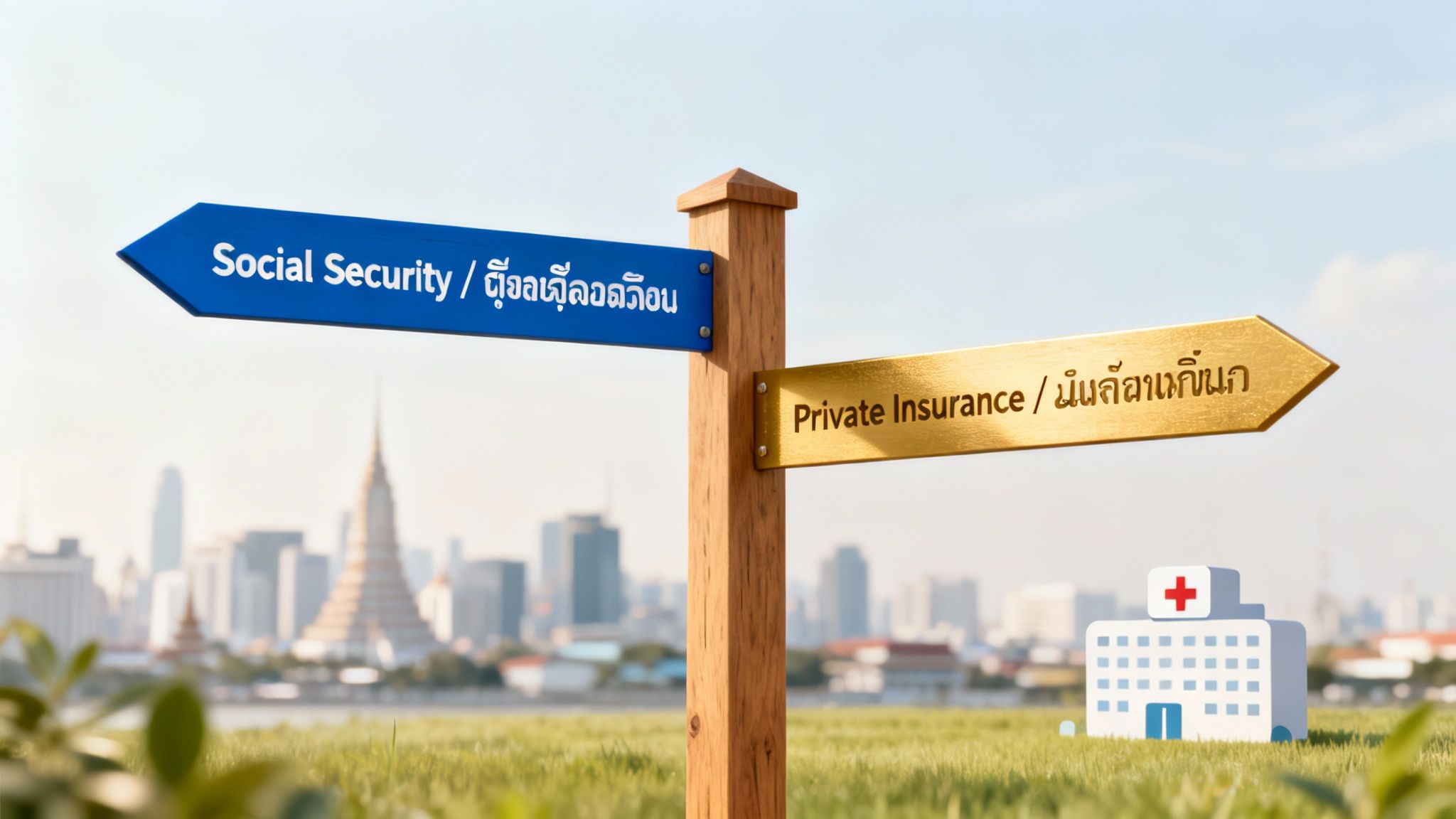
Moving to Thailand is an incredible adventure, but trying to get your head around the healthcare system can feel a bit overwhelming at first. The good news? It's much more straightforward than it seems. Your whole healthcare journey starts with one single decision: will you go with the public system or opt for private coverage?
Think of it like choosing your transportation. The public system is like a reliable city bus—it gets you where you need to go. The private option is more like a private taxi, offering more comfort, speed, and personalized service. For a lot of expats, this choice isn't just about preference; it's often determined by their visa status and employment situation.
Public vs. Private: A First Look
The main public option for working expats is Thailand's Social Security scheme. If you're legally employed here with a work permit, your employer will sign you up automatically. A small slice of your salary (5%, but capped at THB 875 per month) is deducted to cover it. This gets you access to a designated public hospital for most basic medical needs.
On the flip side, private health insurance in Thailand is the standard choice for:
- Retirees and others on long-stay visas that actually require proof of private coverage.
- Digital nomads and self-employed folks who don't have a traditional Thai employer.
- Families who want more extensive coverage and access to top-tier international hospitals.
- Anyone who prefers more choice in doctors, shorter wait times, and English-speaking staff.
Your visa type and job are the biggest factors steering you down one path or the other. For many, like retirees on an O-A visa, private insurance isn't just a nice-to-have—it's a non-negotiable requirement from Thai immigration.
This first decision between the public Social Security system and a private plan really sets the stage for your entire healthcare experience in the Land of Smiles. Getting this distinction right is the first step toward making a smart choice that protects your health and gives you peace of mind.
To make things clearer, let's break down how these two options stack up against each other.
Public vs Private Health Insurance in Thailand at a Glance
This table gives you a quick snapshot of the key differences between relying on the government's Social Security plan and getting your own private insurance policy.
| Feature | Public System (Social Security) | Private Insurance |
|---|---|---|
| Eligibility | Legally employed expats with a work permit | Open to all expats, retirees, and visa holders |
| Cost | Fixed monthly deduction from salary | Varies widely based on age, coverage, and plan |
| Hospital Access | Limited to a designated public hospital | Broad access to private and international hospitals |
| Choice of Doctor | Limited to assigned hospital staff | Freedom to choose specialists and doctors |
| Wait Times | Can be long for non-emergency care | Generally very short for appointments and treatment |
As you can see, the trade-off is pretty clear: the public system offers low-cost, basic coverage for those who qualify, while private insurance provides flexibility, choice, and access to a higher tier of care for a variable premium.
Navigating the Thai Healthcare Landscape

Before you can make a smart decision about health insurance in Thailand, you first need to get the lay of the land. The country basically runs on a two-track healthcare system, and the differences between the public and private options are massive. Figuring out what each one offers is the key to matching an insurance policy to what you'll actually need and expect.
Think of it like getting across town. You could take the reliable city bus, or you could hail a private taxi. Thailand's public healthcare system is the city bus—it's extensive, affordable, and it'll get you where you need to go for essential care. The trade-off? It can get crowded, the waits can be long, and you might not always get a seat right away.
The private system is that taxi. It's fast, comfortable, and offers a premium, personalized experience. You get direct access to specialists, shiny modern facilities, and English-speaking staff. But all that convenience and top-tier service comes with a much, much higher price tag.
The Public Hospital Experience
Public hospitals are the absolute backbone of healthcare for millions of Thai citizens. If you're an expat with a work permit and you're paying into the Social Security system, this is your default access point for medical treatment. While the actual quality of care is generally good, the experience itself can be a real culture shock.
You should be prepared for:
- Longer Wait Times: It's totally normal to spend hours waiting for a consultation, even if you have an appointment.
- Crowded Facilities: These hospitals serve a huge volume of patients every single day, which means busy waiting rooms and not a lot of personal space.
- Language Barriers: While the big public hospitals in Bangkok will have some English-speaking staff, it's far from guaranteed, especially if you need a specialist or are outside the capital.
The whole system is built for high-volume, cost-effective care. It's a functional and vital service, but it definitely prioritizes necessity over comfort. For a deeper dive, our detailed health insurance in Thailand guide can provide further context.
The Private Hospital Advantage
Thailand's private hospitals are famous for a reason—they are world-class facilities that attract medical tourists and expats from all over the globe. Places like Bumrungrad International and Bangkok Hospital feel more like five-star hotels than clinics, and they hold accreditations from major international bodies.
The private sector here is so advanced that it draws in over 2 million international patients every year, making Thailand a world leader in medical tourism. That alone tells you a lot about the quality and service you can expect.
Opting for a private hospital means you get immediate appointments, access to the latest state-of-the-art technology, and dedicated international patient departments. The staff are fluent in English and other languages, so communication is never a problem. This premium experience is exactly what most expat health insurance plans are designed for, giving you access to this incredible level of care without having to pay the enormous costs out-of-pocket. Grasping this difference is the first real step in picking the right insurance for your life in Thailand.
Choosing Your Private Health Insurance Plan
So you've decided private coverage is the way to go. The good news is the market for health insurance in Thailand is both diverse and competitive. For expats, this means plenty of choices and good value for your money. The flip side is that you need a clear way to sort through all the options.
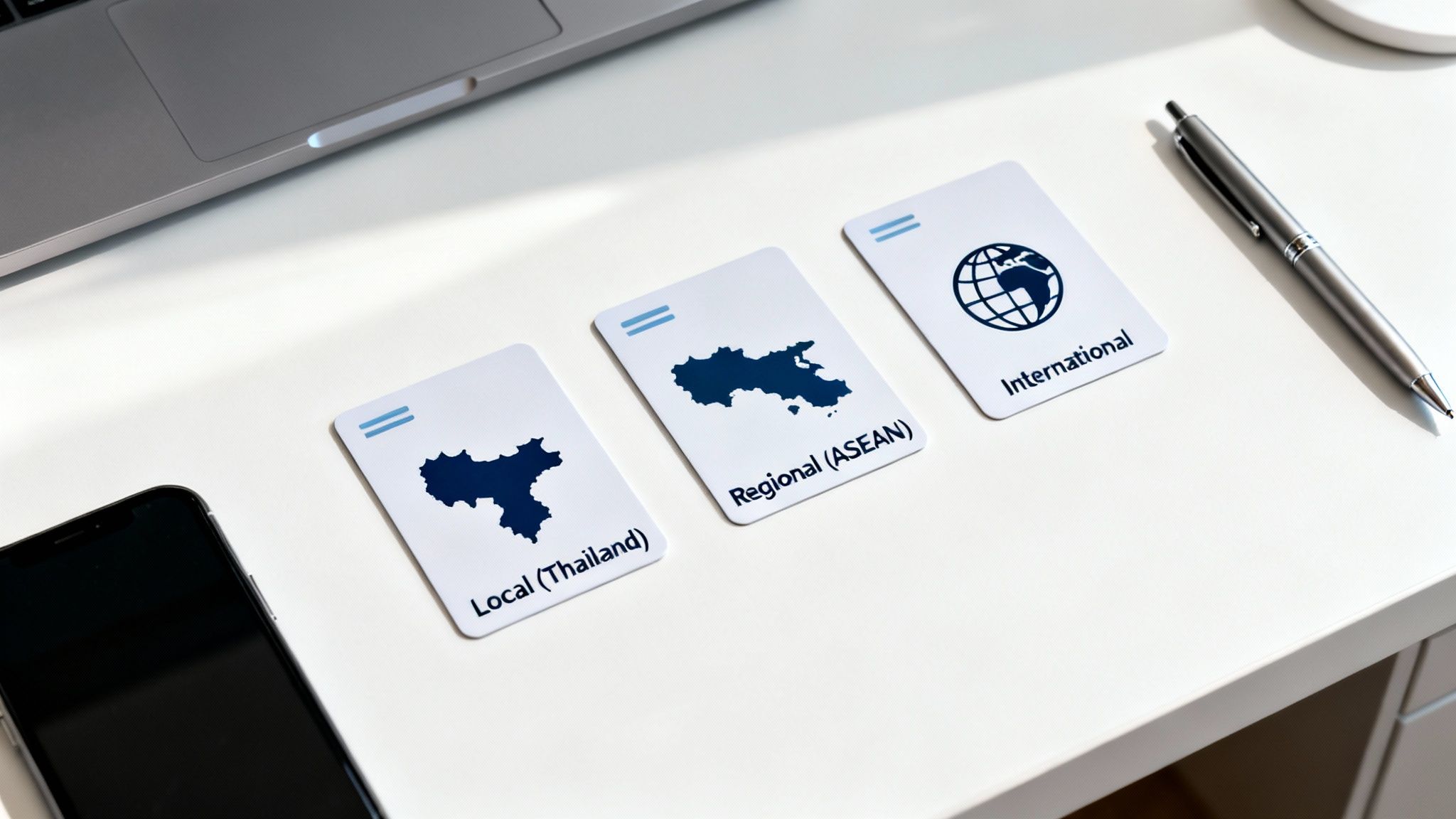
I find it helps to think of it like picking a mobile phone contract. Do you just need service for local calls (a Thai-only plan)? Or do you travel around Southeast Asia for work or weekend trips (a regional plan)? Maybe you fly back home to Europe or the US and need a plan that works everywhere (an international plan). Your lifestyle, travel habits, and budget are going to be your main guides here.
The Thai health insurance scene is a big deal and it's only getting bigger. The market continues to grow steadily, driven by a growing demand for top-notch healthcare. This growth means we'll keep seeing new and better insurance products hit the market.
The Three Main Types of Private Plans
For most expats, private health insurance policies boil down to three main categories. Getting your head around the scope of each one is the first step to finding the right fit.
- Local Thai Plans: These policies are from Thai insurance companies and, as the name suggests, only cover you within Thailand. They're usually the most affordable and are a fantastic choice for retirees or any expat who plans on spending almost all their time in the country.
- Regional (ASEAN) Plans: This is the middle-ground option, giving you coverage in Thailand plus other countries in Southeast Asia. It's perfect for expats who often travel for business or pleasure to places like Vietnam, Singapore, or Malaysia.
- International Plans: These are the most comprehensive policies, offering global coverage. You can often choose to include or exclude the USA, which makes a huge difference in the price. A digital nomad splitting their time between Chiang Mai, Bali, and Lisbon would find this kind of plan absolutely essential.
The key difference isn't just about geography; it's also about the level of benefits. International plans typically come with much higher coverage limits, more bells and whistles like wellness check-ups and dental care, and bigger direct-billing hospital networks.
Let's put this into practice. A retiree living the good life in Hua Hin would be perfectly happy with a local plan from a provider like AXA Thailand, giving them access to excellent local hospitals for a reasonable price. But an executive based in Bangkok who's constantly flying to Singapore and Hong Kong for meetings? They'd absolutely need a regional or international plan to stay protected on the road.
Decoding Key Insurance Terms
To really compare policies, you need to speak the language of insurance. It can seem a bit intimidating at first, but these core concepts are pretty straightforward once you understand what they mean for you.
1. Deductible (or Excess) This is the amount of money you have to pay out of your own pocket for medical care before your insurance kicks in. Think of it as your initial contribution. A higher deductible usually means a lower monthly premium, which can be a smart way to save money if you're generally healthy and don't anticipate frequent doctor visits.
2. Coverage Limit (or Annual Maximum) This is the absolute maximum amount your insurer will pay for your medical bills in a policy year. Local plans might have lower limits, maybe around $100,000, while a premium international plan can offer coverage well over $1,000,000. When it comes to a serious illness or accident, a high limit provides critical financial protection.
3. Direct Billing Network This is, arguably, one of the most important features to look for. A direct billing network is simply a list of hospitals that have an agreement with your insurer to settle bills directly. This means if you're admitted for a covered treatment, the hospital bills the insurance company—you don't have to pay a massive sum upfront and then wait weeks to get reimbursed. Always, always check that your preferred hospitals are in a plan's network.
Getting a handle on these elements is crucial. If you're looking for a deeper dive, check out our in-depth article on how to compare health insurance plans to make an even more informed choice.
Meeting Health Insurance Rules for Your Thai Visa
For a growing number of expats, health insurance isn't just about peace of mind—it's a non-negotiable line item on a visa application. Thai immigration has made it crystal clear: if you want to enjoy a long-term stay in the Kingdom, you have to prove you won't be a financial burden on their healthcare system.
Think of it like a key to a door. Without the right policy, your application for certain long-stay visas simply won't get looked at. This isn't a friendly suggestion; it's a firm rule with specific documentation and minimum coverage levels.
Getting these requirements right from the start is the difference between a smooth, stress-free visa process and one filled with delays, frustration, and potential rejection.
Navigating Specific Visa Insurance Mandates
Different long-stay visas come with their own distinct health insurance rules. The requirements are incredibly precise, so it's vital to get a policy that explicitly checks every box for your specific visa category.
The most common visas with strict insurance mandates are:
- Retirement Visa (Non-Immigrant O-A): This is a go-to for retirees aged 50 and over. Applicants absolutely must have health insurance with a minimum of THB 3,000,000 (roughly $100,000) in total coverage. This policy has to cover both inpatient and outpatient care for the entire time you plan to stay.
- Long-Term Resident (LTR) Visa: This newer visa targets high-net-worth individuals and skilled professionals, and the bar is set even higher. Applicants need to lock in a policy with at least $50,000 in coverage.
- SMART Visa: Aimed at tech entrepreneurs and highly skilled experts, this visa also demands proof of health insurance that covers your entire stay in Thailand.
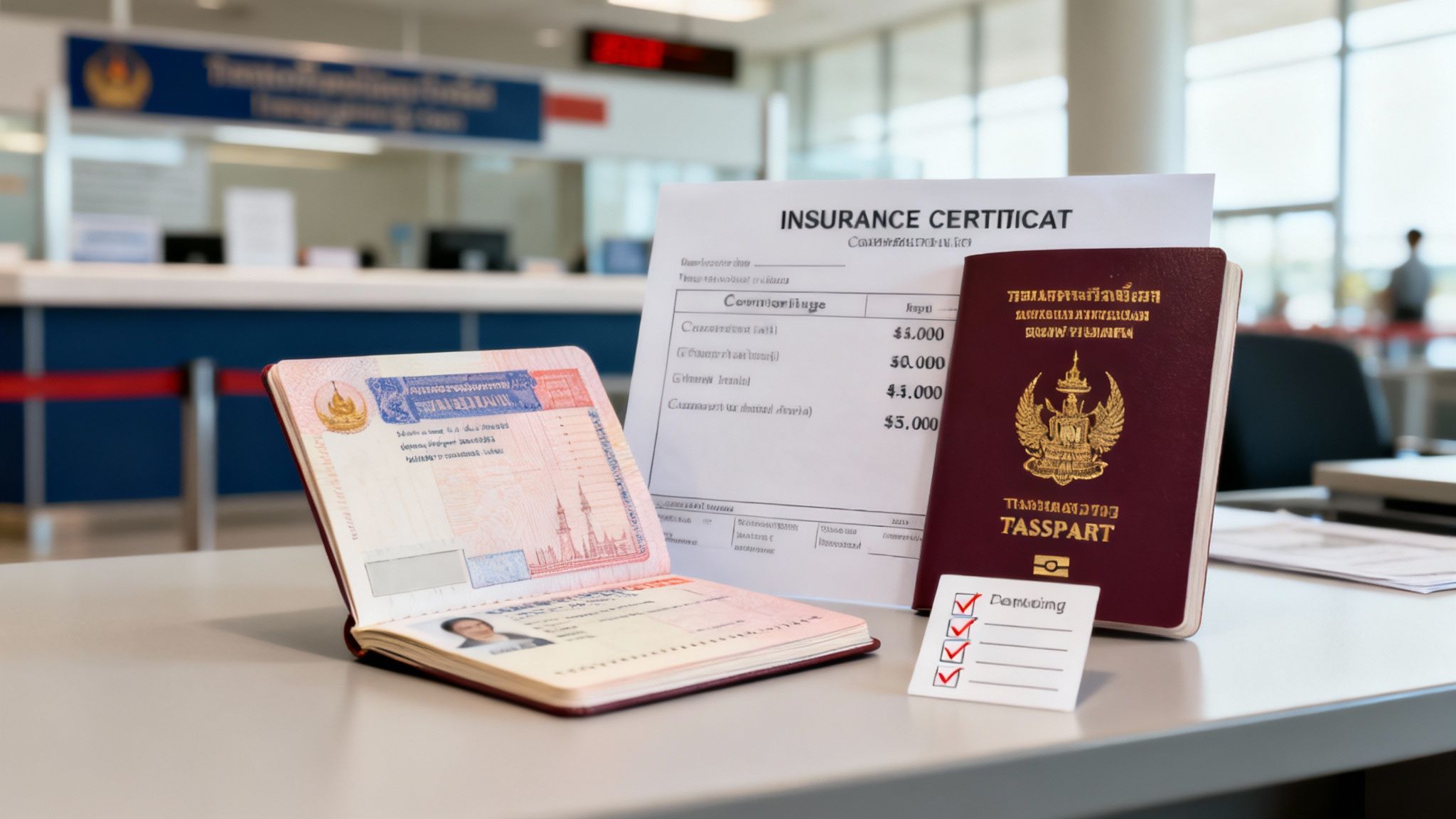
It's not enough to just have any insurance. Your policy certificate has to clearly state the coverage amount in Thai Baht or US Dollars and confirm it's valid for the full length of your intended stay. Immigration officials will be looking at this document with a magnifying glass.
Finding a Compliant Plan and Getting the Paperwork Right
Once you know what your visa demands, the hunt for an insurance plan that ticks all the boxes begins. The good news is that many international and local Thai insurers now offer policies specifically designed to be "visa-compliant."
When you're shopping around, look for insurers that provide the Foreign Insurance Certificate. This is a standardized form required by the Thai General Insurance Association (TGIA), and it's the exact document immigration officials are trained to look for. It cuts through the confusion by confirming your policy meets all the necessary standards.
To keep your application process on track, just follow these steps:
- Confirm the exact coverage needed for your visa type. Always check the official Royal Thai Embassy or Consulate website for the latest numbers.
- Purchase a compliant policy that meets or, even better, exceeds the minimum inpatient and outpatient coverage requirements.
- Get the official Foreign Insurance Certificate from your provider. A simple policy schedule or welcome letter usually isn't enough.
- Submit all required insurance documents along with the rest of your visa application.
Dealing with these rules has become a standard part of the long-term expat journey in Thailand. For a deeper dive into how these regulations came to be, you can read more about mandatory health insurance for long-stay visas in Thailand to understand the government's official position. Properly sorting out your insurance paperwork is one of the most critical steps you can take to make sure your Thai dream becomes a reality without any bureaucratic headaches.
How Much Does Expat Health Insurance Cost in Thailand?
When you're trying to budget for life in Thailand, health insurance is one of the most critical—and variable—expenses on your list. Trying to nail down a single price for an expat policy is a bit like asking for the price of a car without mentioning the make, model, or features. The final number on your premium really comes down to your personal situation and the level of protection you're looking for.
The cost of health insurance in Thailand isn't just a number pulled out of thin air. It's calculated based on a handful of core factors that directly reflect the risk an insurer takes on. Getting a handle on these key drivers is the first step to figuring out what your own policy might cost and where you might have some wiggle room to adjust the price.
Key Factors That Determine Your Premium
Think of your insurance premium as a custom quote built just for you. The main ingredients that go into this calculation are your age, how comprehensive you want the plan to be, and how large of a geographical area you need to be covered in.
-
Age and Health: This is the big one. A policy for a healthy 30-year-old will always be significantly cheaper than one for a 65-year-old retiree, simply because health risks naturally increase with age.
-
Coverage Level: A bare-bones plan that only covers major inpatient hospital stays is going to cost less than a premium plan that includes outpatient visits, dental care, wellness check-ups, and maternity benefits. You get what you pay for.
-
Geographic Scope: A plan that only covers you within Thailand will be the most affordable. If you add coverage for the rest of Southeast Asia, the cost goes up. A global plan, especially one that includes the USA, will be the most expensive option by a long shot.
-
Deductible: Just like with car insurance, you can choose a higher deductible. This is the amount you pay out-of-pocket before your insurance kicks in, and opting for a higher number here can bring down your annual premium.
This reality is playing out in the broader market. Thailand's life insurance sector, which often bundles health coverage, is seeing steady growth. In the first half of 2025, total premiums reached approximately 327 billion THB (around USD 9.3 billion), and the health-specific part of that jumped by nearly 19%. This is being fueled by a growing health awareness and, frankly, significant medical inflation.
Real-World Cost Examples
To make this all a bit more concrete, let's look at some sample profiles. These are illustrative annual premiums that should give you a realistic ballpark of what different types of expats might expect to pay for health insurance here in Thailand.
Remember, these are just estimates. The only way to know your actual cost is to get a personalized quote based on your specific age, health status, and the coverage you want.
A detailed look at potential costs can really help you budget more effectively. The table below breaks down some sample premiums for a few common expat scenarios, from a young digital nomad to a retired couple.
Sample Annual Health Insurance Premiums in Thailand
This table shows illustrative cost examples to help you benchmark what you might pay for a policy.
| Expat Profile | Plan Type | Estimated Annual Premium (USD) |
|---|---|---|
| 30-Year-Old Digital Nomad | Local Thai Plan (Inpatient Only) | $800 - $1,200 |
| 45-Year-Old Professional | International Plan (Worldwide excl. USA) | $3,500 - $5,500 |
| Family of 4 (Two Adults, Two Kids) | Comprehensive Regional Plan | $8,000 - $12,000 |
| 65-Year-Old Retiree | Local Thai Plan (Inpatient & Outpatient) | $4,000 - $7,000 |
As you can see, a young person just looking for basic emergency coverage can get it pretty affordably. On the other hand, comprehensive international coverage for a family or a senior represents a more significant financial commitment—but it's one that provides a critical safety net against the high cost of care at top-tier private hospitals.
A Practical Checklist for Buying Your Policy
So, you've done the research and you're ready to pull the trigger. Fantastic. That's the hardest part. Buying the right health insurance in Thailand is much less intimidating when you have a clear game plan. This final checklist is your playbook for making a smart, informed decision and making sure the application goes off without a hitch.
Think of this as the final walkthrough before buying a house. You've seen the brochures and liked what you heard, but now it's time to ask the tough questions and check the foundation. This is where you make sure there are no nasty surprises waiting for you down the road.
Key Questions for Every Provider
Before you sign on the dotted line, you need to pin down some specifics with the insurer or your broker. Vague promises won't cut it; you need to know exactly how the policy works in the real world. Any reputable company will have no problem giving you straight answers.
Here's what you absolutely must ask:
- Direct Billing Network: "Could you send me a complete list of hospitals in your direct billing network, specifically for my city—Bangkok, Chiang Mai, Phuket, etc.?" This is non-negotiable for avoiding massive out-of-pocket payments for hospital stays.
- Claims Process: "What's the step-by-step process for getting reimbursed for an outpatient visit? And what's your average turnaround time for paying out those claims?"
- Waiting Periods: "Are there any waiting periods for specific coverage like maternity, dental, or pre-existing conditions? I need to know the exact duration for each."
- Policy Exclusions: "Beyond the standard stuff, are there any unique activities or conditions this plan absolutely will not cover?"
Pro tip: Get these answers in writing. An email thread creates a clear record of what you were told. It can be a lifesaver if a coverage dispute pops up later.
Broker vs. Direct: Which Way to Go?
One of the last big decisions is whether to work with an insurance broker or go straight to the insurance company. A good broker is like your personal advocate, comparing plans from multiple insurers to find the one that truly fits your life. Going direct means you're only looking at one company's product line.
A broker can save you a ton of time and legwork, often uncovering better deals than you'd find on your own. On the other hand, going direct might feel simpler if you've already zeroed in on a specific provider you trust. There's no wrong answer here—it really comes down to how comfortable you are navigating the market by yourself.
As more people look for a higher standard of care, demand for quality private hospital services is growing.
The application itself is usually pretty straightforward. Expect to fill out a detailed medical questionnaire. Be brutally honest here, especially about any pre-existing conditions. Trying to hide something is a recipe for disaster later. Insurers might also ask for a basic health check-up, particularly for older applicants or those going for high-end plans.
Follow these steps, and you'll be well on your way to securing the right protection for your life in the Land of Smiles.
Frequently Asked Questions
Even after you've done your homework, a few specific questions always come up when picking out a plan. We get it. Here are some straightforward answers to the most common things we hear from expats getting covered in Thailand for the first time.
Can I Just Use My Insurance from Home in Thailand?
This is probably the number one question we get, and the short answer is almost always no.
Your plan back home, whether it's Medicare in the US or the NHS in the UK, is built to work at home. It wasn't designed for long-term expat life and usually offers little to zero coverage once you've moved abroad.
And what about travel insurance? That's not the right tool for the job either. Travel insurance is for emergencies during short trips—think a broken arm on a two-week vacation. It won't cover routine check-ups, ongoing care, or major medical procedures. For anyone truly living in Thailand, a proper international or local Thai health plan is the only way to be sure you're properly protected.
What if I Have a Pre-Existing Medical Condition?
When it comes to pre-existing conditions, honesty is absolutely the best policy. Trying to hide a condition is a surefire way to get a claim denied down the road, right when you need the coverage most.
Insurers in Thailand typically handle these situations in one of three ways:
- Exclusion: They'll offer you a policy but will permanently exclude any treatments related to your specific condition.
- Waiting Period: The policy might agree to cover the condition, but only after a "waiting period" of 12-24 months has passed with no related symptoms or treatments.
- Higher Premium: Some of the more comprehensive international plans might cover the condition from day one, but they'll charge a higher yearly premium to account for the added risk.
Why Is a Direct Billing Network So Important?
A direct billing network is a total game-changer, especially when it comes to your peace of mind. It's a simple arrangement where your insurance company pays the hospital directly for your covered care. You don't have to pay a massive bill out-of-pocket and then spend weeks chasing a reimbursement.
For a major surgery or an unexpected hospital stay, direct billing can be the difference between a smooth, stress-free experience and a sudden financial nightmare.
Having a strong network that includes top-tier private hospitals like Bumrungrad International, Samitivej, and the Bangkok Hospital Group means you can access world-class care without the financial headache. It's one of the most practical features to look for in any health insurance Thailand policy.
Do I Really Need Dental and Maternity Coverage?
These are typically optional add-ons, and whether you need them really boils down to your personal situation and stage of life.
Dental care in Thailand is excellent and surprisingly affordable, so many expats find it easier to just pay for cleanings and routine check-ups out-of-pocket.
Maternity coverage, on the other hand, is a major benefit that requires planning. It always comes with a long waiting period, usually 10 to 12 months. This means you have to get the coverage in place well before you even start trying to conceive if you want prenatal care and delivery costs to be covered.
Figuring out health insurance in Thailand can feel overwhelming, but you don't have to go it alone. The expert brokers at Expat Insurance can help you compare plans from over 65 insurers to find the perfect fit for your life and budget. Get your free, personalized quote today!
Get Protected While Living Abroad
Found this article helpful? Make sure you have the right insurance coverage too. Get instant quotes for international health, life, and travel insurance.
Takes 2 minutes • Compare multiple providers • Expert advice
