

December 27, 2025
•
5 min read
What Does Travel Insurance Cover: Essential protections for your trip
Discover what does travel insurance cover and how it shields you from medical, trip cancellation, baggage, and other emergencies.
Think of travel insurance as a financial safety net for anything that goes wrong before or during a trip. It's designed to pay you back for everything from a last-minute cancellation to an unexpected hospital bill in another country, protecting both your wallet and your well-being.
Your Essential Guide to Travel Insurance Coverage
It's easy to dismiss travel insurance as something only for worst-case scenarios, but it's actually a practical tool for handling the common headaches that can derail a dream vacation. From minor hiccups like a delayed suitcase to major emergencies like a sudden illness, a good policy is there to cover your non-refundable expenses and out-of-pocket costs.
This kind of protection is especially crucial for expats and long-term travellers who are far from their usual support systems. Your health insurance back home often provides little to no coverage once you cross international borders, and that's precisely where travel insurance steps in.
A Quick Look at Common Coverage
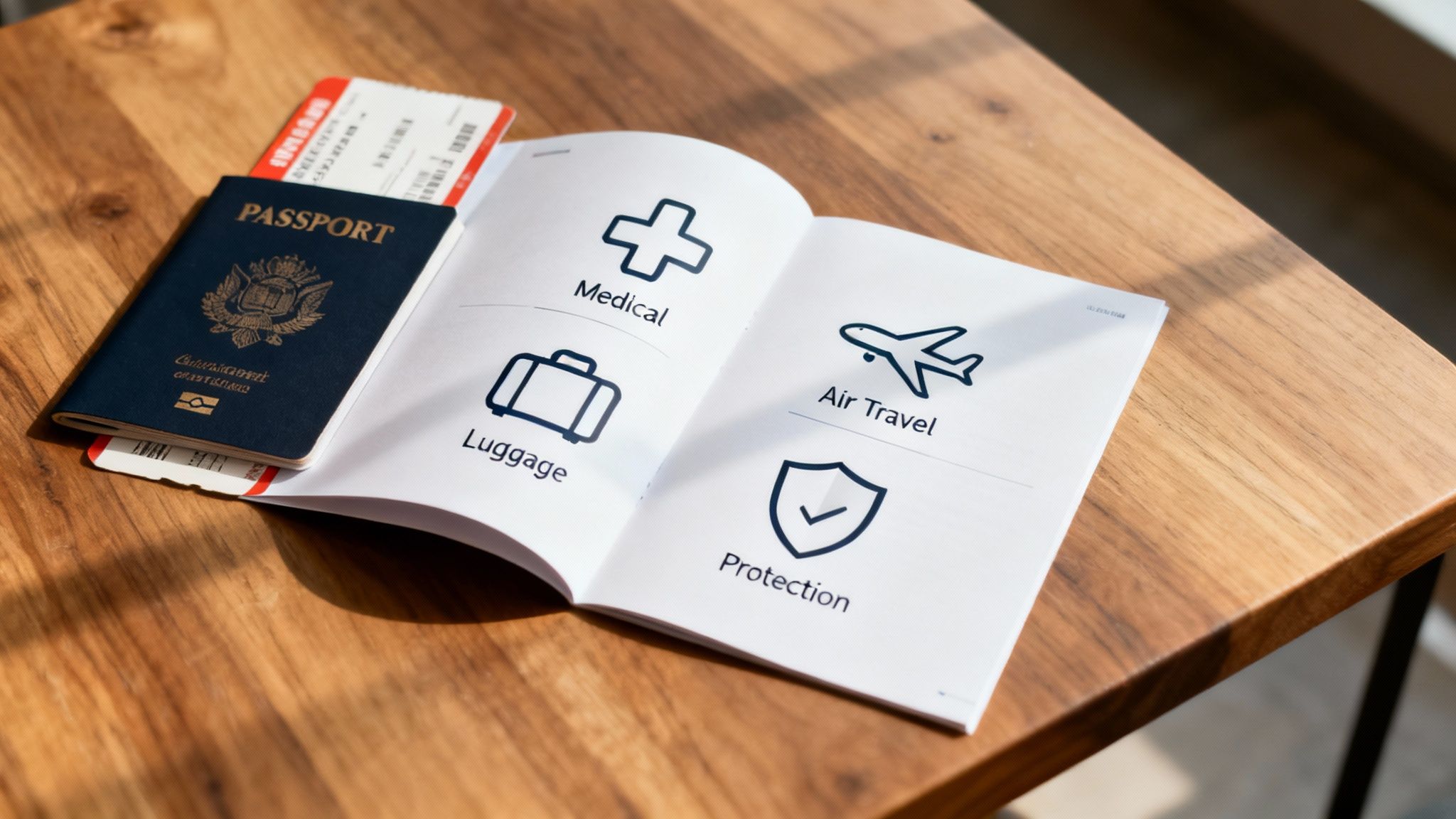
To give you a clear, at-a-glance idea of what travel insurance covers, the table below breaks down the most common benefits you'll find in a standard policy. Think of it as your cheat sheet before we get into the nitty-gritty of each protection.
Travel Insurance Coverage at a Glance
| Coverage Type | What It Typically Covers |
|---|---|
| Trip Cancellation | Reimburses your pre-paid, non-refundable costs if you have to cancel your trip for a covered reason before you leave. |
| Trip Interruption | Covers the unused portion of your trip and extra costs to get home if you have to cut your trip short. |
| Emergency Medical | Pays for doctor visits, hospital stays, and medical care if you get sick or injured while travelling. |
| Medical Evacuation | Covers the cost of transporting you to the nearest adequate medical facility or back home if medically necessary. |
| Baggage Loss/Delay | Reimburses you for lost or damaged luggage, and for essential items you need to buy when your bags are delayed. |
| Travel Delay | Covers expenses like meals and lodging when your trip is delayed for a covered reason, such as weather. |
Each of these coverages is designed to handle a specific type of travel mishap, from the initial booking all the way until you're safely back home. Now, let's explore what each one really means for you.
Protecting Your Health Abroad with Medical Coverage

Of all the safety nets travel insurance provides, emergency medical coverage is without a doubt the most important. Think of it as your personal medical hotline and financial shield in a foreign country, ready to step in the moment an unexpected accident or sudden illness strikes.
This isn't for your annual check-up or any planned procedures; it's purely for the emergencies that blindside you and demand immediate care. The real value of this coverage snaps into focus when you confront a painful truth: your health plan from back home is often useless overseas. This leaves you completely exposed to potentially astronomical medical bills for what might seem like a minor incident.
A simple trip and fall could easily turn into an emergency room visit, X-rays, and a treatment plan that costs thousands out-of-pocket. Without travel insurance, that entire financial weight lands squarely on your shoulders.
What Emergency Medical Insurance Typically Covers
When a health crisis hits you abroad, your policy is designed to handle the big, scary expenses that come with it. Every plan has its own specifics, but you can generally expect a comprehensive policy to cover costs for:
- Emergency Room Visits: Immediate care after an accident or for a sudden, severe illness.
- Hospital Stays: This covers your room, board, and necessary medical services while you're admitted.
- Surgical Procedures: Any medically necessary surgery to treat your injury or acute condition.
- Ambulance Services: Ground or air transport to get you to the nearest hospital that can properly treat you.
- Prescription Medications: Drugs prescribed by a doctor to treat your covered medical emergency.
The demand for this kind of protection has skyrocketed, especially as people start traveling the world again. It points to a growing 'health-first' mindset among international travelers. In 2025, medical insurance attachment rates in the US market are projected to jump from 73.5% to 80.8%. That's a significant 7.3 percentage point increase, showing a clear willingness to invest more in solid medical coverage.
The Lifeline of Medical Evacuation and Repatriation
Okay, so you get immediate treatment. But what happens if you're stuck in a remote village with only a small local clinic? Or what if you need to get back home to continue your recovery? This is where medical evacuation and repatriation coverage becomes absolutely essential.
Medical evacuation pays to transport you from where you are to the nearest hospital that's equipped to handle your condition. Repatriation pays to bring you all the way back to your home country for ongoing care once you're stable enough for the journey.
Imagine you're trekking through a remote mountain range and suffer a serious fracture. The local clinic might be able to set a bone, but they won't have the orthopedic specialists or surgical tools you need. Medical evacuation is what arranges and pays for the helicopter or specialized ambulance to get you to a major city hospital that does.
These services are wildly expensive, often running into the tens or even hundreds of thousands of dollars. Without insurance, that cost is simply out of reach for most people, making this one of the single most valuable benefits in any travel policy. You can get a better sense of the staggering costs of medical evacuation in our detailed guide.
Real-World Scenarios Where Coverage Is Key
To really see how this works, let's walk through a few concrete examples:
- The Sudden Infection: You're exploring ancient ruins in a tropical climate and develop a severe bacterial infection. Your travel insurance would cover the emergency doctor's visit, antibiotic prescriptions, and any lab tests needed.
- The Food Poisoning Fiasco: A celebratory dinner goes horribly wrong, leaving you dangerously dehydrated from food poisoning. Your policy would cover being hospitalized for IV fluids and monitoring until you're back on your feet.
- The Skiing Accident: You take a nasty fall on the slopes in the Alps and break your leg. The policy would cover the ski patrol rescue, the ambulance ride down the mountain, emergency surgery, and your hospital stay. If the injury stops you from flying commercial, repatriation benefits could even cover a medically supervised flight home.
In every one of these scenarios, the insurance acts as a critical buffer, stopping a health crisis from becoming a financial disaster. It makes sure you get the care you need, where you need it, without having to liquidate your savings to pay for it. This is why robust medical and evacuation coverage is the non-negotiable foundation of any safe trip.
Safeguarding Your Finances with Trip Protection
While emergency medical benefits look after your health, trip protection coverage is all about safeguarding your travel investment. Think about it: you often pay for flights, hotels, tours, and cruises long before you even start packing. Trip protection acts as your financial backstop if something unexpected forces you to cancel your plans or head home early.
At its heart, trip protection splits into two main benefits that cover different stages of your journey: trip cancellation and trip interruption. Getting the difference between them is the key to knowing exactly when you're covered.
Trip Cancellation Before You Depart
Trip cancellation coverage protects you before your trip ever begins. If a covered event makes you call off your travel plans, this benefit pays you back for your pre-paid, non-refundable expenses. It's the safety net that catches your deposits and payments when life throws you a curveball.
Imagine you've booked a $5,000 anniversary cruise, but a week before you set sail, a parent has a medical emergency and needs you. Without insurance, you'd likely lose the entire cost of that cruise. With trip cancellation coverage, you can file a claim to get that money back.
Commonly covered reasons for cancellation include:
- A sudden, serious illness or injury to you, a travel buddy, or a close family member.
- Losing your job unexpectedly (and it's not your fault).
- A death in your immediate family.
- Severe weather, like a hurricane, that makes your destination unsafe or uninhabitable.
This is hands-down one of the most-used benefits of any travel policy. Trip cancellation and interruption claims are consistently the most common because they protect the core financial stake you have in a trip. With a 40% travel insurance penetration rate among U.S. travelers (a big jump from 28% pre-COVID), this protection is more vital than ever.
If you're on the fence and wondering if you really need travel insurance for your specific trip, the best place to start is by adding up your non-refundable costs.
Trip Interruption After You Have Left
Trip interruption coverage kicks in after you've already left home. It's designed for those awful situations that force you to cut your trip short and race back unexpectedly. This benefit is a two-part solution for a journey gone wrong.
First, it reimburses you for the unused, non-refundable parts of your trip. Second, it covers the reasonable and unexpected costs of getting you home, like a last-minute, one-way flight that would otherwise cost a fortune.
Scenario: You're two days into a 10-day guided tour of Italy when you get a frantic call: a pipe burst and flooded your house. You have to get back immediately. Trip interruption would reimburse you for the eight tour days you'll miss and cover the cost of your emergency flight home.
This protection ensures that a crisis back home doesn't just end your vacation—it also prevents it from becoming a massive, unexpected travel bill.
The Ultimate Flexibility: Cancel For Any Reason
Standard trip cancellation only covers the specific reasons listed in your policy document. But what if you need to cancel for a reason that isn't on the list? Maybe a huge work project lands on your desk, or you simply get a bad feeling about traveling. That's where the Cancel For Any Reason (CFAR) upgrade comes in.
CFAR is an optional add-on that lets you cancel your trip for, well, literally any reason your policy doesn't already cover. It offers the highest level of flexibility, but it comes with a few specific rules:
- Partial Reimbursement: It typically pays back 50% to 75% of your non-refundable trip costs, not the full 100%.
- Time-Sensitive: You have to buy the CFAR upgrade shortly after making your first trip payment, usually within 14-21 days.
- Early Cancellation: You must cancel your trip at least 48 hours before you're scheduled to depart.
While adding CFAR will increase your policy's cost, it offers priceless peace of mind, especially for travelers facing uncertainty or booking those expensive, once-in-a-lifetime trips.
Covering Your Belongings from Loss and Delay

We've all been there. That slow-motion dread watching the baggage carousel spin, every bag looking vaguely like yours until it isn't. Baggage coverage is designed for this exact travel nightmare, giving you a financial safety net when your luggage gets delayed, stolen, or vanishes into thin air.
This protection is a fundamental part of what travel insurance covers, tackling the all-too-common headache of mishandled luggage. It's become such a critical feature for travelers that one specific bundle—combining Travel Medical, Trip Interruption, Trip Delay, and Baggage Protection—saw explosive 369% growth in the U.S. market in 2025, according to battleface's 2025 US Travel Insurance Trends report.
This coverage really breaks down into two distinct benefits: one for when your bags are just late to the party, and another for when they're gone for good.
When Your Baggage Is Delayed
Think of baggage delay coverage as your emergency slush fund. It's a small allowance designed to help you buy essentials when your suitcase decides to take an unscheduled detour. If your bags don't arrive after a certain amount of time—usually 6 to 12 hours—this benefit kicks in.
It reimburses you for necessary purchases up to a specific daily or total limit, so you can grab things like:
- A fresh change of clothes
- Basic toiletries like a toothbrush and deodorant
- Any other absolute essentials you need to get by comfortably
Just remember to hang on to your receipts, as you'll need them to file a claim. This coverage is meant to bridge the gap until you and your luggage are reunited, not to fund a whole new wardrobe.
When Your Baggage Is Lost, Stolen, or Damaged
If that delay turns into a permanent disappearance or your bag gets stolen, your travel insurance steps up with a much bigger benefit. This coverage reimburses you for the value of your luggage and everything inside it, right up to your policy's maximum limit.
This protection is typically based on the actual cash value (which factors in depreciation) or the replacement cost of your belongings. While coverage limits vary a lot between plans, many comprehensive policies will reimburse you anywhere from $500 to $2,500 per person.
Important Takeaway: This benefit usually kicks in after you've received whatever compensation the airline offers. Airlines have limited liability for lost luggage, so your travel insurance is there to cover the rest of what you lost.
To make any potential claim as painless as possible, it's a great idea to get in the habit of creating a detailed inventory for insurance claims before you even leave home.
Understanding the Fine Print and Exclusions
Like any insurance, baggage coverage has its own set of rules and limitations. Knowing what isn't covered ahead of time can save you a lot of frustration. Keep a close eye on these common details:
- Per-Item Limits: Most policies will only pay out so much for a single item, often capping it around $250 to $500.
- Specific Item Maximums: You'll often find lower, combined limits for high-value categories like jewelry, electronics, or sporting equipment.
- Common Exclusions: Things like cash, securities, and tickets are almost never covered. You might also find that eyeglasses, hearing aids, and certain medical devices are excluded.
Always comb through your policy documents for these specifics. If you're traveling with an expensive laptop or high-end camera gear, you might need a separate, specialized insurance policy to make sure they're fully protected. A little proactive planning goes a long way.
Understanding Policy Exclusions and Limits
No insurance policy is a blank check, and travel insurance is certainly no exception. While it provides a fantastic safety net, understanding its boundaries—what it doesn't cover—is just as important as knowing what it does. These boundaries come down to two simple concepts: exclusions and limits.
Think of exclusions as the specific "house rules" of your policy. These are the events, activities, or conditions that are intentionally left out of your coverage. Limits, on the other hand, are the maximum dollar amount your insurer will pay for a covered claim. Getting a handle on both is the key to avoiding nasty surprises right when you need help the most.
Common Exclusions to Watch For
Every policy has a list of situations it won't cover. While you always need to read the fine print of your specific document, some exclusions are nearly universal across the industry. Knowing them ahead of time can save you a massive headache and a denied claim.
A few of the most common things you'll see excluded are:
- High-Risk Activities: Your standard policy probably isn't going to cover you if you get hurt scuba diving, rock climbing, or backcountry skiing. If your trip involves anything more thrilling than visiting a museum, you'll almost certainly need to buy a special rider or an adventure sports add-on.
- Acts of War or Civil Unrest: If your trip gets derailed or you're injured because of a declared war, political turmoil, or widespread civil disturbances, travel insurance typically won't step in.
- Foreseeable Events: You can't insure against a problem you already see coming. For example, buying a policy for a trip to Florida after a hurricane has already been named and is barreling toward the coast won't cover you for any storm-related cancellations. The event was already known.
- Non-Emergency or Elective Medical Care: Travel insurance is designed for unexpected medical emergencies. It's not there to pay for routine check-ups, cosmetic procedures, or any treatments you planned to get while abroad.
The Challenge of Pre-Existing Medical Conditions
One of the trickiest exclusions for many travelers involves pre-existing medical conditions. This term generally refers to any illness, injury, or health issue you received treatment, advice, or medication for within a certain window (usually 60 to 180 days) before buying your policy.
So, if an old back injury flares up or a chronic condition like diabetes requires unexpected treatment on your trip, a standard policy might deny the claim. This is where a pre-existing condition waiver becomes incredibly valuable. This upgrade removes that exclusion, but it comes with a catch: you usually have to buy your policy within a very short timeframe—often just 10 to 21 days—after making your first payment for the trip.
How Policy Limits Define Your Coverage
Policy limits are the ceiling on your financial protection. They are the absolute maximum amount of money an insurer will pay for a specific type of claim. These limits can vary wildly from one plan to another, and that difference directly impacts how much real protection you have.
A higher limit isn't just a bigger number; it's a measure of your policy's strength. For a serious medical emergency in a country with expensive healthcare, a $50,000 limit could be exhausted quickly, while a $500,000 limit provides a much more robust safety net.
Before you lock in your insurance, it's also a good idea to check your tour operator's specific policies and conditions, as what they do or don't cover can influence how much coverage you really need.
To illustrate how this plays out, take a look at how the limits might differ between a basic and a premium plan.
Comparing Basic vs Premium Travel Insurance Limits
Here's an example of how coverage limits can differ between standard and upgraded travel insurance policies.
| Coverage Benefit | Example Basic Plan Limit | Example Premium Plan Limit |
|---|---|---|
| Emergency Medical | $50,000 per person | $500,000 per person |
| Medical Evacuation | $250,000 per person | $1,000,000 per person |
| Trip Cancellation | 100% of trip cost up to $5,000 | 100% of trip cost up to $20,000 |
| Lost Baggage | $500 per person | $2,500 per person |
As you can see, the jump is significant. Choosing the right limits is all about matching your coverage to your trip's value and your personal comfort level with risk. It ensures your policy is truly ready for whatever comes your way.
How to Choose the Right Coverage for Your Trip
Knowing what travel insurance covers is one thing, but picking the right policy is where that knowledge really pays off. Every trip and every traveler is different, so grabbing a one-size-fits-all plan is rarely the best move. Your perfect policy depends entirely on your travel style, where you're going, how long you'll be there, and who's coming with you.
Think of it like packing for a trip. You wouldn't throw the same clothes in your suitcase for a weekend business conference in Singapore as you would for a six-month backpacking trek through South America. Your insurance needs to be just as tailored to the journey ahead.
Tailoring Coverage for Your Traveler Profile
The best way to start is by figuring out what kind of traveler you are. Each profile comes with its own unique risks and priorities, and that should guide your choice of coverage. We've broken down some recommendations for common traveler types to help you find that perfect fit.
-
For Digital Nomads and Long-Term Travelers: Forget standard vacation policies; they just won't cut it. You're living abroad, not just visiting. You need a long-stay plan that functions more like international health insurance, giving you solid medical coverage across multiple countries. Prioritize high medical limits, emergency dental care, and—critically—protection for your gear like laptops and cameras. Also, make sure the plan lets you renew your coverage while you're still on the road.
-
For Families with Children: When you're traveling with kids, health and flexibility are everything. Look for policies that cover dependents, ideally for free or at a reduced rate. Trip interruption coverage is a must-have, because a child getting sick is one of the top reasons families have to cut a trip short. You'll also want strong medical benefits and access to 24/7 assistance that can help you find a trusted pediatrician in a foreign country.
Choosing the right travel insurance is less about finding a single "best" plan and more about matching the policy's strengths to your specific travel vulnerabilities. A business traveler needs efficiency, while a retiree needs comprehensive health security.
Specialized Plans for Specific Needs
Beyond those common profiles, some travelers have even more specific needs that require specialized protection.
For Business Travelers: If you travel frequently for work, efficiency is the name of the game. An annual multi-trip policy is almost always the way to go. It's far more convenient and cost-effective than buying a new single-trip plan every time you fly out. These plans cover all your trips over a 12-month period, as long as each individual trip doesn't exceed a set duration (like 30 or 90 days). Look for perks that cater to business needs, like coverage for missed connections and frustrating travel delays.
For Retiree Expats: For retirees living abroad, health is the number one priority. You need a policy with high emergency medical limits—we're talking $500,000 or more. Even more important is getting a waiver for pre-existing conditions. For anyone managing chronic health issues, this is absolutely non-negotiable. Also, double-check that the policy includes robust medical evacuation and repatriation benefits to get you home if a serious medical event occurs. For those shorter visits back home or quick trips elsewhere, you might want to look into the specifics of short-term travel insurance to fill any potential coverage gaps.
By lining up your policy with your travel style, you go from simply knowing what travel insurance is to confidently choosing a plan that actually has your back when you need it most.
Frequently Asked Questions
Even when you've got a good handle on why you need it, a few practical questions always pop up when it's time to pick a travel insurance plan. Let's clear up some of the most common points of confusion with quick, straight-up answers.
What Is the Difference Between Travel Insurance and International Health Insurance?
The easiest way to think about it is this: travel insurance is for trips, while international health insurance is for life abroad.
Travel insurance is a short-term plan you buy for a specific journey. It's your safety net for travel hiccups and emergencies—think a sudden bout of food poisoning in Thailand, a canceled flight out of Paris, or your luggage taking a detour to a different continent.
International health insurance is a different beast altogether. It's a long-term plan designed for expats and digital nomads living overseas. It acts as your primary health coverage, handling everything from emergency surgery to routine doctor's appointments and wellness check-ups.
Does Travel Insurance Cover Pre-Existing Medical Conditions?
Sometimes, but you have to be smart about it. A typical, off-the-shelf policy will often exclude any claims related to a pre-existing condition, which is just about any health issue you've seen a doctor for or received treatment for recently.
However, many of the more comprehensive plans offer what's called a pre-existing condition waiver. This waiver effectively erases that exclusion, but there's a catch: you usually have to buy your policy within 14-21 days of making your very first trip payment. If you're managing a chronic condition, getting this waiver is non-negotiable.
When Is the Best Time to Buy Travel Insurance for My Trip?
Simple: buy it right after you make your first non-refundable payment. That could be your flight, a tour deposit, or your hotel booking. Buying early isn't just a good idea—it's critical for a couple of big reasons.
- Time-Sensitive Benefits: The most valuable perks, like the pre-existing condition waiver and "Cancel For Any Reason" (CFAR) coverage, are only on the table for a short time after you book. Wait too long, and you lose the option.
- Immediate Cancellation Coverage: Your protection against trip cancellation kicks in the moment you purchase the policy. If a family emergency forces you to cancel a month before you're scheduled to leave, you're covered. If you wait until the week before your flight to buy insurance, you're out of luck.
How Do I File a Claim If Something Happens on My Trip?
First thing's first: if it's an emergency, especially a medical one, call your provider's 24/7 assistance line immediately. They can guide you to the right facilities and get things sorted.
From there, it's all about the paper trail. Hold on to every single document—medical reports, police reports if something was stolen, receipts for any unexpected expenses, and every email or text from the airline about a delay. Most insurers now have online portals or apps to make submitting your claim and all that documentation much smoother and faster.
Navigating insurance for life abroad can be complex. At Expat Insurance, our expert advisors help you compare plans from over 65 insurers to find the perfect coverage for your needs, ensuring you're protected wherever you go. Find your ideal plan today by visiting https://www.expatinsurance.com.
