

November 25, 2025
•
5 min read
A Guide to Living in Dubai for Expats
Considering living in Dubai? This complete guide explores the cost of living, visas, housing, healthcare, and cultural tips for a smooth move.
Living in Dubai brings together a unique mix of high-speed ambition and a comfortable, tax-free lifestyle, making it a powerful magnet for professionals and families from all over the world. It's a city defined by its ultra-modern skyline, incredible safety, and a genuinely multicultural community. But that package comes with a high price tag and some specific cultural norms that take some getting used to.
What Is It Really Like Living in Dubai

Picture this: your work network is a tapestry of dozens of nationalities, and your weekends could be anything from a desert safari to lounging at a world-class beach club. That contrast is the heart and soul of daily life in Dubai. It's a city built on a massive vision, pulling in global talent with the promise of big opportunities and an unbeatable quality of life.
The reality of living here is a carefully balanced equation. On one hand, you have perks that are tough to find anywhere else on the planet. On the other, there are practical and cultural hurdles that every new resident needs to learn to navigate.
The Dubai Lifestyle Equation
To figure out if Dubai is the right move for you, it helps to see the trade-offs in black and white. The city's breakneck development has turned it into a major global hub, but that kind of growth brings its own set of challenges. This dynamic is central to the whole expat experience.
A key reason for this growth is the city's magnetic pull on the global workforce. Dubai's population has blown past 4 million residents, and expats make up over 90% of the population—a staggering number that shows just how successful its policies have been. You can read more about this demographic boom and what it means for Dubai's urban planning at dxbinteract.com.
For many, Dubai is a chance to hit the accelerator on their careers and savings in one of the world's most energetic cities. It's a place designed for convenience, safety, and a high standard of living, which are major draws for everyone from single professionals to families with kids.
To help you weigh your options, we've put together a quick pros-and-cons list. It's a good starting point for understanding the give-and-take of Dubai life.
Living in Dubai at a Glance Pros vs Cons
| Pros | Cons |
|---|---|
| Tax-Free Income | High Cost of Living |
| High Safety and Security | Intense Summer Heat |
| Multicultural Environment | Strict Laws and Cultural Norms |
| World-Class Amenities | Reliance on Post-Dated Cheques |
As you can see, the benefits are significant, but they're matched by real considerations you need to be prepared for. This table sums up the core trade-offs every expat faces when they decide to call Dubai home.
Securing Your Visa and Residency
Before you can really settle into your new life in Dubai, you've got to tackle the residency process. Think of your visa as the official key that unlocks everything else—from opening a bank account to signing a lease on an apartment. Without it, you're just a tourist.
The whole system is built on sponsorship. This means that nearly every resident needs someone—a person or a company—to vouch for them.
Most of the time, this sponsor will be your employer. However, it could also be a family member or even a company you own. This relationship is the bedrock of your legal status in the UAE, making the visa application your first major milestone as an expat. The process itself is surprisingly organized, but it demands you pay close attention to every detail.
Common Visa Routes for Expats
For most professionals making the move, the simplest path to residency is an employer-sponsored work visa. It's the most common and direct route by far. That said, Dubai has rolled out several other options to fit different situations, offering a lot more flexibility for investors, entrepreneurs, and highly skilled people.
Here are the main visa types you'll likely run into:
- Employment Visa: This is the standard visa you get with a job offer. Your employer will handle most of the paperwork and act as your official sponsor.
- Golden Visa: A long-term residence visa designed for investors, entrepreneurs, and people with exceptional talents in fields like science, art, and sports. It offers much more independence because you don't need a traditional sponsor.
- Freelance Permit: Perfect for self-employed professionals working in designated free zones, especially in industries like tech, media, and education. This permit lets you operate as a sole practitioner.
A crucial first step for any aspiring expat is learning how to get a residence visa in Dubai, which this guide covers in detail. Understanding this process gives you a huge advantage, even when your company is helping out.
The Visa Application Journey
Once your sponsorship is locked in, the application follows a clear set of steps. While your sponsor—often the company's PRO, or Public Relations Officer—will guide you, knowing the stages helps take the mystery out of it all.
- Entry Permit Issued: First, your sponsor applies for an entry permit. This is what allows you to legally enter the UAE for the purpose of employment.
- Medical Fitness Test: After you arrive, you'll have to go for a mandatory medical screening. They're mainly looking for specific communicable diseases.
- Emirates ID Application: Next, you'll visit a government service center for biometrics—that means fingerprints and photos—to apply for your Emirates ID card.
- Visa Stamping: With a clean bill of health from the medical test, your visa is officially stamped into your passport. This finalizes your residency status.
The lifestyle in Dubai is known for its luxury and high standards, which is what attracts such a diverse expat population. In fact, somewhere between 85%–90% of residents are foreign nationals. This whole system is supported by a solid legal framework that makes the residency process manageable. This process is also tied to global travel permissions; for more details, check out our guide on visa requirements for foreign travel.
Once you have it, your Emirates ID becomes your single most important document. It's your official proof of identity everywhere in the UAE.
Managing the Cost of Living in Dubai
The dream of a tax-free salary is what pulls many expats to Dubai. It's a powerful incentive, for sure. While it's true that you get to keep 100% of your gross income, the real question is what that money can actually buy.
Dubai is a city of incredible contrasts. You can live a sensible, budget-conscious life or dive headfirst into ultra-luxury—and your daily expenses will reflect that choice. A common trap for newcomers is thinking "tax-free" means "expense-free." The reality is quite different.
Costs for essentials like housing and schooling can be seriously high. The trick is to build a realistic budget that lines up with your income and the lifestyle you want, making sure you can save a little while still enjoying everything this city has to offer.
Let's break down the main expenses that will shape your monthly spending.
Core Monthly Expenses for Expats
When you start mapping out your finances, you'll find that four major categories eat up most of your budget. For most people, housing is the biggest chunk, followed by education if you have kids. After that, it's the day-to-day costs of groceries and getting around.
- Housing and Utilities: Your rent will almost certainly be your single biggest recurring cost. A one-bedroom apartment in a central area can run you about $1,700 USD a month. For a family needing a three-bedroom, that can easily jump past $3,500 USD. On top of that, you've got utilities from the Dubai Electricity and Water Authority (DEWA), plus internet and cooling charges, which can tack on a few hundred extra dollars each month.
- Transportation: Dubai has a fantastic public transport system, including the Metro and buses, which are clean, efficient, and affordable. A monthly pass is around $95 USD. That said, a lot of expats still prefer the convenience of owning a car or using ride-hailing apps like Uber, which will obviously push your transport budget higher.
- Groceries: What you spend on food really comes down to your shopping habits. If you're single, you might get by on around $455 USD a month. For a family of four, it's more realistic to budget closer to $1,180 USD. A huge tip here: stick to local and regional products at supermarkets like Carrefour or Lulu. You'll save a fortune compared to shopping at stores that specialize in expensive imported Western brands.
- Education: This is the big one for families. International school fees are a massive financial commitment. Annual tuition can start at $10,000 USD and soar to over $25,000 USD per child, all depending on the school's curriculum and prestige. For many expat families, this becomes their largest single expense and something that absolutely must be discussed during salary negotiations.
The cost of living is a tricky subject with tons of variables. For a closer look at how different lifestyles impact your budget, our complete guide offers a more detailed breakdown of the global cost of living and can help you fine-tune your financial plans.
Budget Scenarios Single Professional vs Family of Four
To make these numbers feel a bit more real, let's walk through two common expat scenarios. These are just estimates, of course—your personal choices will make a big difference—but they give you a solid idea of what to expect.
Sample Monthly Budget: Single Professional
| Expense Category | Estimated Monthly Cost (USD) | Notes |
|---|---|---|
| Rent (1-Bed Apartment) | $1,700 | Prime location |
| Utilities & Internet | $250 | Includes DEWA and internet |
| Groceries | $450 | Mix of local and imported goods |
| Transportation | $200 | Combination of Metro and taxis |
| Entertainment & Dining | $500 | Socializing, dining out, activities |
| Total Estimated Cost | $3,100 | A comfortable, but not lavish, lifestyle |
Sample Monthly Budget: Family of Four (2 Children)
| Expense Category | Estimated Monthly Cost (USD) | Notes |
|---|---|---|
| Rent (3-Bed Villa/Apt) | $3,500 | Family-friendly community |
| Utilities & Internet | $400 | Higher consumption for a larger home |
| Groceries | $1,200 | Includes school lunches and family meals |
| Transportation | $500 | Running a family car |
| Schooling (2 Children) | $3,000 | Mid-tier international school fees |
| Entertainment & Activities | $700 | Family outings and kids' activities |
| Total Estimated Cost | $9,300 | Reflects the significant impact of schooling |
At the end of the day, living in Dubai can be as affordable or as eye-wateringly expensive as you decide to make it. If you get a handle on the main costs and plan your budget from the start, you can truly take advantage of that tax-free income and build a fantastic life here.
Finding Your Perfect Dubai Neighborhood
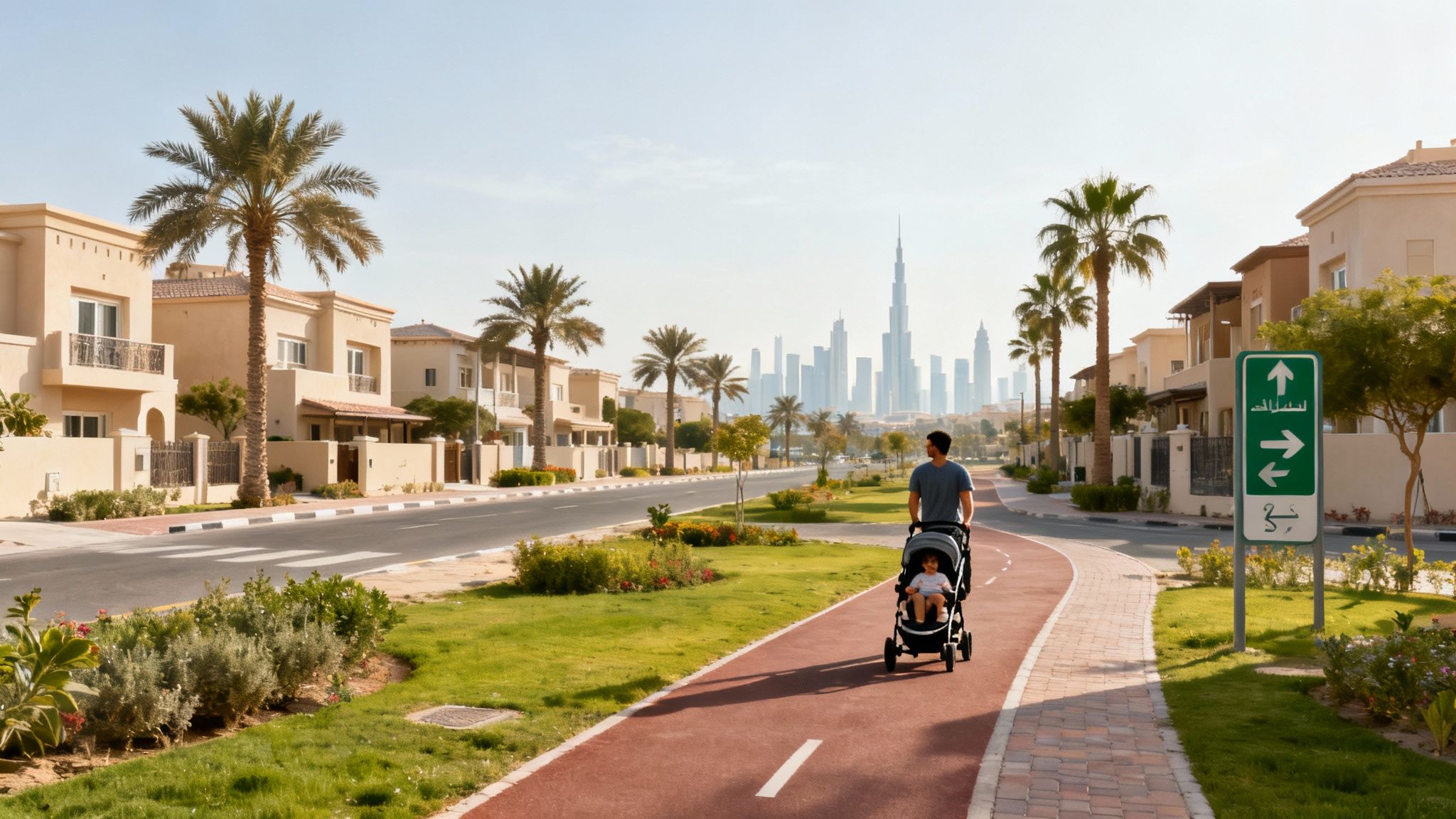
Choosing where to live in Dubai is about so much more than just finding an apartment or a villa—it's about picking your lifestyle. Every neighborhood has its own unique personality, and where you land will shape everything from your daily commute to your social life and your overall experience of the city.
Think of Dubai as a collection of interconnected villages, each with its own distinct flavor. Finding your perfect match really comes down to your priorities. Are you a young professional who wants a buzzing social scene right outside your front door? Or a family on the hunt for quiet green spaces and great schools?
This decision really sets the stage for your entire life in Dubai, so it's worth taking the time to understand what each community offers before you dive into a property search.
Lifestyles From Skyscraper To Suburb
Dubai's neighborhoods offer a whole spectrum of living options. From the high-energy pulse of waterfront towers to the quiet, tree-lined streets of suburban communities, there's a place for every preference and life stage.
-
For the Young Professional and Socialite: Neighborhoods like Dubai Marina and Downtown Dubai are the city's beating heart. Here you'll find sleek high-rise apartments with incredible views, world-class restaurants, a non-stop nightlife, and direct access to the Dubai Metro. These spots are perfect for anyone who wants to be in the middle of all the action.
-
For the Growing Family: If you've got kids in tow, your focus will probably shift to communities like Arabian Ranches or The Springs. These areas are famous for their spacious villas with private gardens, community pools, fantastic international schools, and a much quieter, more suburban vibe.
-
For the Budget-Conscious Expat: Places like Jumeirah Village Circle (JVC) and Dubai Silicon Oasis offer a more affordable way to get settled. They might be a bit further from the city center, but they provide modern apartments and a strong sense of community at a much more accessible price point.
Navigating The Rental Market
The city's incredible growth has put some serious pressure on the housing market. For every 470 new residents arriving in Dubai, only about 150 new homes are built each day. This creates a supply-and-demand squeeze that keeps the rental market pretty competitive. You can get a deeper dive into how Dubai's population growth impacts housing from Khaleej Times.
Understanding the rental process is key to a smooth transition. Unlike many Western countries where rent is paid monthly, the standard in Dubai is to pay for the entire year upfront, typically with a series of post-dated cheques.
This system can be a bit of a shock for newcomers, so it's crucial to have your finances sorted before you start looking. Here's a quick rundown of the key steps and terms you'll come across:
- Find a Registered Agent: Only work with a RERA (Real Estate Regulatory Agency) certified agent to find properties and handle the paperwork.
- Sign the Tenancy Contract: This is your official lease agreement. Make sure you read every single line before you sign it.
- Provide Post-Dated Cheques: You'll usually need to give your landlord between one and four cheques to cover the full year's rent.
- Register with Ejari: Your tenancy contract absolutely must be registered with Ejari, the government's online portal. This legally protects both you and the landlord and is required before you can set up your utilities (DEWA).
Popular Dubai Neighborhoods for Expats
To help you get started and narrow down your options, we've put together a quick comparison of some of the most popular communities for expats living in Dubai.
| Neighborhood | Best For | Average Rent (1-Bed Apt) | Key Features |
|---|---|---|---|
| Dubai Marina | Young Professionals, Singles | $27,000 - $40,000 USD/year | Waterfront living, nightlife, restaurants, Metro access. |
| Downtown Dubai | Luxury Seekers, Couples | $35,000 - $50,000 USD/year | Home to Burj Khalifa & Dubai Mall, urban buzz, premium amenities. |
| Arabian Ranches | Families with Children | $20,000 - $30,000 USD/year (Apt) | Gated community, spacious villas, golf course, top schools. |
| JVC | Budget-Conscious Residents | $15,000 - $22,000 USD/year | Affordable, modern apartments, growing community feel. |
Choosing the right neighborhood is a huge first step in building your new life. By making sure your location lines up with your lifestyle and budget, you can set yourself up for a comfortable and enjoyable experience living in Dubai right from day one.
Navigating Healthcare and Insurance
When you're sorting out your move to Dubai, there's one thing you absolutely can't put on the back burner: health insurance. This isn't just a nice-to-have safety net; it's a non-negotiable legal requirement for every single resident.
The government has baked this into the system, directly linking your health coverage to your visa application. Bottom line: you can't get or renew your residency visa without proving you have a valid, compliant health insurance policy.
This whole setup is designed to make sure everyone in Dubai can access the city's top-notch healthcare facilities without the risk of facing astronomical medical bills. For most expats, your employer is legally on the hook to provide a basic health plan, but be warned—"basic" might not be enough for you and your family.
Understanding Your Coverage Options
Think of the insurance plan provided by your employer as your starting point. The quality of these plans can vary wildly. Some companies offer fantastic, comprehensive packages that cover just about everything, while others provide only the bare minimum required by law. It's up to you to dig into the policy details and figure out if you need to upgrade or buy a separate, more robust plan.
When you're looking at a policy, here are the big things to check:
- Network of Hospitals: Which hospitals and clinics are you actually allowed to visit? Make sure your preferred doctors and facilities are on the list to avoid getting stung with massive "out-of-network" fees.
- Co-payments and Deductibles: How much are you paying out-of-pocket for each visit or procedure? A plan with a lower monthly premium often comes with higher co-pays.
- Specific Coverage Needs: Does the plan cover things like dental, vision, or maternity care? These are often left out of basic plans and usually require a more premium policy.
Choosing the right insurance is easily one of the most critical decisions you'll make for your life in Dubai. It determines your access to care and gives you incredible peace of mind, ensuring you're ready for whatever health challenges come your way.
Public vs. Private Healthcare Facilities
Dubai runs a two-tiered healthcare system, giving residents both public and private options. Both are known for their high standards, but they serve different needs and budgets.
Public Hospitals: These facilities, run by the Dubai Health Authority (DHA), are well-equipped and staffed by highly trained medical professionals. They're often the more affordable choice, especially for major procedures. The trade-off? You might face longer wait times for non-emergency appointments.
Private Hospitals: This is where you'll find the premium, almost hotel-like, healthcare experience. Expect shorter wait times, private rooms, and a massive roster of specialist doctors. Of course, this luxury comes at a significantly higher cost, which makes solid insurance an absolute must. For their convenience and service, most expats lean towards private facilities.
Ultimately, the insurance plan you choose will dictate which of these facilities you can comfortably use. For anyone seeking broader protection, it pays to shop around. Getting a handle on health insurance for expats can help you compare international plans that offer coverage not just in Dubai, but around the world. Taking the time to find a policy that fits your lifestyle is a crucial step in setting up a secure and healthy life abroad.
Understanding Daily Life and Local Culture
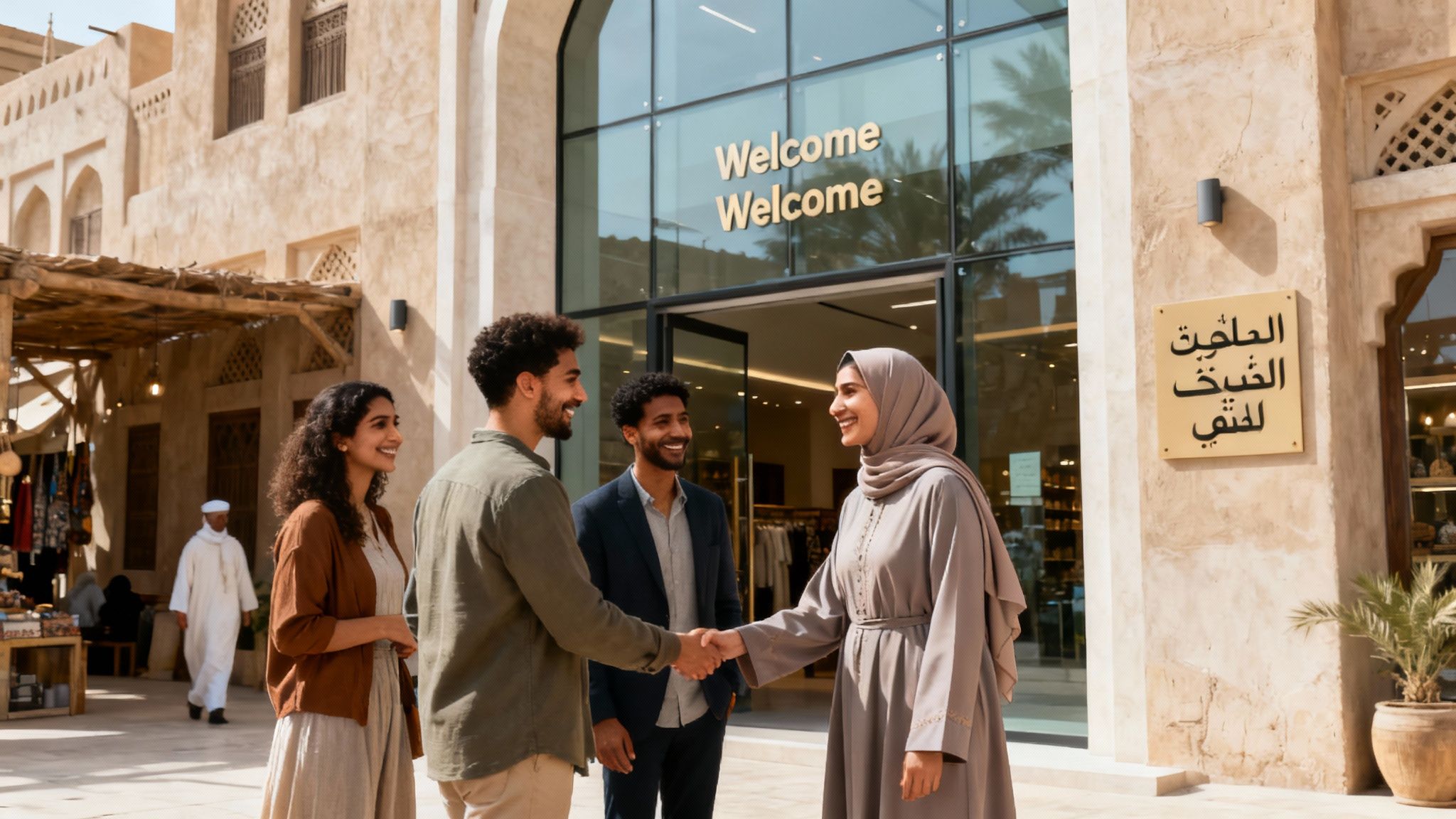
To really settle into Dubai, you have to get a feel for its unique rhythm. It's a fascinating place where deeply rooted Islamic traditions meet a fast-paced, international mindset. Sure, it's a global business hub where English gets you by everywhere, but the city's heart still beats to the customs of the UAE.
This blend makes daily life both incredibly convenient and culturally rich. Getting a handle on local etiquette isn't about memorizing a rulebook; it's about showing respect and making your integration into the community that much smoother. It's what helps you go from feeling like a visitor to truly feeling at home in this remarkable city.
Embracing Social Etiquette and Dress Code
Dubai is more tolerant than many people expect, but that tolerance is built on a foundation of respect for local customs. This is most obvious when it comes to dress and how people conduct themselves in public. While you'll see every fashion imaginable in the sprawling malls, a general principle of modesty is always your best bet.
Think of it as simply dressing for the occasion. Inside a private resort or at a beach club, swimwear is completely normal. But if you're heading to a government office, a traditional souk, or even just the mall, it's a good sign of respect for both men and women to cover their shoulders and knees. This small gesture shows you're considerate of the local culture.
The core idea is simple: respectful awareness. It's not about strict rules being enforced at every turn, but about acknowledging you are a guest in a country with its own cultural values. That little bit of effort goes a very long way in building positive relationships.
Navigating Local Laws and Public Conduct
The secret to Dubai's incredible safety record? Clear laws that are taken very seriously. For any expat, getting to know these rules is crucial for a smooth and happy life here. The legal framework is based on Sharia law, and some behaviors that are commonplace elsewhere simply aren't permitted.
A few key things to keep in mind:
- Public Displays of Affection: Holding hands is generally fine for married couples, but anything more is best saved for private settings.
- Alcohol Consumption: You can find alcohol, but only in licensed places like hotels, restaurants, and clubs. Being intoxicated in public is a serious offense, and there is an absolute zero-tolerance policy for drinking and driving.
- Respect During Ramadan: The holy month of Ramadan is a time of fasting and prayer. During fasting hours (sunrise to sunset), it's prohibited to eat, drink, or smoke in public spaces as a sign of respect for those who are fasting.
These rules aren't there to make life difficult; they exist to maintain public order and uphold cultural norms. Following them is just a fundamental part of living in Dubai.
Understanding the Work Week and Pace of Life
Dubai has shifted its work week to better align with global markets, now running from Monday to Friday. Friday is the traditional day of worship, so you'll find the workday usually wraps up around noon to allow time for prayers. It's a perfect example of the city's practical approach to blending international business needs with local traditions.
The pace of life feels energetic and efficient, but there's also a strong emphasis on family and social connections that balances it all out. Business relationships are often built on personal trust, so don't be surprised if a meeting starts with a polite chat about your family—it's a common and appreciated gesture.
Why Dubai Is One of the Safest Cities
One of the biggest draws for expats—especially families—is Dubai's reputation for being incredibly safe. The city consistently ranks among the safest in the world. This isn't by chance; it's a direct result of strict laws, a visible and effective police force, and a culture that puts a high value on security.
Violent crime is virtually unheard of, and it's common to hear residents talk about how safe they feel walking around alone, even late at night. This profound sense of security is a cornerstone of the high quality of life that attracts millions from all over the globe, allowing everyone to enjoy the city's amazing amenities with complete peace of mind.
Your Top Questions About Moving to Dubai, Answered
Making a move to a new country always sparks a ton of questions. To help you feel more prepared for the adventure of a lifetime in Dubai, we've put together some quick, straightforward answers to the things most prospective expats wonder about. Think of this as filling in the last few gaps so you can move forward with confidence.
Can You Get a Residency Visa Without a Job Offer?
Yes, absolutely. While having a company sponsor your visa is the most beaten path, it's far from the only one. Dubai has rolled out several other options to attract investors, freelancers, and other talented people who want to call the city home.
These alternative visas give you a lot more freedom and control.
- The Golden Visa: This is a long-term residency visa, usually for 10 years. It's aimed at investors, entrepreneurs, and people with exceptional talents in fields like science, art, and technology. It does require a hefty financial investment or a proven track record of incredible work.
- The Green Visa: A great option for skilled professionals, freelancers, and the self-employed. This visa lets you sponsor yourself for five years, meaning you don't need an employer or a UAE national to back you.
- Starting Your Own Company: Another popular route is to set up your own business in one of Dubai's many free zones. Once you do that, your new company can sponsor you, putting you in the driver's seat of your residency status.
What's the Schooling Situation for Expat Kids?
Dubai is famous for its massive selection of private international schools, which are set up specifically for its huge expat population. The education system is incredibly diverse, with schools offering curriculums from all over the world. This makes it much easier for kids to transition if your family ever moves again.
The most popular options you'll find are:
- British: Follows the UK system, leading to IGCSEs and A-Levels.
- American: Offers the US High School Diploma and Advanced Placement (AP) courses.
- International Baccalaureate (IB): A globally respected program known for its academic rigor.
It's impossible to overstate this: school fees are a major part of any family's budget in Dubai. Annual tuition can easily run from $10,000 to over $25,000 USD per child. This cost has to be a central piece of your financial planning and any salary negotiations. The best schools often have long waiting lists, so it's smart to start your research and applications long before you plan to move.
Do I Need to Speak Arabic to Get By?
While Arabic is the official language of the UAE, you don't need to be fluent to live and work comfortably in Dubai. English is the common tongue for business, shopping, and just about everything in daily life.
Because the city is such a melting pot, you'll see that all road signs, restaurant menus, and government services are available in both English and Arabic. That said, learning a few basic Arabic phrases is a fantastic way to show respect for the local culture. Simple greetings like 'Marhaba' (Hello) or a quick 'Shukran' (Thank you) are always appreciated and go a long way in building connections.
Is It Possible to Bring My Pets?
You bet! Plenty of expats bring their beloved pets with them to Dubai. The process, however, is very specific and requires a good bit of planning to make sure your furry family members have a smooth journey.
The UAE has strict rules for importing animals to protect public health, so you'll need to follow a precise set of steps. For anyone thinking about relocating your pet to Dubai, having a solid checklist is a lifesaver. Generally, this involves microchipping, getting all the right vaccinations, securing a pet passport, and obtaining an import permit. Many people find that working with a professional pet relocation service makes the whole thing far less stressful.
Navigating life in a new country comes with unique challenges, especially when it comes to healthcare. At Expat Insurance, we specialize in finding the right international health insurance plan to protect you and your family, no matter where your adventures take you. Compare plans from over 65 insurers and get a quote in just 24 hours. Learn more and secure your peace of mind at https://www.expatinsurance.com.
