

February 7, 2026
•
5 min read
Portugal Retirement Visa Requirements: A Complete Guide
Learn the Portugal retirement visa requirements for 2026, including D7 visa income thresholds, document checklists, and health insurance tips for a smooth move.
Justin Barsketis
Insurance Expert
Picture this: Waking up to the warm Algarve sun, sipping coffee on your balcony, and knowing that a day of exploring historic European cities awaits. This isn't just a daydream; it's a very achievable reality for many retirees, and it all starts with understanding the Portugal retirement visa requirements.
For most non-EU citizens, the main path to this lifestyle is the D7 Visa, often called the Passive Income Visa.
Your Path to Retiring in Portugal Starts Here

The idea of retiring in Portugal often brings to mind golden beaches and easy afternoons. While that life is absolutely within reach, getting there requires a plan. Think of this guide as your personal roadmap, built to turn the tangled visa process into a series of clear, manageable steps.
We're going to zero in on the three pillars of a successful D7 visa application:
- Demonstrating Stable Passive Income: You'll need to prove you have a steady income from sources like pensions, rentals, or investments - enough to support yourself without needing to work in Portugal.
- Securing Compliant Health Insurance: Portugal requires you to have private health coverage that meets their standards for your initial stay.
- Gathering the Right Paperwork: This is all about putting together a perfect, complete file of all the personal and financial documents they ask for.
What Is the D7 Passive Income Visa?
Think of the D7 Visa as Portugal's official welcome mat for anyone who is financially self-sufficient. It's not about having a huge bank account; it's about the consistency of the money that comes in every month without you having to actively work for it. That's the heart of "passive income."
Portugal's D7 has become the go-to choice for retirees from places like the US, UK, and Canada looking for a secure base in the EU. To qualify, you need to show proof of a stable passive income that's more than €920 per month for a single person. That's roughly $970 USD, depending on the day's exchange rate. If you're curious about visa trends, Global Citizen Solutions offers some great data-driven insights.
This visa is specifically for non-EU/EEA/Swiss citizens. Its popularity is no surprise, given Portugal's incredible quality of life, excellent healthcare, and a cost of living that's refreshingly low compared to other Western European countries.
The D7 Visa is your key to unlocking long-term residency. It's not just an entry ticket; it's the first step on the path toward permanent residency and even citizenship after five years of legal residence. (Note: Portugal is currently considering legislation that could extend this timeline to ten years. Check with an immigration attorney for the latest updates.)
To give you a quick snapshot, here are the core requirements in one place.
Portugal D7 Retirement Visa at a Glance
| Requirement Category | Key Details for a Single Applicant |
|---|---|
| Minimum Passive Income | €920 per month (100% of the Portuguese minimum wage) |
| Proof of Funds | Recommended €11,040 in a Portuguese bank account |
| Accommodation | Proof of a 12-month lease or property ownership in Portugal |
| Health Insurance | Private policy with at least €30,000 coverage |
| Criminal Record Check | Clean record from your home country and any country you've lived in for over a year |
| NIF Number | A Portuguese tax identification number is required |
This table provides a high-level overview, but we'll dive deeper into each of these elements throughout this guide.
Getting this framework right is crucial. By breaking down the Portugal retirement visa requirements into these core parts, we can tackle them one by one. This approach cuts through the confusion, reduces that feeling of being overwhelmed, and brings your dream of retiring in Portugal into sharp focus. Suddenly, it feels less like a fantasy and more like a plan.
Understanding the Passive Income Requirement

Here's the bottom line: the single most important part of your retirement visa application is proving you have enough passive income. Think of this as the bedrock of your entire case. Portuguese authorities need to see, in black and white, that you can support yourself comfortably without ever needing to find a job in Portugal.
But what does "passive" actually mean in this context? It's simply money that shows up in your account regularly without you having to actively work for it day-to-day. This isn't about having a giant nest egg sitting in the bank; it's about demonstrating a consistent, reliable flow of cash. It's this stability that immigration officials are really looking for.
Defining Acceptable Passive Income Sources
So, what kind of income qualifies? The Portuguese government is pretty clear on what they'll accept for the D7 visa. Your job is to pull together the paperwork for one - or even better, several - of these income streams to paint a clear picture of your financial health.
Commonly accepted sources include:
- Pensions and Social Security: This is the go-to for many retirees. Official statements showing your monthly or annual benefits are perfect.
- Rental Income: If you own properties that generate rent, you're in a great position. You'll just need your lease agreements and bank statements showing those deposits hitting your account.
- Investment Dividends and Interest: Got a solid portfolio? Income from stocks, bonds, and other investments absolutely qualifies. Your portfolio statements showing regular payouts are what you'll need.
- Royalties: Income from intellectual property, like a book you wrote or a patent you own, is also considered passive.
The key here is predictability. Cashing out a big stock holding one time won't cut it. They need to see a pattern of reliable payments that you can count on month after month.
The core idea is self-sufficiency. Your financial documents need to tell a simple, convincing story: "I have a stable, recurring income that allows me to live in Portugal without becoming a financial burden on the state."
Meeting the Minimum Financial Thresholds
Portugal ties its income requirements to its national minimum wage, known as the salário mínimo nacional. This number gets updated annually, so it's always a good idea to double-check for the latest figures right before you apply.
As of 2026, here are the monthly minimums you need to show:
- Main Applicant: 100% of the minimum wage (which is currently €920 per month).
- Spouse or Partner: An additional 50% of that amount (an extra €460 per month).
- Dependent Children: An extra 30% of that amount for each child (an extra €276 per month).
Let's put that into a real-world scenario.
A retired couple applying together would need to prove a combined monthly passive income of at least €1,380 (€920 for the first person + €460 for the second). That comes out to €16,560 for the year.
Proving Your Financial Stability
Meeting that monthly income number is step one. Step two is showing you have the funds to hit the ground running when you arrive. This is where opening a Portuguese bank account becomes a game-changer.
While there isn't an official law stating you must do this, the accepted best practice - and what we see succeed time and again - is to deposit at least a year's worth of the required income into your new Portuguese bank account. This one move is a powerful signal of your commitment and financial readiness.
| Applicant(s) | Minimum Monthly Passive Income | Recommended Bank Deposit (12x Monthly) |
|---|---|---|
| Single Applicant | €920 | €11,040 |
| A Couple | €1,380 | €16,560 |
| A Couple + 1 Child | €1,656 | €19,872 |
Making this deposit tells the consulate you're not just dreaming about moving; you're prepared. It shows you've taken concrete steps and have the cash to cover your living expenses for the first year, which massively strengthens your application. At the end of the day, meeting the Portugal retirement visa requirements isn't just about the numbers, but about presenting a complete picture of financial responsibility.
Assembling Your Essential Document Checklist
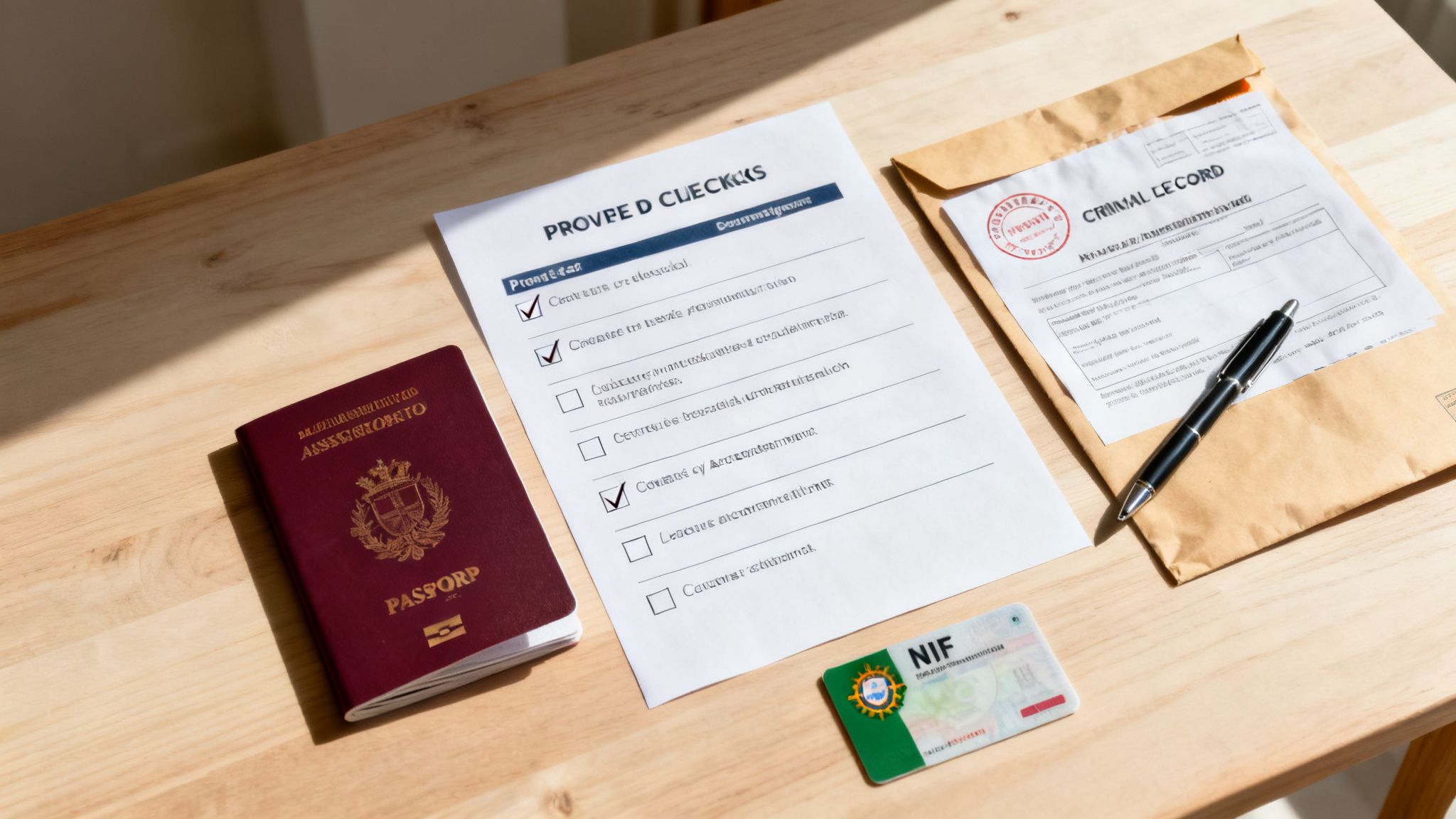
Tackling the paperwork for any visa can feel like you're prepping for a major expedition. Every single document is a crucial piece of gear, and you absolutely can't leave anything behind. Let's break down this daunting task into a simple, manageable checklist.
Think of your application as a big puzzle. If even one piece is missing or doesn't quite fit, the whole picture falls apart. Portuguese consular officials look at hundreds of these, so a perfectly organized, complete file makes their job easier and your approval that much more likely.
Core Personal and Legal Documents
First up, let's get the foundational paperwork together. These are the non-negotiables that prove who you are and where you're coming from.
-
Valid Passport: This is obvious, but the details matter. Your passport must be valid for at least six months beyond the visa's duration, and make sure you have at least two blank pages for the shiny new visa stamp.
-
Passport-Sized Photos: You'll need two recent, high-quality color photos. They have to meet the Schengen visa specifications, which usually means a clear shot of your face against a plain white background.
-
Completed Visa Application Form: This is the official D7 application. Fill it out completely and honestly. Double-check for any typos or missing information before you even think about submitting it.
-
Criminal Record Check: You'll have to provide a clean criminal record certificate from your home country, or from any country where you've lived for more than a year. This document usually needs an apostille to be considered valid in Portugal.
What's an apostille? It's basically an official sticker or stamp that authenticates a public document for international use. Think of it as a notarization that's recognized globally, making your criminal record check legitimate in the eyes of the Portuguese government.
Getting this first batch of documents sorted establishes your identity and confirms you meet the baseline legal requirements to be considered for residency.
Financial and Accommodation Proof
Next up are the two big ones: proving you can support yourself financially and showing you have a place to live. This is where you demonstrate to Portugal that you can enjoy your retirement without becoming a financial burden on the state.
Your financial stability is shown through a few key documents:
- Proof of Passive Income: Start gathering official statements for your pensions, Social Security, investment dividends, or real estate rental income. You'll need at least six months' worth of bank statements to show this consistent flow of funds.
- Portuguese Bank Account Statement: As we talked about, having a Portuguese bank account with a balance of at least €11,040 for a single applicant sends a very strong signal that you're financially prepared.
- NIF (Número de Identificação Fiscal): This is your Portuguese tax ID number. You can't open a bank account or sign a lease without it, making it one of the very first things you need to get.
Once your finances are in order, you need to prove you have a roof over your head.
- Proof of Accommodation: This can be a signed 12-month lease (the most common and convincing option), the deed to a property you've bought, or an official letter of invitation from a legal resident in Portugal.
A long-term lease is your best bet. It shows a genuine commitment to living in the country and is a cornerstone of a successful application.
Health and Travel Documentation
The final pile of paperwork deals with your health coverage and travel plans. The Portuguese authorities need to know you won't face a medical emergency you can't pay for.
-
Valid Health Insurance Policy: You must have proof of a private health insurance plan with a minimum coverage of €30,000. The policy needs to be valid for international travel and specifically cover you in Portugal. If you're sorting through your options, working with a dedicated brokerage for international health insurance can simplify the process of finding a compliant plan.
-
Travel Itinerary: You don't need to buy a non-refundable ticket yet, but you do need a flight reservation showing your intended travel dates to Portugal.
-
Letter of Intent: This is your chance to speak directly to the consular officer. Write a personal, sincere letter explaining why you want to retire in Portugal. Keep it concise, outline your motivations, and make it clear you understand you won't be seeking employment.
By methodically collecting every item on this list, you're not just submitting papers; you're building a compelling, bulletproof case for your new life in Portugal. Each document has a specific job, and together, they tell a story of a well-prepared and serious applicant.
Navigating the Health Insurance Requirement
Securing the right health insurance is a non-negotiable step for your Portugal retirement visa. This is about giving Portuguese authorities the confidence that you can cover your own medical needs without burdening their public system before your residency is official.
It's also your key to peace of mind as you start your new life.
One of the most common places applicants get tripped up is the insurance requirement itself. Many people don't realize there are actually two different types of insurance needed at two different stages of the game.
The Two-Phase Insurance Strategy
Think of it like packing for a two-part trip. For the first leg (your visa appointment at the consulate) you just need a basic ticket to get on the plane. But for the second leg (actually living in Portugal) you need a full-access pass for your long-term stay.
Phase 1: Travel Insurance for Your Visa Application This is the policy you'll show at your initial appointment, likely at a VFS Global center or your local Portuguese consulate. It's a short-term fix designed to meet the immediate entry rules.
- Coverage Amount: The plan must offer at least €30,000 in medical coverage.
- Geographic Scope: It has to be valid for the entire Schengen Area, not just Portugal.
- Purpose: Its main job is to prove you won't be a liability the moment you land. It covers emergencies and potential repatriation costs during your initial travel.
Phase 2: Comprehensive Health Insurance for Residency Once you're in Portugal and have your appointment with AIMA (the Agency for Integration, Migration, and Asylum), you need to level up. This is where you present proof of a real, long-term health insurance policy. This plan will be your primary coverage until you're fully registered in Portugal's national health service, the SNS.
Showing up to your AIMA meeting with only a basic travel policy is a classic mistake that causes serious delays. They expect to see a proper Portuguese or international health plan.
What to Look for in a Compliant Health Plan
When picking your long-term insurance, you need a plan that not only satisfies the Portugal retirement visa requirements but also gives you practical, real-world coverage. This is where a specialized brokerage can be a huge help, letting you compare compliant plans from top insurers to find the perfect fit.
A good plan should have these key features:
- Full In-Country Coverage: The policy must explicitly cover you within Portugal for both inpatient (hospital stays) and outpatient (doctor visits, labs) care.
- Sufficient Duration: Make sure the plan covers you for at least the first full year of your residency.
- Reputable Insurer: Stick with a well-known provider that Portuguese authorities will recognize instantly.
For many retirees, this approach offers the best of both worlds. While Portugal's public healthcare (the SNS) is excellent, a private plan gives you faster access to specialists and English-speaking doctors. To learn more about your options, check out our guide on the best health insurance for expats and our guide on international health insurance for retirees. Private insurance is a great way to supplement the public system, where retirees over 65 often pay just nominal fees (think €4.50-€18 per consultation) while your private plan fills any gaps.
Why a Broker Simplifies the Process
Let's be honest: sorting through international health insurance options on your own is a headache. The policy documents are dense with jargon, and it's tough to know which plans AIMA will actually accept.
This is where working with a specialized brokerage like Expat Insurance makes a real difference.
Instead of you spending countless hours digging through dozens of insurance company websites, a broker does all the heavy lifting. They already know the specific documentation AIMA requires and can show you a curated list of pre-vetted, compliant options. This approach saves a ton of time, removes the guesswork, and makes sure one of the most critical pieces of your application is handled correctly from the start.
The Application Journey: From Submission to Your New Life in Portugal
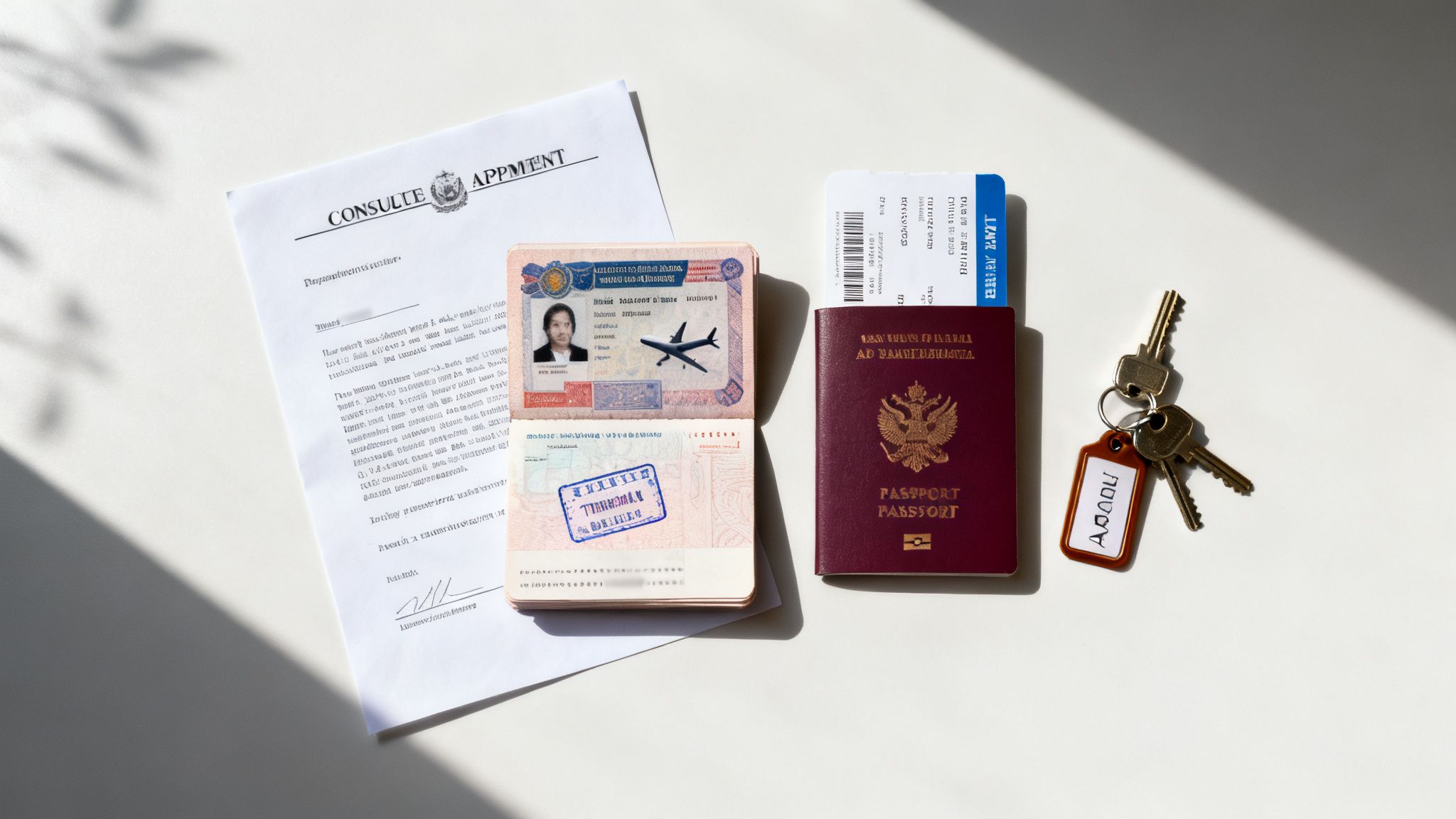
Getting your retirement visa isn't a single event - it's a multi-step process with several important milestones along the way. Knowing the route ahead of time is the secret to a stress-free transition to Portugal.
The whole process unfolds in four distinct phases. Let's break down each one so you know exactly what to expect.
Phase 1: The Consulate Appointment
This is where all your hard work gathering documents pays off. You'll head to the designated Portuguese consulate or VFS Global center in your home country to submit your complete application package, from your proof of income and criminal background check to your health insurance policy.
Once you've handed everything over, the waiting game begins. Consular processing times can be a bit of a moving target depending on where you are and the time of year, but you should generally budget for 60 to 90 days. During this period, officials will carefully review every document to make sure you meet all the requirements.
Phase 2: Receiving Your Temporary Visa
Once your application gets the green light, you'll be asked to send in your passport. The consulate will then place a temporary D7 visa stamp inside - a huge milestone! This stamp is your golden ticket to enter Portugal with the intent to establish residency.
This temporary visa is typically valid for 120 days, giving you a generous window to book your flights and get ready for the big move. When you get your passport back, it will have this stamp inside, along with the details for your all-important residency appointment in Portugal.
It's crucial to understand that this initial stamp is not your residency card. It's a temporary travel visa that allows you to enter the country and attend the final, most important meeting of the process.
Phase 3: Arrival in Portugal and the AIMA Appointment
With your temporary visa secured, it's time to fly to Portugal! After you land and get settled, your main priority is attending your scheduled appointment with AIMA (Agency for Integration, Migration, and Asylum), the government body that issues residency permits.
At this meeting, you'll present the original copies of all the documents you submitted back home, plus a few new ones like proof of your Portuguese address. They will also take your biometric data (fingerprints and a photo) for your official residency card.
If you want extra peace of mind, having an experienced immigration attorney on your side can help. Our moving abroad checklist is also a great resource for keeping track of everything you need to do before and after your move.
Phase 4: Getting Your Residency Card
After a successful AIMA appointment, you've officially cleared the final hurdle. The only thing left to do is wait for your official residency card, the Título de Residência, to be printed and mailed to your address in Portugal. This can take anywhere from a few weeks to a couple of months.
This visa program typically grants an initial temporary residence permit valid for two years. After that, it can be renewed for another three years, putting you on a clear five-year path toward permanent residency. (Keep in mind: Portugal is currently considering legislation that could extend the residency requirement for citizenship from five to ten years, so confirm the latest rules with an immigration professional.) This card is the ultimate prize, making you an official resident of Portugal. You can also read our detailed guide on how to retire in Portugal for more insights.
Financial Planning for Your New Life in Portugal
Getting the paperwork right is only half the battle. A truly successful move to Portugal hinges on smart financial planning. Figuring out the full cost of retiring - from the application fees all the way to your daily budget - is what ensures your new life isn't just a dream, but a sustainable reality for years to come. Solid retirement planning is the foundation you're building your new Portuguese home on.
This means looking beyond the bare minimum income requirements. You need a realistic budget that accounts for visa fees, potential legal help, and the initial funds you'll have to park in a Portuguese bank account. When consular officials see you have a solid financial footing, it gives them confidence in your application - and it gives you priceless peace of mind.
Understanding the Total Cost of Relocating
The upfront costs can stack up quickly, and they go well beyond the visa application fee itself. You'll need to budget for things like getting documents legalized (those official apostilles), translation services, and consultation fees if you decide to bring an immigration lawyer on board.
Opening a Portuguese bank account is a non-negotiable step. In our experience, the most successful applicants go the extra mile here. They deposit at least 12 months' worth of the required minimum income to really drive home their financial stability. For a single person, that's over €11,040. Taking this one action is one of the most powerful signals you can send to the Portuguese authorities that you are serious and well-prepared.
Understanding Portugal's Tax Landscape for Retirees
If you're planning to retire in Portugal, it's worth understanding how taxation works for new residents. Portugal used to offer a program called the Non-Habitual Resident (NHR) tax regime, which gave retirees a flat 10% tax rate on foreign pension income. That program closed to new applicants in early 2024.
The replacement, called the IFICI (or NHR 2.0), is designed for highly qualified professionals in fields like science, technology, and innovation. It offers a 20% flat tax on qualifying Portuguese income, but it does not provide special tax treatment for pension income. This means retirees arriving in 2026 will generally be taxed on their worldwide income at Portugal's standard progressive rates, which range from 14.5% to 48%.
That said, Portugal's cost of living is significantly lower than most of the US and Western Europe, and many retirees find their money stretches much further even without special tax incentives. Portugal also has tax treaties with many countries (including the US) that help prevent double taxation.
Tax rules change frequently, and your individual situation matters a lot. We strongly recommend consulting a Portuguese tax advisor before your move to understand exactly how your pension, Social Security, and investment income will be taxed.
Creating a Realistic Cost of Living Budget
What you spend day-to-day in Portugal will really depend on where you plant your flag and the kind of lifestyle you want. Life in a vibrant, bustling city like Lisbon is naturally going to be more expensive than in the sun-drenched, laid-back towns of the Algarve or the historic city of Coimbra.
- Major Cities (Lisbon, Porto): Brace yourself for higher rent and dining costs. A couple could expect to budget somewhere between €2,000 to €3,500 per month for a comfortable lifestyle.
- The Algarve & Smaller Towns: Your money goes a lot further here. A couple could live quite well on €1,500 to €2,000 per month.
A key piece of this puzzle is understanding how your Social Security benefits work while living abroad. Once you have that figured out, you can start digging into the details. By researching rental prices, grocery bills, and utility costs in the specific areas you're interested in, you can build a budget that proves your passive income will more than cover your needs.
Got Questions About the Portugal Retirement Visa?
As you start putting the pieces together for your move, a few questions always seem to pop up. Getting straight answers to these common queries will help you move forward with confidence, making sure there are no surprises down the road.
Let's tackle some of the things people ask most often.
Can I Still Work on a D7 Retirement Visa?
This is a big one. While the D7 visa is built on the foundation of your passive income, it doesn't chain you to a rocking chair. The main rule is simple: you can't be an employee of a Portuguese company.
However, you generally have the green light to work as a freelancer or a self-employed professional. This is fantastic news for retirees who want to keep a hand in with some part-time consulting or continue remote work they were already doing.
The key thing to remember is that your application must stand on its own two feet with stable, sufficient passive income. The ability to do some freelance work is a bonus, not the basis of your visa.
Is Speaking Portuguese a Requirement?
Good news for English speakers: no, there is no language requirement to get your initial D7 visa or your first residency permit. This makes the first step of your move far more accessible.
That said, it's smart to look ahead. If you fall in love with Portugal (and you probably will) and decide to apply for permanent residency after five years, you'll need to show you have an A2 level of Portuguese.
Besides the legal requirements, learning the language is the best way to truly connect with your new home and handle daily life with ease.
What Happens if My Visa Gets Rejected?
Seeing a rejection notice is discouraging, but it's not always the end of the line. Most of the time, denials happen for predictable reasons, like not providing enough proof of your passive income or simply submitting an incomplete application.
The consulate will tell you why they made their decision. You might have the option to appeal, but it's often faster and more effective to just fix the problems they pointed out and re-apply with a much stronger, more organized package. This really underscores how important it is to get every single detail right the first time.
Portugal continues to attract retirees from around the world, drawn by its well-earned reputation as one of the safest and most welcoming places to spend your retirement years. You can dig into the numbers yourself with these in-depth reports on Portuguese visa statistics.
Planning a move to Portugal involves a lot of moving parts, and healthcare is one you can't afford to get wrong. Expat Insurance takes the headache out of finding a compliant international health insurance plan. We let you compare options from over 65 insurers to find the perfect fit for your needs and budget. Get a free quote today and make sure you're covered from day one.
Justin Barsketis
Insurance Expert & Writer
Justin is an insurance guru that loves digital marketing. As our founder Justin manages our business development programs and MGA network. Please don’t hesitate to contact him if you are not getting the attention you deserve.
