
January 9, 2026
•
5 min read
Your Guide to Social Security Benefits Living Abroad
Unlock your Social Security benefits living abroad. This guide covers eligibility, payments, taxes, and how to apply for your US benefits from anywhere.
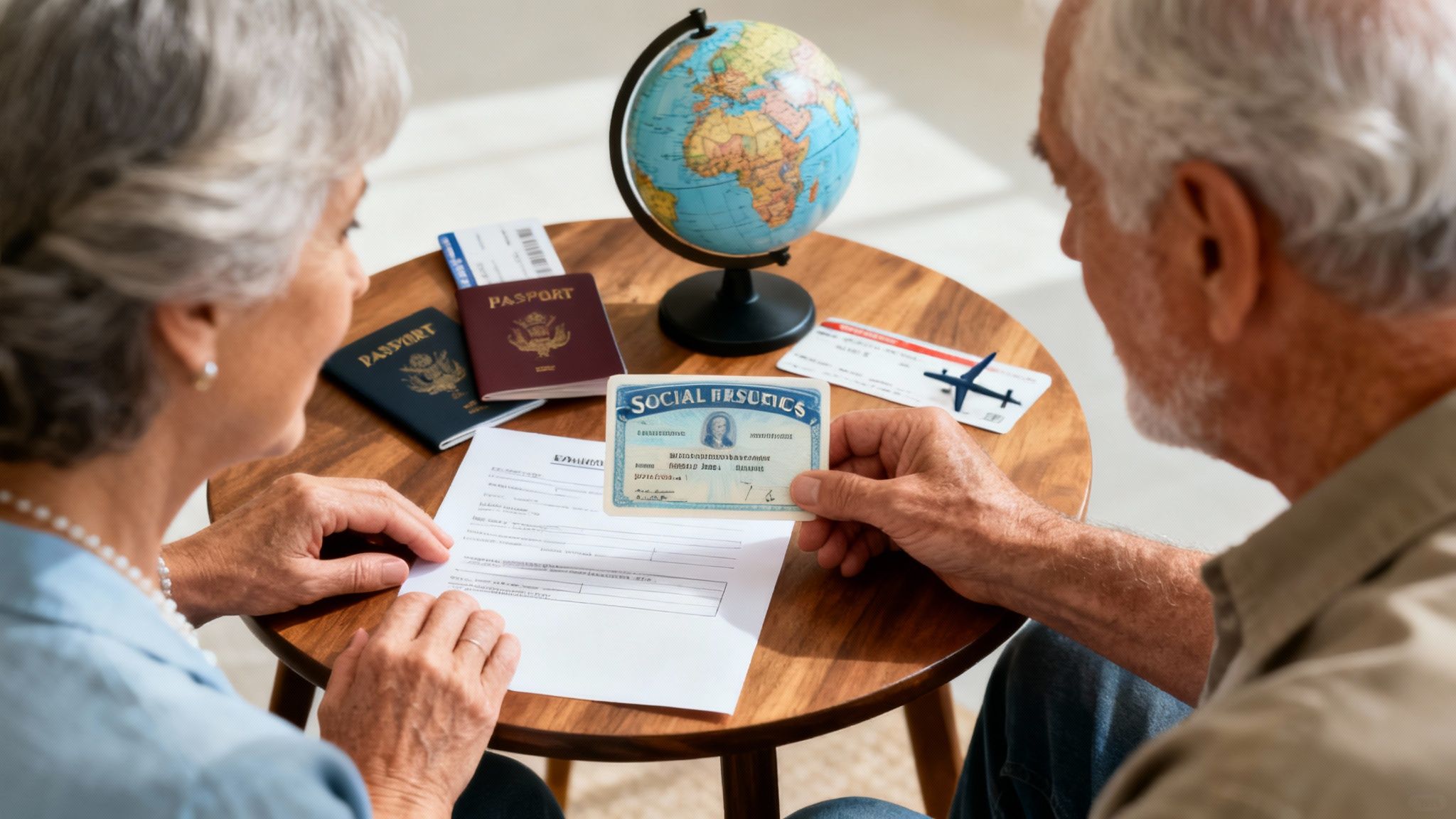
Thinking about retiring abroad? Picturing yourself sipping coffee in a Parisian café or enjoying a sunset on a beach in Portugal? It's a fantastic dream, and for many Americans, it's becoming a very real possibility. A huge part of making that dream work is figuring out if your hard-earned Social Security benefits can follow you.
The short answer is yes, absolutely. In most cases, you can receive your U.S. Social Security benefits while living in another country. The Social Security Administration (SSA) already sends checks to eligible retirees in over 100 countries. The work you put in to qualify doesn't just disappear when you cross a border.
Your Guide to Receiving Social Security Overseas
Let's break down exactly what this means for your retirement plans. This guide will walk you through the essentials—no jargon, no confusing government-speak—just a clear, straightforward look at how to manage your Social Security from abroad.
The Bedrock of Your Expat Retirement Plan
Think of your Social Security as a portable financial foundation. The rule of thumb for eligibility—earning at least 40 work credits, which is about 10 years of work for most people—is the same whether you're in Des Moines or Lisbon. This gives you a reliable income stream that can make an international retirement far more affordable and take a lot of the financial stress out of the equation.
It's a well-trodden path. In 2023, the SSA paid benefits to roughly 67 million people, with about 50 million of those being retired workers. Out of that massive group, around 450,000 retirees had their payments sent directly overseas. It's a small slice of the pie, but it proves the system is firmly in place for expats.
Key Things to Sort Out Before You Pack Your Bags
While your benefits are portable, it's not quite as simple as just changing your address. There are a few critical details you need to get straight before you make the move. Here's a quick rundown of what to keep on your radar:
- Your Destination Country: The SSA can't send money everywhere. A handful of countries are on a restricted list, usually due to U.S. Treasury sanctions.
- Getting Your Money: You'll need to figure out the best way to receive your payments. Do you want them sent to a U.S. bank account or directly deposited into a foreign one?
- Taxes, Taxes, Taxes: Don't forget Uncle Sam. As a U.S. citizen, you're still on the hook for filing federal taxes on your worldwide income, and that can include a portion of your Social Security benefits.
- The Medicare Question: This is the big one. Your Medicare coverage does not follow you abroad. This is non-negotiable. Securing comprehensive international health insurance is an absolute must.
Here's the most important thing to burn into your memory: Your Social Security checks can travel the world with you, but your U.S. health insurance can't. Your first and most critical step should be arranging for private international health coverage.
To give you a clearer picture, here's a summary of the main points to consider.
Key Factors for Receiving Social Security Abroad at a Glance
| Factor | Key Consideration | What It Means for Expats |
|---|---|---|
| Citizenship Status | Are you a U.S. citizen? A permanent resident? | Eligibility rules can differ significantly based on your citizenship and residency status. |
| Country of Residence | Is the country on the SSA's approved list? | Payments are restricted to certain countries (like Cuba and North Korea). Always verify first. |
| Work Credits | Have you earned the required 40 credits? | Your fundamental eligibility is based on your U.S. work history, regardless of where you live. |
| Tax Obligations | Are you prepared for U.S. tax filing? | Expats must continue to file U.S. taxes, and benefits may be taxable in both the U.S. and your new country. |
| Health Insurance | Do you have private health coverage? | Medicare does not cover you overseas. You will need to purchase a separate international health plan. |
| Payment Method | U.S. bank or foreign bank? | You'll need to set up direct deposit, and currency conversion fees can be a factor with foreign accounts. |
Getting these ducks in a row early will save you a world of headaches later on.
There are also special rules that might come into play, especially concerning your own citizenship status or if you have a foreign spouse who might be eligible for benefits. To really dig into those specifics, check out our detailed guide on Social Security for U.S. expats and their foreign spouses. It will help you build a complete picture of your financial life abroad.
How to Qualify for Your Benefits as an Expat
Think of your Social Security eligibility like a long-term loyalty program from your working days in the States. It's the first thing you need to lock down when building a financial plan for a life abroad. Every year you worked and paid Social Security taxes in the U.S., you were banking "credits" toward your future retirement benefits.
To cash in on those benefits, you need to collect 40 credits. For most of us, that translates to about 10 years of work. The system is designed so you can earn up to four credits each year, and this is the foundation of your eligibility, whether you dream of retiring in Ohio or Italy.
The great news? These credits don't have an expiration date. If you put in seven years in the U.S. before an international assignment took you overseas, those 28 credits are safely waiting for you. You can always add to them later if you come back to the U.S. to work, making sure every bit of your effort counts toward hitting that 40-credit goal.
From Credits to Cash: How Your Benefit Is Calculated
Once you've got your 40 credits in the bag, the Social Security Administration (SSA) gets to work figuring out your actual payment. They don't just glance at your last paycheck; they take a much broader look at your entire career.
The SSA calculates your monthly benefit based on your 35 highest-earning years. They use a process called "indexing" to adjust your past earnings, which basically accounts for changes in average wages over time. This ensures your income from, say, the 1990s is valued fairly against today's standards. If you have fewer than 35 years of U.S. earnings, the SSA plugs in zeros for the missing years, which will pull your average down and reduce your benefit amount.
Your benefit isn't some random number—it's a direct reflection of your lifetime earnings in the U.S. Higher, consistent earnings over 35 years mean a larger monthly payment in retirement. That's a huge piece of the puzzle when you're managing your finances from another country.
This calculation gives you a baseline number, but another massive factor comes into play: when you decide to start taking your benefits.
The Critical Role of Timing Your Claim
Deciding when to file for Social Security is one of the biggest financial calls you'll make as a future expat. It will dramatically impact your monthly payment for the rest of your life.
Here are the key age milestones you need to have on your radar:
- Age 62 (The Earliest You Can Start): You can begin claiming benefits at 62, but there's a catch. Your monthly payment will be permanently cut—by as much as 30%—compared to what you'd get if you waited for your full retirement age.
- Full Retirement Age (FRA): This is the magic number, ranging from 66 to 67 depending on when you were born. If you claim at your FRA, you get 100% of the benefit you've earned.
- Age 70 (The Maximum Payout): Patience pays off here. For every year you delay claiming past your FRA, all the way up to age 70, your benefit grows by about 8%. This strategy locks in the largest possible monthly check.
As more Americans look to live and work abroad, this calculation is becoming a core part of long-term planning. The OECD reported that around 102,000 U.S. citizens emigrated in 2021, a jump of 36% from the year before. Many are working-age expats who keep contributing to Social Security, aiming for that 40-credit mark with the knowledge that they can maximize their benefits down the road. You can explore more about these demographic shifts by reading the full report on social security and immigration.
Navigating Country Restrictions and Payment Logistics
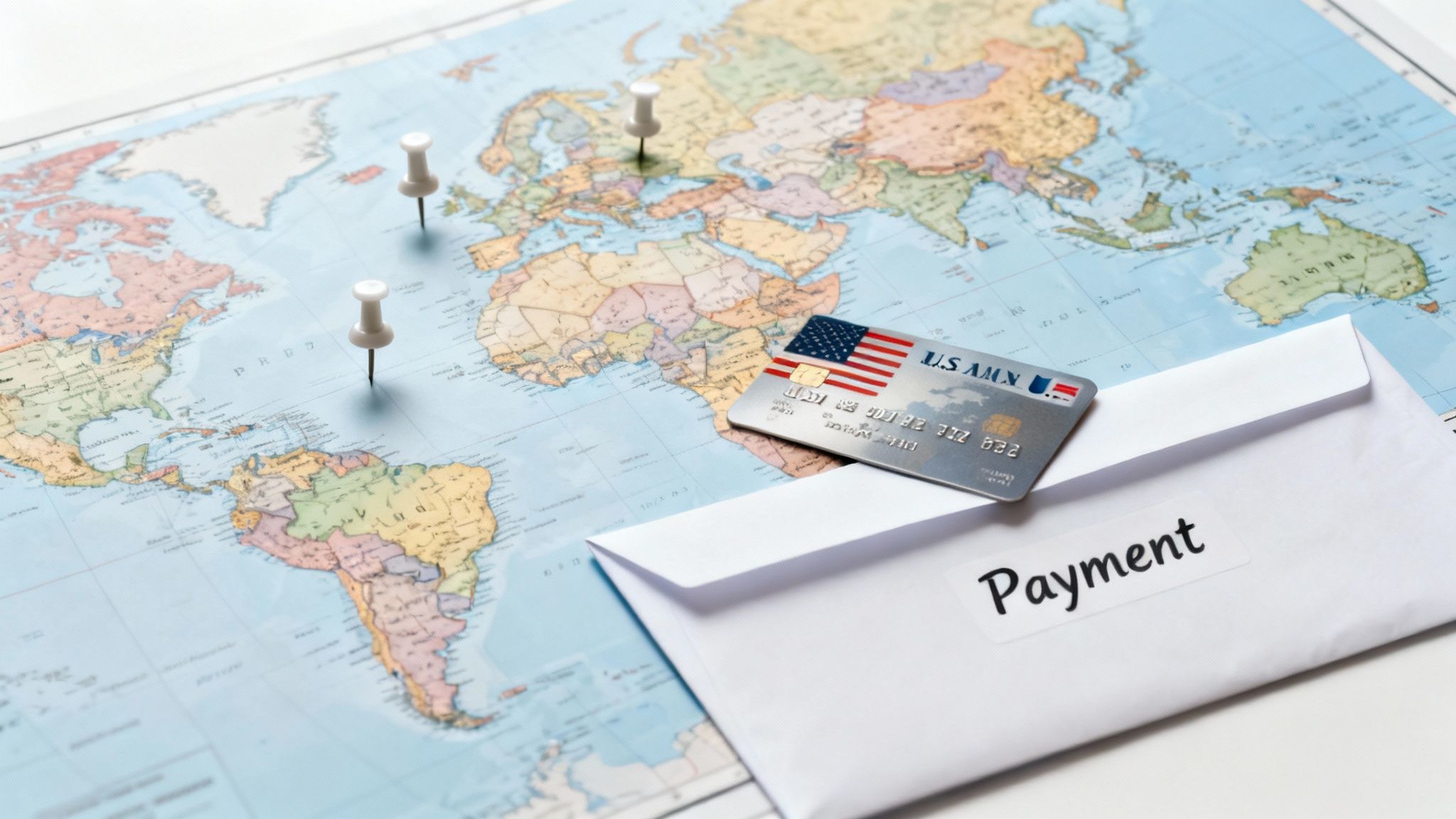
While your Social Security benefits are portable, they don't exactly have a passport that works everywhere. The U.S. government has some pretty specific rules about where it can and can't send payments, which makes your choice of retirement destination a critical logistical decision.
These restrictions aren't just random. They're usually tied to U.S. Treasury Department sanctions or other foreign policy measures. What this means for you is that a handful of countries are simply off-limits for receiving Social Security checks.
Understanding Restricted Countries
For U.S. citizens, the big two countries where the Social Security Administration (SSA) cannot send payments are Cuba and North Korea. If you decide to pack your bags and move to one of these spots, your benefits will be put on hold.
But "suspended" doesn't mean "lost forever." The SSA will essentially hold onto that money for you. You can collect all of your withheld benefits once you move to a country where payments are allowed. So, you don't permanently forfeit the money you've earned over your working life.
The SSA's policy is straightforward: your eligibility for benefits doesn't vanish, but their ability to deliver them hinges entirely on your country of residence. It's always smart to confirm a country's status before you make any serious moving plans.
There's also a wider list of countries, mostly former Soviet republics like Belarus and Moldova, that have payment restrictions due to sanctions. The rules here can get complicated, so your best bet is to use the SSA's official screening tool to verify the specifics for your intended destination.
To clarify how these rules apply, here is a simple breakdown of the different country categories and the SSA's corresponding payment policies.
Social Security Payment Status by Country Type
| Country Category | Payment Policy | Example Countries |
|---|---|---|
| Generally Permitted | Payments are sent without issue to eligible recipients. | Mexico, Spain, France, Japan, Philippines |
| Restricted (U.S. Citizens) | Payments are withheld until you move to a permitted country. | Cuba, North Korea |
| Sanctioned (Complex Rules) | Payments may be restricted; rules vary and require verification. | Belarus, Moldova, Azerbaijan |
| Totalization Agreement | Special agreements coordinate benefits; payments are generally secure. | Canada, Germany, Australia, United Kingdom |
This table provides a general overview, but you should always check the SSA's official Payments Abroad Screening Tool for the most current information on your specific country of interest.
Your Payment Options: Direct Deposit or U.S. Bank
Once you've confirmed your new home country is on the "approved" list, the next step is figuring out how to get your money. You have two main options, each with its own pros and cons.
1. International Direct Deposit
This is usually the most convenient route. The SSA can wire your benefits directly into a bank account in your new country. The funds arrive in U.S. dollars and are then converted by the receiving bank into the local currency.
- Pros: It's simple, automatic, and pretty much a "set it and forget it" solution.
- Cons: You're at the mercy of the bank's daily currency exchange rate, which can fluctuate. This can make your monthly income a bit unpredictable.
2. Deposit to a U.S. Bank Account
Many expats choose to keep a U.S.-based bank account open. Your Social Security is deposited there in dollars, and you can then transfer funds to your international account whenever you need them.
- Pros: This gives you more control over when you exchange currency, letting you potentially time transfers for better rates.
- Cons: It adds an extra step to accessing your money and might involve wire transfer fees from your bank.
Setting up an account overseas can feel like a process, but it's an essential step for managing your day-to-day finances. You can get a head start by checking out this guide on how to open a foreign bank account, which lays out the typical documents and steps involved.
Staying Connected with the SSA from Abroad
Managing your benefits from thousands of miles away means you need to keep the lines of communication open with the Social Security Administration. The good news is, they've made it pretty manageable.
Your my Social Security online account is your best friend. From your dashboard, you can change your address and manage direct deposit details without ever needing to make an international phone call. For anything more complex, the U.S. Embassy or Consulate in your new country should be your first stop. Many have a dedicated Federal Benefits Unit (FBU) to help expats with Social Security matters.
Finally, keep an eye on your mail. The SSA periodically mails a questionnaire to beneficiaries living abroad to confirm their status. It is absolutely critical to fill this out and send it back promptly. If you don't, they could suspend your benefits until you get the situation sorted out.
Understanding How Totalization Agreements Work

If you've built a career that spans both the United States and another country, you might worry about your social security contributions getting lost in the shuffle. It's a common concern for international workers. This is where Totalization Agreements come into play.
Think of them as social security treaties between the U.S. and other nations. They're designed to solve two major headaches for people who work across borders.
First, they stop you from being taxed twice. Without one of these agreements, you could end up paying social security taxes to both the U.S. and your host country on the exact same income. These treaties make sure you only pay into one system at a time, saving you a small fortune and a lot of paperwork.
Second, and perhaps more importantly, they help people who've split their careers qualify for benefits they might otherwise miss out on. The agreements let you combine your work credits from both countries to meet the minimum requirements, making sure your time abroad actually counts for something.
How Combining Work Credits Helps You Qualify
The real magic of a Totalization Agreement is its power to bridge gaps in your work history. To get U.S. Social Security retirement benefits, you generally need 40 work credits—which is roughly 10 years of work. If your U.S. career was shorter than that, you might fall just short of the goal line.
This is where the agreement acts as a safety net. It lets the Social Security Administration look at your work in a partner country and count that time toward your U.S. eligibility. It's not about transferring money from one country to another; it's about combining the time you worked so you can meet the minimums in one or both systems.
A Totalization Agreement acts like a financial passport for your work history. It allows your professional contributions in one country to be recognized in another, unlocking benefits that would otherwise be out of reach.
Let's look at an example. Imagine you worked in the U.S. for seven years, earning 28 credits, before moving to Spain, where you worked for another ten. On its own, your U.S. work history isn't enough to qualify for benefits.
But since the U.S. and Spain have a Totalization Agreement, you can use your work history from Spain to meet the 40-credit U.S. requirement. This allows you to receive a partial, or "pro-rata," U.S. Social Security benefit based on the 28 credits you actually earned in the States.
Countries with Totalization Agreements
The U.S. currently has these vital agreements with 30 countries. This network covers most of Europe, Australia, and parts of Asia and South America, making it a critical piece of the puzzle for anyone planning to retire abroad after an international career.
Here are just a few of the countries that have these treaties with the U.S.:
- United Kingdom
- Canada
- Germany
- France
- Australia
- Japan
- Spain
- Italy
- Brazil
- South Korea
It's crucial to remember that your benefit amount is still calculated based only on your U.S. earnings. The foreign credits are just there to help you get your foot in the door and meet the eligibility rules. This clever system ensures your hard work abroad doesn't keep you from collecting the benefits you rightfully earned back in the United States.
Managing Your Taxes and Healthcare Abroad
Moving abroad is about so much more than just packing boxes and sorting out visas. You also have to get a solid plan in place for two of life's biggest certainties: taxes and healthcare.
As an American expat, your relationship with the IRS doesn't end just because you've moved. At the same time, your U.S. health coverage—specifically Medicare—almost certainly won't follow you. Let's break down what you need to know to handle both for a secure, stress-free retirement overseas.
How the IRS Views Your Social Security Benefits
Here's the bottom line: as a U.S. citizen, you are taxed on your worldwide income, no matter where you call home. This rule absolutely applies to your Social Security benefits.
Whether you'll actually owe taxes on your benefits hinges on your "combined income." Don't worry, it's not a complicated formula. It's just your adjusted gross income, plus any nontaxable interest you earned, plus half of your Social Security benefits for the year.
Here's a quick look at the income thresholds:
- For Individuals: If your combined income is between $25,000 and $34,000, you might have to pay income tax on up to 50% of your benefits. If it's over $34,000, up to 85% of your benefits could be taxable.
- For Married Couples Filing Jointly: If your combined income is between $32,000 and $44,000, you could owe tax on up to 50% of your benefits. If your income tops $44,000, up to 85% may be taxable.
The good news? The U.S. has tax treaties with many countries specifically designed to prevent double taxation. This means you probably won't get hit with taxes on the same income from both your new country and the United States. Still, these treaties can be tricky, so talking to a tax professional who specializes in expat finances is always a smart move.
The Critical Gap Medicare Leaves Behind
Now for the single most important healthcare fact for any American planning to retire abroad: Medicare does not cover you outside the United States.
This isn't a minor detail you can figure out later—it's a massive, potentially bank-breaking gap in your health coverage that you absolutely must fill.
Relying on Medicare is simply not an option for routine check-ups, unexpected illnesses, or major emergencies in your new country. Any medical care you receive, from a simple prescription refill to an extended hospital stay, will be a 100% out-of-pocket expense.
This is a non-negotiable part of planning your move. You need to start thinking of international health insurance not as an optional add-on, but as a direct replacement for your Medicare. It's the only way to protect both your health and your retirement savings from catastrophic costs.
When you're mapping out your financial future, thorough planning for healthcare costs in retirement is absolutely essential, especially when you can't fall back on U.S. government programs.
Your first and most critical step is to secure a private international health insurance policy. These plans are built specifically for expats and offer coverage across different countries. To get a handle on the rules, it's worth learning more about why Medicare coverage does not apply outside the US and what your options are for global protection. This preparation is what allows you to truly relax and enjoy your new life with real peace of mind.
A Step-By-Step Guide to Claiming Your Benefits Overseas
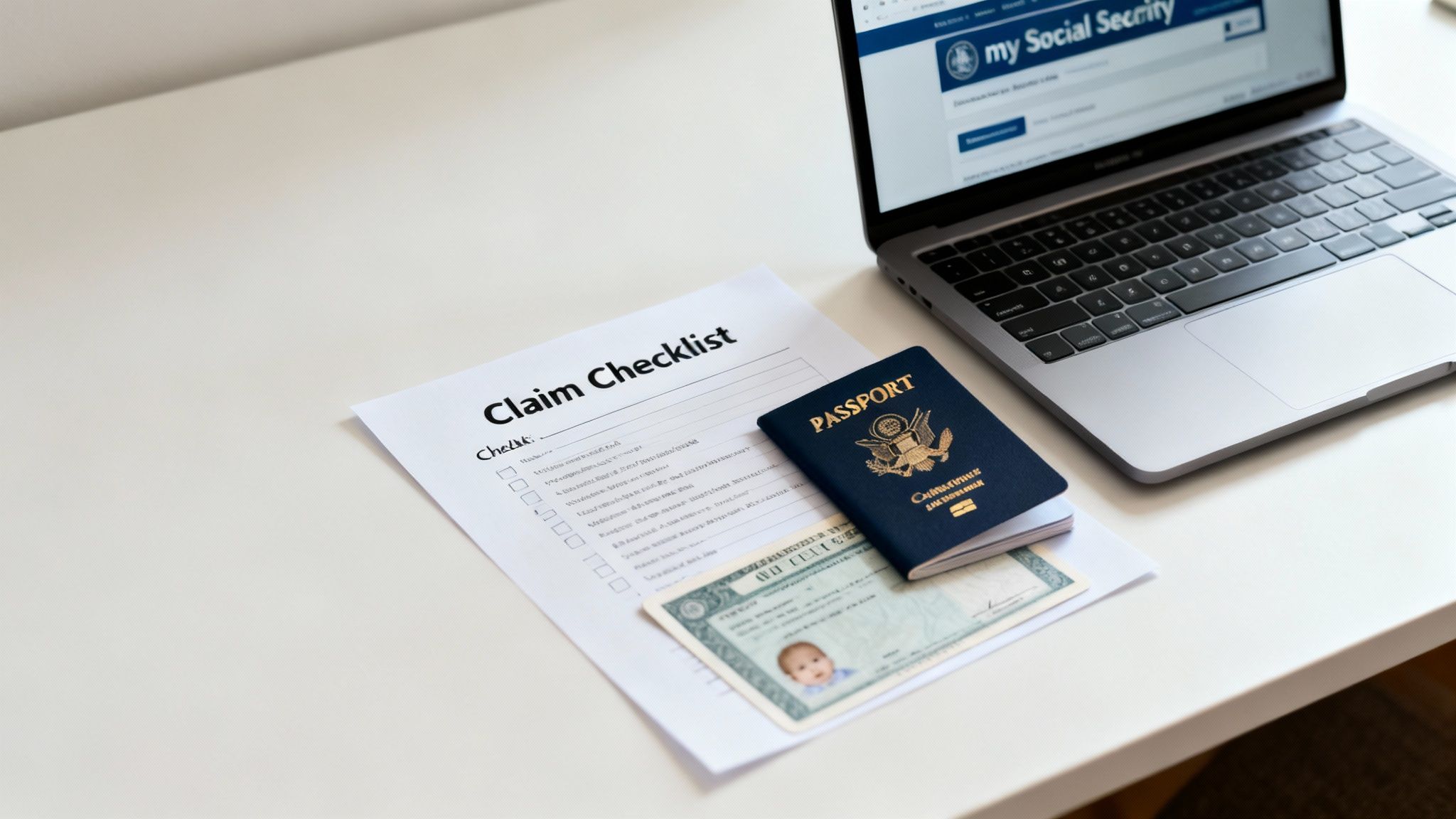
So, you're ready to make the move and start drawing your social security benefits living abroad? Navigating the application from another country can feel a bit daunting, but it's a well-trodden path. Let's break it down into simple, manageable steps to get you squared away.
Think of this as your pre-flight checklist for securing your financial footing overseas. By getting your ducks in a row now, you can sidestep common headaches and ensure your payments kick in without a hitch.
Before You Even Apply
A little prep work goes a long way. Before you dive into the official application, a couple of key actions can save you a world of trouble later on. This is all about confirming what you're eligible for and getting your paperwork in order.
-
Check Your Eligibility Online: First things first, head over to the Social Security Administration (SSA) website. You'll want to create or log in to your my Social Security account. This is where you can see your complete earnings record, make sure you have the necessary 40 work credits, and get a personalized estimate of what your monthly benefit will look like at various retirement ages.
-
Gather Your Essential Documents: You'll need a handful of key documents to prove who you are. Trust me, it's infinitely easier to track these down while you're still stateside.
- Your original birth certificate or a certified copy.
- Proof of U.S. citizenship, like your U.S. passport, or documentation of lawful alien status.
- Your U.S. military service papers if you served before 1968.
- Your W-2 forms or self-employment tax returns from the last year.
Submitting Your Application from Abroad
Once you're settled overseas, the process pivots. Instead of dealing with a local U.S. office, your main points of contact become international channels.
In many cases, applying for benefits online is the quickest and simplest route. However, if your situation is a bit more complex or you just prefer in-person help, you'll need to reach out to the nearest U.S. Embassy or Consulate.
Many U.S. Embassies have a Federal Benefits Unit (FBU), which essentially functions as a local SSA office for expats. These are your go-to people for submitting documents, asking questions, and sorting out any issues with your benefits.
Setting Up Payments and Ongoing Duties
After your application gets the green light, the last piece of the puzzle is telling the SSA where to send the money. You'll need to choose between having payments sent to a U.S. bank account or to an eligible foreign bank through International Direct Deposit.
Finally, remember that your responsibilities don't stop once the checks start arriving. You have to keep the SSA in the loop about any major life events—a change of address, getting married or divorced, or the death of a beneficiary. The SSA also periodically mails questionnaires to beneficiaries abroad to confirm their status. If you don't return that form promptly, you risk having your payments suspended. A little proactivity here ensures your benefits keep flowing without interruption.
Common Questions About Social Security Abroad
Even with the best planning, you're bound to have some specific questions pop up about receiving Social Security benefits while living abroad. Let's tackle some of the most common ones we hear from the expat community.
I'm Not a U.S. Citizen. Can I Still Get Benefits Overseas?
For many, the answer is yes, but the rules are definitely tighter and hinge on your country of citizenship. If you're a citizen of one of the 30 countries that has a Totalization Agreement with the U.S., you're generally in the clear and can receive your payments without any major hurdles.
Things get trickier for citizens of other nations. Payments can be cut off after you've been outside the U.S. for six months unless you meet a specific exception. The best way to get a definitive answer for your situation is to use the SSA's official Payments Abroad Screening Tool. It's your go-to resource for checking the rules for your specific nationality.
How Will Currency Fluctuations Affect My Monthly Payment?
Your Social Security benefit is always calculated and paid out in U.S. dollars. If you set up international direct deposit, your local bank handles the conversion to the local currency based on whatever the exchange rate is that day. This means the final amount that hits your account can vary, sometimes significantly, from one month to the next.
A lot of savvy expats get around this by having their benefits deposited into a U.S.-based bank account. They can then transfer the money themselves, giving them the flexibility to wait for a day when the exchange rate is more in their favor.
It adds an extra step to your process, but this strategy can bring some much-needed stability to your monthly income.
Do I Still Have to File U.S. Taxes While Living Abroad?
Yes, you absolutely do. Being a U.S. citizen comes with a lifelong requirement to file a federal tax return every year, no matter where in the world you call home. Your Social Security benefits may or may not be taxable, which all depends on your annual "combined income."
The good news is that tax treaties between the U.S. and many other countries are designed to prevent you from being taxed twice on the same income. You can usually claim foreign tax credits or exclusions for what you've already paid to your host country. Still, this is a complex area, and it's always a smart move to work with a tax professional who specializes in expat finances to make sure you're buttoned up on all the rules.
Navigating healthcare abroad is the biggest challenge for U.S. retirees, as Medicare won't cover you. At Expat Insurance, we specialize in finding the perfect international health insurance plan to protect your health and finances. Get a free quote today and ensure you have reliable coverage wherever your retirement takes you.
