
December 22, 2025
•
5 min read
How to Open Foreign Bank Account: A Guide for Expats and Nomads
Discover how to open foreign bank account quickly with our practical guide: required documents, residency tips, and choosing the right international bank.

So, you're thinking about opening a bank account in another country. It might sound like something reserved for globetrotting executives or the super-rich, but it's actually a super practical—and often necessary—move for anyone living, working, or investing across borders.
For expats, digital nomads, and entrepreneurs with a global footprint, a local bank account isn't a luxury; it's the key to making your financial life abroad a whole lot simpler.
Why Bother With a Foreign Bank Account?
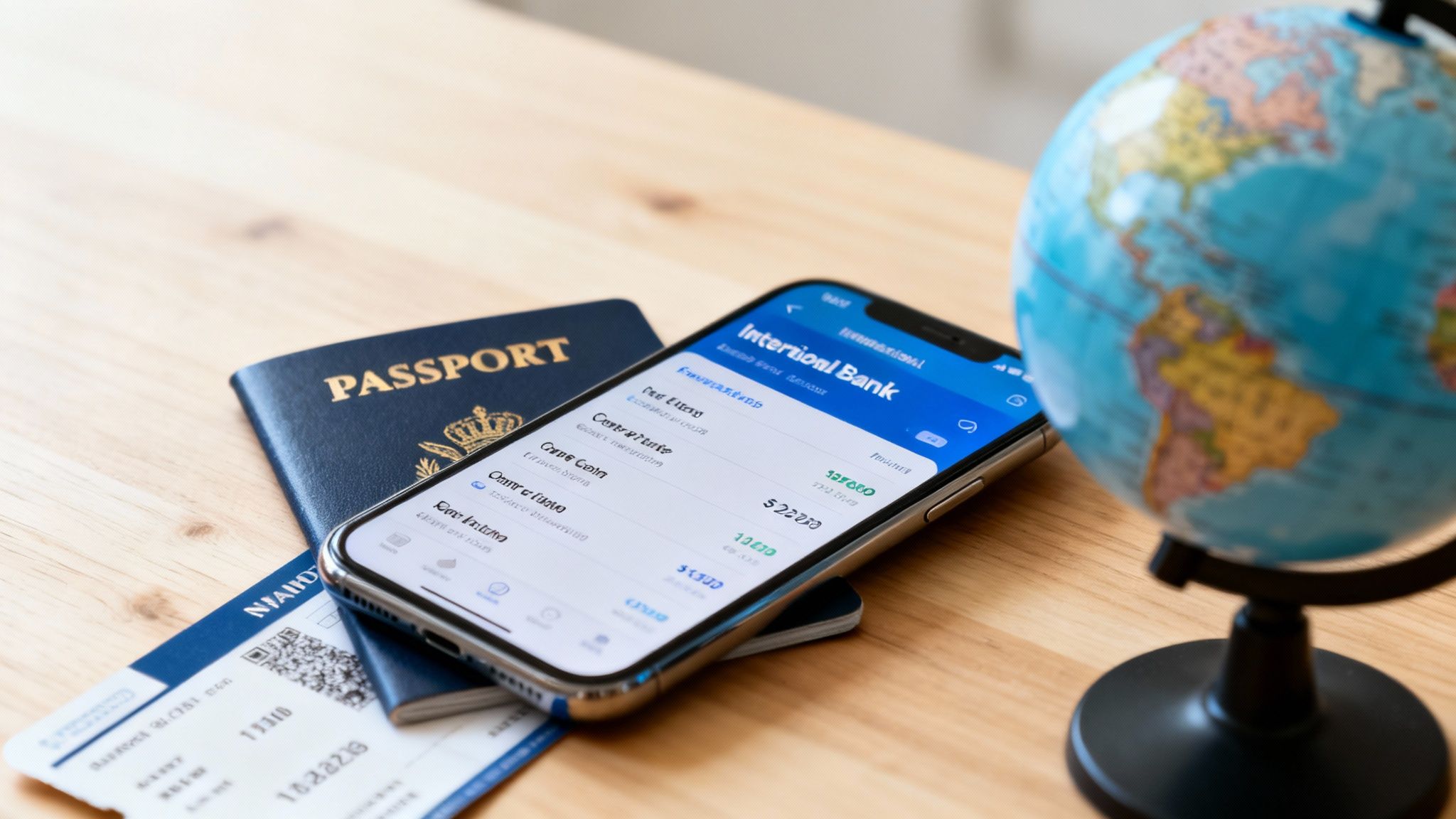
Think about trying to pay your rent in Berlin from a U.S. dollar account. Every single month, you're at the mercy of fluctuating conversion rates and getting hit with painful international transfer fees. It’s a headache. A local account in Euros just erases all that friction.
Suddenly, everyday life gets easier. Your local salary can be deposited directly, you can set up automatic payments for your utility bills, and you can pay for groceries without doing mental gymnastics about fees.
Get Your Global Finances in Order
Beyond just day-to-day convenience, having a foreign bank account brings some serious financial perks. It’s a great way to hedge against currency swings, letting you hold money in different currencies and move it around when the exchange rates are working in your favor. This is a game-changer for freelancers or business owners who get paid by clients all over the world.
Let's break down the main advantages:
- Slash Those Fees: You can finally say goodbye to expensive international wire fees and terrible exchange rates your home bank charges for simple local payments.
- Make Local Life Easy: Paying for things, setting up direct debits for rent, and getting paid by a local employer becomes completely straightforward.
- Diversify Your Currency: Holding your money in different currencies is a smart way to protect your wealth from the ups and downs of a single economy.
- Unlock Local Credit: Once you build a banking history in a new country, it can open the door to getting local credit cards, loans, or even a mortgage down the road.
Before you dive in, it’s worth taking a moment to think through a few key things. This isn't just about picking a bank with a nice logo; it's about finding the right fit for your specific situation.
Key Considerations Before You Start
| Factor | Why It Matters | Quick Tip |
|---|---|---|
| Residency Status | Many banks require proof of local residency. Non-resident options exist but are often more limited and may come with higher fees or minimum balances. | Check if the country allows non-resident accounts. If you're planning to move, it might be easier to wait until you have a residence permit. |
| Account Purpose | Are you saving, investing, or just handling daily expenses? The type of account you need will depend on your goals. | Be clear about your needs. A simple checking account is great for daily life, but you might need a multi-currency or investment account for other goals. |
| Documentation | Banks have strict "Know Your Customer" (KYC) rules. You'll need a valid passport, proof of address, and sometimes proof of income. | Gather your documents before you start the application. Get official translations if your documents aren't in the local language. |
| Fees & Exchange Rates | Look beyond the monthly account fee. Check for costs related to international transfers, ATM withdrawals, and currency conversion. | Compare fee structures between traditional banks and modern fintech options like Wise or Revolut. The differences can be significant. |
| Tax Implications | Opening a foreign account triggers reporting requirements in your home country (like FBAR in the U.S.). Ignoring this can lead to massive penalties. | Consult with a tax advisor who understands expat tax laws. It's a small investment to avoid huge problems later. |
Thinking through these points upfront will save you a ton of time and frustration. The world of international banking has changed so much in the last decade, becoming far more accessible.
It's pretty incredible to see how much has changed. Global financial inclusion has exploded, with 79 percent of adults around the world now having some kind of financial account. That's a huge leap from just 51 percent in 2011, mostly thanks to technology making banking easier for everyone. For a deeper dive, check out the Visa Economic Empowerment Institute's analysis of the World Bank Global Findex data.
This guide is here to walk you through the whole process, step by step. We'll cut through the jargon and give you the practical advice you need to manage your money across borders like a pro.
Navigating Documentation and Residency Rules
This is the part of the journey where good intentions often hit a bureaucratic wall. You’ve picked your country, maybe even found the perfect bank, but now comes the paperwork. Getting your documents in order might seem simple, but international banks operate under strict anti-money laundering (AML) and Know Your Customer (KYC) rules. One tiny mistake can send you right back to the beginning.
When it comes down to it, opening an account abroad is all about proving two things: who you are and where you live. The specific documents might change from Spain to Singapore, but these two core principles are universal.
The Essential Document Checklist
Let's get practical. Before you even think about filling out an application, you need to assemble a documentation toolkit. I recommend having both physical and digital copies ready to go—it will make your life infinitely easier, whether you’re applying in person or online.
Here’s the typical laundry list:
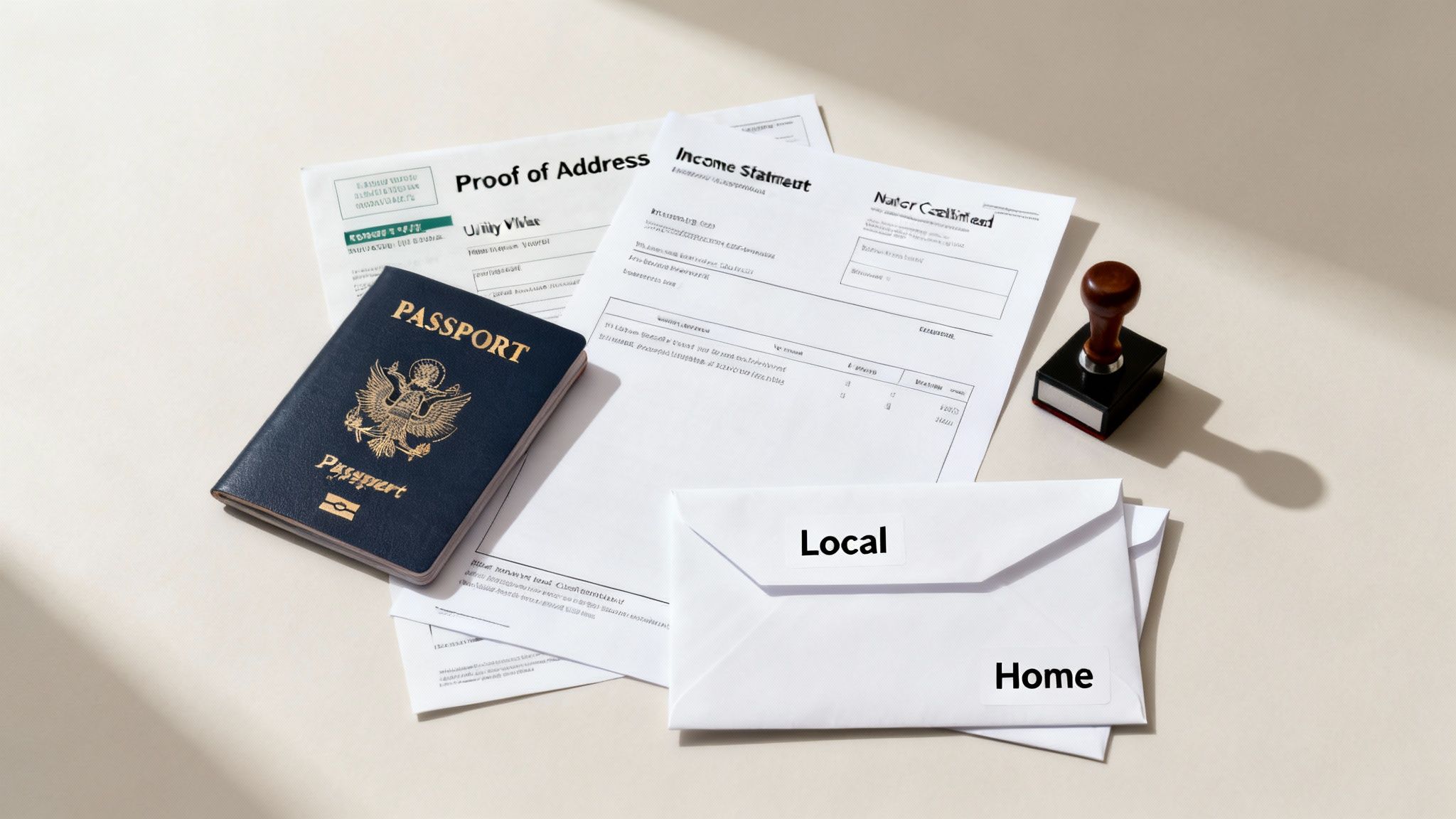
- Proof of Identity: This one’s a no-brainer. Your valid, government-issued passport is the gold standard everywhere. In some regions, a national ID card might work, but a passport is always your safest bet.
- Proof of Address: This is where most people get tripped up. Banks need a recent utility bill (water, electricity) or a formal bank statement from another institution. The key is that it must be less than three months old and clearly display your name and full residential address.
- Proof of Income or Funds: The bank needs to know where your money is coming from. This could be recent pay stubs, a formal letter from your employer, or even your latest tax return. For non-resident accounts, they might just want to see statements from your home bank to verify you have the funds you claim.
Here's a pro tip: if you're trying to prove your address in your new country, use a local document. A utility bill from your apartment in Lisbon carries a lot more weight with a Portuguese bank than a bank statement from back home in Chicago. It shows a real, tangible connection to the country.
The Resident vs. Non-Resident Fork in the Road
Your residency status is the single biggest factor that will dictate how this process goes. It determines which banks will even talk to you, what kinds of accounts you can open, and how much scrutiny you'll be under.
Opening an Account as a Resident If you have a residence permit, a long-stay visa, or some other official status, congratulations—life just got a lot easier. You'll be treated almost like a local citizen. This opens the door to a much wider selection of banks and accounts, often with lower fees and no crazy minimum deposit requirements.
For example, an American who moves to Spain on a digital nomad visa can stroll into a local branch of Santander or BBVA with their residence card (the TIE), their passport, and a rental contract. It's a relatively straightforward process because the visa itself has already cleared many of the bank's verification hurdles. Getting a handle on visa requirements for foreign travel and long-term stays is a crucial first step; you can find more information by reading up on guidance on different visa types for expats.
Opening an Account as a Non-Resident This is a completely different ballgame. As a non-resident, your options shrink dramatically, and the paperwork gets more intense. Many standard high-street banks will simply turn you away because the compliance headache isn't worth it for them.
The banks that do cater to non-residents will often require:
- A much higher minimum opening deposit—we're often talking thousands of dollars.
- A very clear, documented reason for needing the account (e.g., you're buying property, starting a business, or making a local investment).
- Extra certified documents, sometimes even a formal letter of reference from your current bank.
Banks in major financial hubs like Switzerland, Singapore, or Dubai are more accustomed to dealing with non-resident clients. The catch? They are typically geared toward high-net-worth individuals and may require initial deposits of $25,000 or more. For the average person, finding a non-resident friendly bank takes some dedicated research.
Getting Your Paperwork Certified and Submitted
Don't even think about just sending in a photocopy of your passport. Banks require your documents to be officially certified or "notarized." This involves taking the original document and a copy to an authorized professional who can legally vouch for its authenticity.
Who can do this?
- A notary public
- A lawyer or solicitor
- A chartered accountant
- In some cases, an official at your home country's embassy or consulate
Before you do anything, ask the bank for their specific certification rules. Some might require an Apostille stamp, which is a more formal, internationally recognized layer of authentication. Submitting improperly certified documents is one of the most common—and frustrating—reasons for an application to be rejected. Getting this small detail right from the start can save you weeks of headaches.
Choosing the Right Bank for Your Global Lifestyle
Picking the right bank for your life abroad is a lot more than just finding a place to stash your cash. It’s about finding a financial partner that actually gets the messy, multi-currency reality of an international lifestyle. Let's be honest, not all banks are created equal, especially when you're trying to pay local bills, send money home, and not get hammered by fees in the process.
The banking world has split into a few distinct paths. The right one for you really boils down to your situation. Are you a freelancer juggling payments in USD and EUR, or an expat trying to pay rent in Bangkok without losing a small fortune on every transfer? Your answer points the way.
Global Banking Giants
The big, multinational names like HSBC, Citibank, and Standard Chartered offer a certain comfort of familiarity. Their biggest selling point is their massive global footprint, which often lets you link accounts between your home country and your new one. This can make moving money between your own accounts much simpler.
These institutions are generally well-versed in handling non-resident applications and often have dedicated international banking divisions. The flip side? They can be slow, tangled in red tape, and frequently hit you with higher fees and hefty minimum balance requirements. They’re a solid, traditional option, but they're not always the most nimble or affordable choice for daily life.
Modern Digital Banks and Fintech
This is where the real action is. Companies like Wise (which you might remember as TransferWise) and Revolut have completely turned the tables for expats and digital nomads. These platforms were literally built for people living and working across borders.
Here's why they're so popular:
- Multi-currency accounts: You can hold dozens of different currencies in a single account, converting between them with low, transparent fees.
- Real exchange rates: They almost always give you a rate much closer to the mid-market rate you'd see on Google, unlike the inflated rates you often get from traditional banks.
- Quick and painless setup: You can often get an account with full international banking details set up on your phone in just a few minutes.
While these services are fantastic for handling currency exchange and international payments, it’s crucial to remember they aren't always "banks" in the traditional sense. Some might not offer credit cards or have the same level of deposit protection as a brick-and-mortar bank. It's also vital to make sure they accept your home address, a key detail we explore in our guide to finding a bank account that accepts your address abroad.
The Local Bank Advantage
Don't overlook the power of a local bank in your new country. They might not have the global reach of the big players, but they offer something the others can't: deep integration into the local economy. For things like setting up utility payments, getting a local credit card, or one day applying for a mortgage, having a relationship with a domestic bank is priceless.
Customer service is often more personal, and they are the true experts on the local financial landscape. The process to open a foreign bank account with them will probably require an in-person visit, but the long-term benefits of being a "local" customer are often well worth it.
The global banking sector is a behemoth, generating record revenues of $5.5 trillion and a net income of $1.2 trillion in a recent year. This highlights the immense resources at their disposal, but it's on you to find the institution whose services truly fit your personal needs, not just their bottom line. You can read more on the state of global banking from McKinsey's analysis.
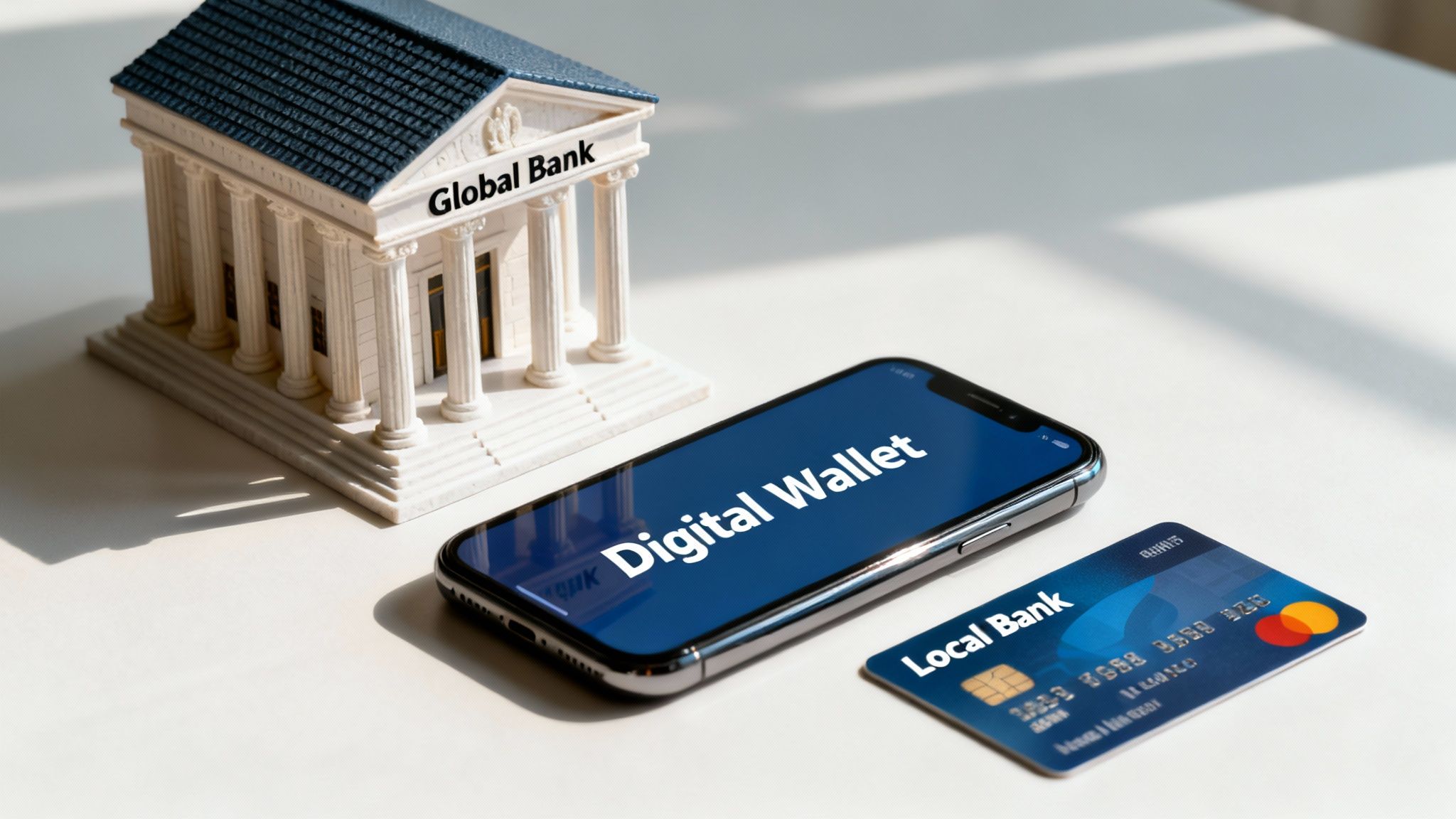
So, what's the final call? For most expats, the best strategy isn't picking just one. It's building a hybrid system. Use a digital platform like Wise for your international currency needs and a solid local bank for your day-to-day life. This approach gives you the best of both worlds—global flexibility and local convenience.
The Application Process: In Person vs. Online

Alright, you've got your documents in a neat pile. Now comes the big decision that really shapes the rest of your experience: do you go the old-school route and walk into a branch, or do you tackle it all from your laptop?
Both paths get you to the same place—a shiny new foreign bank account—but the journey couldn't be more different. One involves a handshake and a stack of paper, the other a webcam and a few clicks. For the globally mobile, the convenience of the remote option is a huge draw, but there’s still something to be said for the classic in-person visit. Let’s break down what each one actually feels like.
Going the In-Person Route
Applying at a physical branch is often the most direct way to get things done, especially if you're already in the country and have your residence permit. The biggest advantage? You can ask questions and get real-time answers from a real person, which is a massive relief when you’re navigating an unfamiliar financial system.
To make this go smoothly, preparation is everything. Don’t just show up. Most international banks now work by appointment, so call ahead or book a slot online. This is also your chance to ask exactly what they need you to bring, saving you from a frustrating second trip.
When you head to your appointment, a few practical tips can make all the difference:
- Bring Originals and Copies: Don't assume they have a high-tech scanner. Have crisp photocopies of your passport, utility bills, and everything else. The bank needs to keep these for their records.
- Plan for Language Barriers: If your grasp of the local language isn't great, bring along a friend who can translate or have a translation app ready on your phone for key financial terms. You might get lucky with an English-speaking staffer in a major city, but you can't count on it.
- Be Ready for an Initial Deposit: Many banks will expect you to fund the new account right there and then. When you book your appointment, ask about the minimum deposit and whether they’ll accept cash, a card, or a transfer.
The in-person method offers a human connection and can be the start of a solid local banking relationship. But, of course, it requires you to actually be there.
Applying Remotely with Digital Verification
The ability to open a bank account from thousands of miles away has been a total game-changer for expats and nomads. This whole process hinges on technology that securely verifies who you are, and it often feels like something out of a spy movie compared to a traditional bank visit.
When you apply online as a non-resident, the verification process is the main event. You'll start by uploading clear, well-lit digital copies of your documents. From there, you'll almost certainly face a digital identity check.
This usually means a quick video call with a verification agent. You'll hold your passport up to the camera, maybe turn your head from side to side, and verbally confirm your details. It's the modern-day equivalent of an in-person ID check, designed to stop fraud.
It's important to know that some countries are way ahead of the curve when it comes to welcoming remote, non-resident applicants. A few of the more digitally-savvy hubs include:
- Portugal: Certain banks have made the online process incredibly smooth for non-residents, particularly if you've already secured a tax number (NIF).
- Singapore: As a premier global financial center, many of its banks are built to handle sophisticated applications from all over the world.
- Estonia: The country's unique e-Residency program offers a clear pathway for global entrepreneurs to open an EU bank account almost entirely online.
If the UAE is part of your financial strategy, it has its own distinct set of rules. This guide on opening a non-resident bank account in Dubai is a fantastic resource for navigating that specific process.
Whichever route you take, pack some patience. Once your application is approved, it can still take a week or two for your debit card and PIN to arrive by mail—almost always in separate envelopes for security. That's the final step that officially kicks off your new global financial life.
Understanding Your Tax and Legal Obligations
Opening a foreign bank account is a huge step toward managing your finances globally, but it also brings a new set of responsibilities you just can't ignore. The second you have an account in another country, you’ve entered the world of international tax compliance. This isn't just about extra paperwork; getting it wrong can lead to some truly staggering financial penalties.
These rules were put in place to fight tax evasion and promote financial transparency. The two big ones you’ll run into are the Common Reporting Standard (CRS) and the Foreign Account Tax Compliance Act (FATCA). Just think of them as global information-sharing agreements between banks and tax authorities.
Decoding FATCA and CRS
When you apply to open a foreign bank account, the bank will ask you to declare your tax residency. This is where these international agreements come into play.
-
FATCA (Foreign Account Tax Compliance Act) is a U.S. law requiring foreign banks to identify their American clients. They then report information about those accounts directly to the Internal Revenue Service (IRS). If you're a U.S. citizen or Green Card holder, your new bank in Paris or Tokyo will be sending your account details straight to the IRS.
-
CRS (Common Reporting Standard) is essentially the global version of FATCA, with over 100 countries participating. Under CRS, banks share financial account information with the tax authorities in whatever country the account holder resides. This ensures your home tax agency knows about your financial life abroad.
So, what does this mean for you, practically speaking? Your new bank isn't just holding your money; it’s legally required to share your information. This automatic exchange of data makes hiding assets offshore next to impossible.
Key Takeaway: You should always assume your home country's tax authority knows about every single foreign account you hold. The days of the secret Swiss bank account for the average person are long gone. Honest, accurate reporting is your only real strategy.
Your Reporting Responsibilities at Home
On top of the bank's reporting duties, you have your own. Most countries require their residents to report foreign financial assets and any income earned from them.
For U.S. citizens, this famously includes filing a Report of Foreign Bank and Financial Accounts (FBAR) if the combined value of your foreign accounts hits $10,000 at any point during the year.
The rules can vary wildly from one country to another. If you have financial ties to Australia, for example, it's critical to understand how their local tax laws and specific Non-Resident Tax Rates might apply to the income you generate overseas.
Why Professional Advice Is Non-Negotiable
Trying to navigate this complex web of rules on your own is a bad idea. Seriously. The penalties for getting it wrong—even by accident—can be severe, sometimes reaching tens of thousands of dollars for a single violation.
This is exactly why consulting a tax advisor who specializes in expat and international tax law is one of the smartest investments you can make.
A qualified professional can walk you through your specific obligations, make sure your reporting is spot-on, and help structure your finances in a tax-efficient way. They are your best defense against making a very costly mistake. For a deeper dive, our expat tax guide is a great place to start understanding these crucial responsibilities.
Common Questions About Opening a Foreign Bank Account
Diving into international banking for the first time? It's bound to kick up a storm of questions. From residency rules to how much cash you actually need to get started, it's completely normal to feel a bit lost in the details. Let's clear the fog and tackle some of the most common queries head-on.
Can I Open a Foreign Bank Account as a Non-Resident?
Yes, you absolutely can—but the path looks a little different than it does for a local resident. Many countries and big international banks offer specific accounts designed just for non-residents. Just be prepared for a more thorough vetting process.
Banks that offer these accounts are managing higher compliance risks, which means they'll ask for more from you. This usually involves:
- A higher initial deposit: While a local might open an account with €50, a non-resident account could require an initial deposit of several thousand dollars to get started.
- More detailed verification: You'll likely need to provide extensive documentation about the source of your funds and have a very clear, legitimate reason for needing the account, like owning property or investing in a local business.
- Potentially higher fees: Non-resident accounts can sometimes come with higher monthly maintenance fees to cover the bank's extra administrative load.
Financial hubs like Switzerland, Singapore, or the Isle of Man are well-practiced in handling non-resident clients. The trick is to look for banks that explicitly market non-resident services and go into it expecting a comprehensive due diligence check.
What Is the Easiest Country to Open a Bank Account In?
This is the million-dollar question, and the honest answer is: it depends entirely on you. Your nationality, residency status, and your reasons for opening the account will determine what's "easiest." There’s no single right answer, but a few trends have emerged.
For many digital nomads and expats, countries in the European Union tend to offer a relatively smooth experience, especially if you have some form of residency. Places like Portugal and Estonia—with its innovative e-Residency program—are often mentioned for their digital-first banking systems that make applications much simpler.
From a pure speed-and-convenience standpoint, modern fintech platforms like Wise or Revolut are often the undisputed champions. You can get multi-currency account details in minutes right from your phone. Just remember, they aren't traditional banks and may not offer things like overdrafts or the same level of deposit protection.
If you're looking at more traditional offshore banking for investments, jurisdictions like the Cayman Islands or Belize are known for their efficient processes. However, these are typically built for wealth management, not for your daily coffee budget. Always weigh the ease of opening an account against the bank's stability, reputation, and fee structure.
How Much Money Do I Need for an International Bank Account?
The amount you'll need can range from practically nothing to well over a million dollars. It all boils down to the type of account you're opening and your residency status.
If you're opening a standard retail account in person after you've already secured residency in a new country, the initial deposit is often minimal. We're talking as low as €20-€100, and sometimes nothing at all. The bank's goal here is to build a long-term relationship with a new local customer.
On the other end of the spectrum is a non-resident or offshore private banking account. These are built for preserving capital and managing wealth, so the barrier to entry is much higher. It’s not uncommon to see minimum deposit requirements ranging from $5,000 to over $1,000,000 for these kinds of specialized services.
Many of the popular digital banks and fintech platforms have flipped this model on its head. They often have no minimum deposit requirements, making them incredibly accessible for anyone who needs to manage multiple currencies without a huge upfront investment. Before you apply anywhere, always find the bank's official "Schedule of Fees" or "Terms and Conditions" to check for both the minimum opening deposit and any minimum balance you need to maintain to avoid monthly fees.
Do I Have to Report My Foreign Bank Account?
For the vast majority of people, the answer is a resounding yes. Tax authorities take the failure to report foreign financial accounts very seriously, and the penalties can be severe. This is one area where you absolutely don't want to cut corners.
Most countries legally require their citizens and residents to declare foreign financial accounts once their combined value crosses a certain line. Here are a couple of key examples:
- For U.S. Citizens: You are required to file a Report of Foreign Bank and Financial Accounts (FBAR) with the Financial Crimes Enforcement Network (FinCEN) if the total value of all your foreign accounts exceeds $10,000 at any point during the year.
- Under the Common Reporting Standard (CRS): This is a global standard for the automatic exchange of financial information, and over 100 countries participate. Your foreign bank will automatically report your account details to your home country's tax authority.
With these automatic reporting systems in place, transparency is your only real option. The penalties for non-compliance simply aren't worth the risk. Because these rules are complex and change from country to country, talking to a tax professional who specializes in expat finances is one of the smartest investments you can make.
Navigating the world of international banking and insurance can be complex, but you don't have to do it alone. The expert advisors at Expat Insurance specialize in helping people just like you find the perfect coverage for their life abroad, comparing plans from over 65 insurers to ensure you get the protection you need. Get personalized guidance and a free quote today by visiting https://www.expatinsurance.com.
