

January 17, 2026
•
5 min read
What Is Trip Cancellation Insurance A Guide for Global Travelers
Wondering what is trip cancellation insurance? This guide explains how it works, what's covered, and how to protect your travel investments as an expat.
Think of trip cancellation insurance as your financial backstop for the unexpected. It’s a policy designed to refund you for the prepaid, non-refundable parts of your trip if you have to cancel before you even leave—but only for a reason your policy specifically covers. It's essentially a refund plan for curveballs life throws your way, protecting the cash you've already laid out for things like flights, hotels, and tours.
Your Financial Safety Net for Unexpected Travel Changes
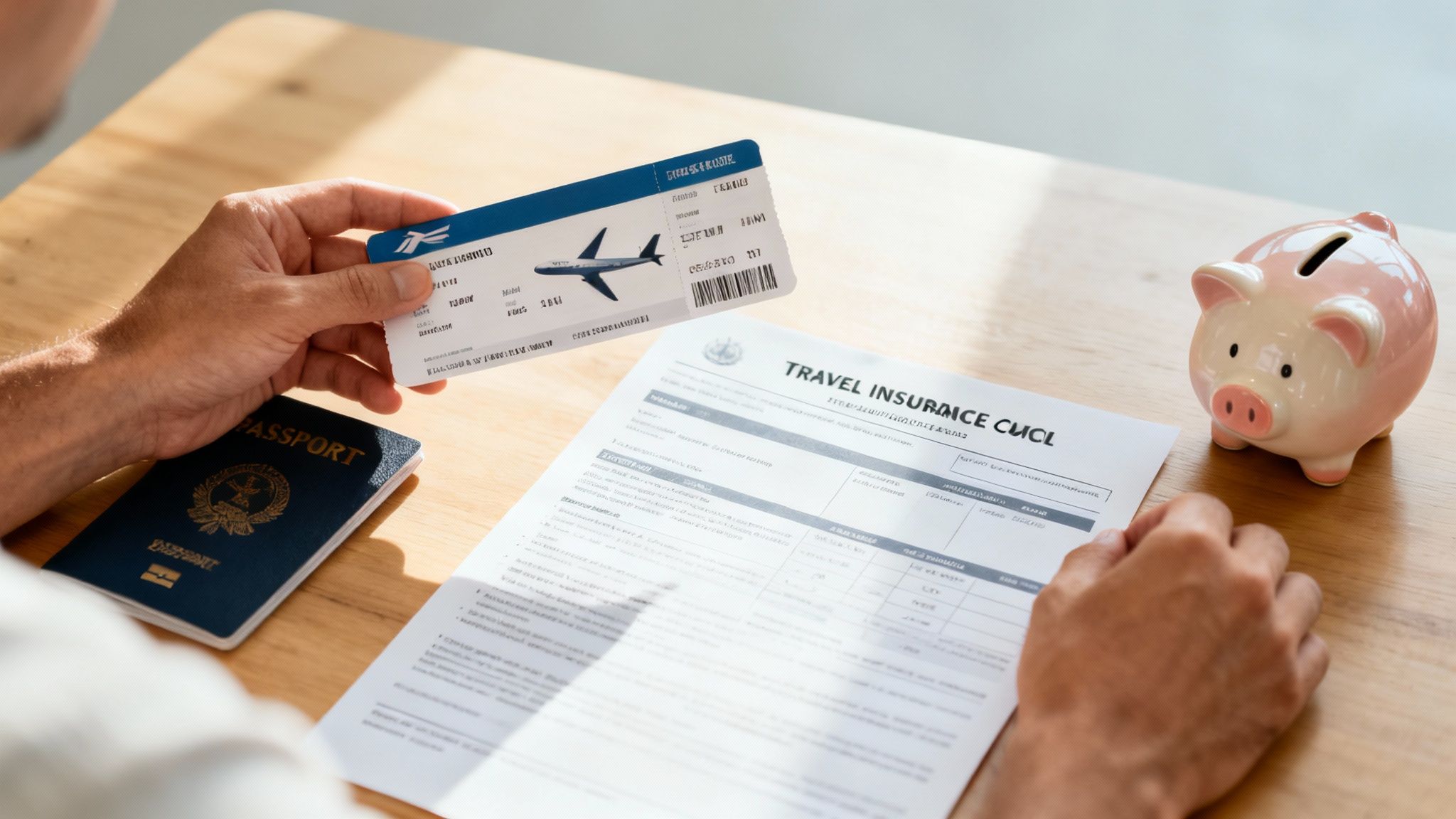
Let’s put this into a real-world context. Imagine you’re an expat in Singapore and you've just booked a $3,000 non-refundable flight home for a big family holiday. A few weeks before you’re set to fly, a close relative has a serious medical emergency, forcing you to postpone the whole trip. Without insurance, that $3,000 is almost certainly gone for good.
This is exactly why getting a handle on what is trip cancellation insurance is so important. It's not just a perk for extravagant vacations; it’s a crucial tool for anyone sinking real money into future travel. This is especially true for expats, who often deal with pricey long-haul flights and more complex travel plans.
Protecting Your Travel Investment
At its core, this insurance is about making you financially whole again when something beyond your control forces a change of plans. It covers the money you can’t get back from the airline, cruise line, or tour company. For long-term travelers and expats, that protection offers some serious peace of mind.
Here’s the simple breakdown of what it does:
- Reimburses Non-Refundable Costs: It’s designed to pay you back for prepaid expenses that the travel provider won’t refund.
- Applies Before Departure: This coverage is only for cancellations that happen before your scheduled departure date. Once your trip starts, other policies like trip interruption kick in.
- Requires a Covered Reason: You can’t just cancel for any reason. Your claim is only valid if the cause of your cancellation is specifically listed in your policy.
A policy acts like a financial backstop, turning a potential monetary disaster into a manageable inconvenience by safeguarding your prepaid, non-refundable trip costs against specific, unforeseen events.
This type of protection is a cornerstone of most comprehensive travel insurance plans, but it’s just one piece of the puzzle. It’s different from other benefits that apply during your travels. To get a better feel for the full range of options, check out our guide to short-term travel insurance. Understanding these distinctions is the key to picking the right coverage for your next journey.
How Trip Cancellation Insurance Actually Works

Understanding trip cancellation insurance becomes much simpler when you see it unfold in real life. Think of your policy as a safety net: cancel for a valid, pre-approved reason and get reimbursed for your losses. It’s a logical progression, moving from the moment you buy coverage to filing a claim if the unexpected happens.
You lock in protection the moment you purchase the policy—ideally right after your first trip deposit. From that instant until you’re due to depart, your non-refundable expenses are shielded against a list of covered mishaps. No surprises, just a clear window of financial security.
The Journey Of A Claim
To make this concrete, let’s follow an expat named Alex. He lives in Lisbon and pays $4,000 upfront for non-refundable flights and a guided tour in Vietnam. As soon as he’s booked, he adds trip cancellation insurance to his plan.
A week before departure, Alex’s doctor delivers bad news: he’s medically unfit to travel. That diagnosis checks the box for a covered reason, so Alex’s policy springs into action. From there, he simply:
- Notify All Parties: He immediately contacts the airline and tour operator to cancel and request any possible refunds.
- Contact the Insurer: Next, he rings up his insurance provider to kick off the claim.
- Gather Documentation: Finally, he assembles all the paperwork—arguably the linchpin of a successful claim.
Key Documents For A Successful Claim
Insurance companies need proof to verify every claim. In Alex’s case, a medical cancellation, this typically means:
- Proof of Payment: Receipts showing the $4,000 spent on flights and tours
- Refund Status: Written confirmation that those bookings are non-refundable
- Medical Certification: A doctor’s letter specifying the diagnosis, travel restriction, and onset date
A successful claim hinges on clear, complete documentation. The insurer isn’t taking your word alone—they need to confirm a covered event occurred and that you lost a specified amount of non-refundable money.
Once Alex submits his documents, the insurer reviews them. Upon approval, he receives a full $4,000 reimbursement. It’s a straightforward way to turn what could have been a financial disaster into a mere bump in the road.
Decoding Your Policy: What Is and Is Not Covered

The real power of your trip cancellation insurance is tucked away in the details. Knowing exactly what triggers your coverage—and what doesn't—is the difference between a successful claim and a frustrating financial loss.
Think of your policy not as a blanket guarantee, but as a specific agreement. It’s designed to reimburse you for a defined list of unforeseen events that force you to cancel. Every policy has a section outlining these covered reasons, which are the specific, unavoidable circumstances that make your claim valid.
What Standard Policies Usually Cover
While every plan is a little different, most standard policies will cover a similar set of serious, unexpected situations. These are the heavy hitters that can completely derail your travel schedule without warning.
And it happens more often than you'd think. Cancellation-related claims are incredibly common, making up over 40% of all paid travel insurance claims. This shows just how frequently these unexpected events pop up. You can discover more insights on these travel insurance trends at gminsights.com.
Common covered reasons typically include:
- Sudden Sickness or Injury: This applies if you, a traveling companion, or a non-traveling family member becomes ill or injured, as long as it's severe enough to make travel impossible.
- Family Emergency: The unexpected death of a close family member is almost always a covered reason to cancel your trip.
- Unexpected Job Loss: If you are laid off from a job you've held for a certain period (e.g., one year), this is often covered.
- Severe Home Damage: An event like a fire or flood that makes your home uninhabitable can be a valid reason to stay home.
- Jury Duty or Legal Summons: If you are legally required to appear in court and can't reschedule, this is generally covered.
Understanding Common Exclusions
Just as important is understanding what your policy excludes. These are the situations where the insurer will not step in to cover your costs. Getting a handle on these limits helps set realistic expectations for your coverage. For a deeper look, you can also check out our detailed guide on what travel insurance covers.
An exclusion is any event or reason for cancellation that is not specifically listed as a covered peril in your policy document. In short, if it’s not on the "covered" list, you can assume it’s excluded.
To make this crystal clear, here’s a quick breakdown of what’s usually in and what’s usually out.
Standard Coverage vs. Common Exclusions
| Typically Covered Reasons | Common Exclusions |
|---|---|
| Sudden illness or injury (traveler or family) | Changing your mind or having travel anxiety |
| Death of a close family member | Pre-existing medical conditions (without a waiver) |
| Unexpected job loss (after 1+ year of employment) | Work-related cancellations (e.g., can't get time off) |
| Home becomes uninhabitable (fire, flood) | Foreseeable events (e.g., named hurricane) |
| Jury duty or court summons | Canceled flights by the airline (airline's responsibility) |
| Serious traffic accident on the way to the airport | Travel provider financial default (unless specified) |
| Terrorist incident at your destination | High-risk activities or sports-related injuries |
This table gives you a good sense of the boundaries. A sudden, verifiable emergency is usually covered, while personal choices or predictable problems are not.
One of the biggest areas of confusion is the idea of foreseeable events. The principle is simple: insurance is for the unexpected. Once a major storm system is named or a labor strike is officially announced, it becomes a known event. Buying a policy after that point to cover a cancellation from that specific event won't work. It’s like trying to buy fire insurance when your house is already on fire.
The Ultimate Flexibility of Cancel For Any Reason Coverage

Standard trip cancellation insurance is a lifesaver, but it’s not a blank check. It only works if your reason for bailing on a trip is on its pre-approved list.
What happens if your reason isn't on the list? For expats and digital nomads, life is full of reasons to change plans that insurance companies don't recognize—a sudden work conflict, a serious bout of travel anxiety, or even a beloved pet falling ill. None of these are typically covered.
That's where the Cancel for Any Reason (CFAR) upgrade saves the day. Think of it as the ultimate escape hatch for your travel plans. It’s an optional add-on that dramatically expands your ability to cancel and still recover a huge chunk of your money.
With CFAR, your reason for backing out doesn't matter anymore. You have the freedom to call off a trip for just about any personal or professional reason that a standard policy won't touch.
How CFAR Works in Practice
CFAR isn’t just a regular feature; it's a special upgrade you have to add to your policy quickly. Knowing its specific rules is the key to actually being able to use it.
Here’s what you absolutely need to get right:
- Time-Sensitive Purchase: You have a very short window to add CFAR coverage, usually within 14 to 21 days of making your very first payment for the trip.
- Insure Full Trip Cost: Most policies require you to insure 100% of your prepaid, non-refundable trip costs to be eligible for the CFAR upgrade.
- Cancellation Window: You can’t wait until the last minute. You must cancel your trip at least 48 to 72 hours before you were scheduled to leave.
- Partial Reimbursement: CFAR doesn't give you a 100% refund. Instead, it pays back between 50% and 75% of your non-refundable expenses.
Cancel for Any Reason coverage provides a safety net for all the messy, real-life moments that don’t come with a doctor’s note or an official letter. It’s for when you just have a solid personal reason to stay home.
This kind of flexibility is in high demand. The global market for CFAR was valued at USD 9.87 billion and is projected to keep growing, showing just how much travelers want this extra protection. You can see more data on the global CFAR market at dataintelo.com.
A Real-World CFAR Scenario
Let's say a digital nomad books a three-month apartment in Bali. It’s non-refundable and costs her $5,000. Right after paying, she buys travel insurance and adds the CFAR upgrade. A few weeks later, a huge, career-making project lands in her lap, but it requires her to be in Europe for those same three months.
A fantastic work opportunity isn't a covered reason under a standard policy. Without CFAR, she’d be out the entire $5,000.
But because she has the CFAR add-on, she can cancel her Bali plans. Her policy offers 75% reimbursement, so she gets $3,750 back. This powerful upgrade turns a total financial loss into a much smaller, manageable hit—offering the kind of flexibility a nomadic lifestyle absolutely demands.
Navigating the Claims Process Step by Step
Filing an insurance claim can sound like a huge headache, but it’s actually a pretty straightforward process if you know the right moves. Just think of it like following a recipe—get the steps and ingredients right, and you’ll get the result you want.
Your main goal is to provide crystal clear proof of a covered cancellation and show exactly how much money you lost because of it.
The very second you know you have to cancel your trip, your first job is to stop the financial bleeding. This means getting on the phone immediately with every single travel provider—airlines, hotels, tour operators, you name it. Let them know you’re canceling and ask what refunds or credits they can offer.
This part is non-negotiable. Your insurance is there to cover your non-refundable costs, so you have to prove to the insurer that you tried to get your money back from the original companies first.
Kicking Off Your Claim
Once you've done your due diligence with the travel companies, it’s time to call your insurance provider. Don't put this off. Most policies have a strict deadline for how long you have to report a claim after you cancel.
Getting the ball rolling right away keeps you within those deadlines and gets a claims adjuster on your case. They'll tell you exactly which documents you'll need for your specific situation. You'll get a claim number and an adjuster's name; keep that info somewhere safe.
Assembling Your Essential Paperwork
Documentation is the absolute heart of a successful claim. The insurance company needs undeniable proof that you had a legitimate, covered reason to cancel and that you lost a specific amount of money.
While the exact list of documents can change depending on why you canceled (a medical issue versus a job loss, for instance), there’s a core set of paperwork you’ll almost always need.
Your evidence file should include:
- Original Trip Itinerary and Invoices: Gather up the receipts for every prepaid, non-refundable expense you're claiming. This includes flights, hotels, tours, and anything else you paid for upfront.
- Proof of Payment: You'll need to show how you paid. Credit card statements or bank records that match the invoices are perfect for this.
- Cancellation Confirmations: This is the proof from your airline, hotel, or tour company. You need their official emails or letters that detail any refunds or credits they gave you—or that flat-out confirm the costs were non-refundable.
- Proof of the Covered Reason: This is the most crucial piece of the puzzle. It’s the document that proves why you had to cancel. It could be a signed letter from a doctor explaining you’re medically unfit to travel, a termination letter from your employer, or an official death certificate for a family emergency.
For expats, getting official documents from foreign institutions can sometimes be a challenge. Always ask for paperwork in English if you can. If not, be prepared to have it officially translated. Keeping digital copies of absolutely everything is a lifesaver.
Once you have all your paperwork organized, submit it to the insurance company using their online portal or by mail. A neat, complete, and well-documented claim gets processed much faster and is far more likely to sail through to approval. This turns what could be a stressful ordeal into a simple reimbursement.
Common Questions About Trip Cancellation Insurance
Figuring out the ins and outs of trip cancellation insurance can feel a bit like learning a new language. You'll run into terms and rules that aren't always crystal clear, especially when you're an expat or nomad whose travel life has a few more moving parts than the average vacationer.
Let's cut through the jargon and tackle the questions I hear most often. Getting straight answers is the first step to making sure you've got the right protection in place.
When Is the Best Time to Buy a Policy?
This is probably the most common question I get, and the answer is simple: buy it right after you make your first non-refundable payment. That could be the moment you book your flight, put a deposit on that safari tour, or pay for your villa.
Why the rush? It’s not just about ticking a box. Acting fast is a strategic move that unlocks the best benefits.
- Cancel for Any Reason (CFAR): This is a powerful upgrade that gives you incredible flexibility. But it’s a use-it-or-lose-it kind of deal—you typically have to add it within 10 to 21 days of your initial trip payment.
- Pre-existing Condition Waivers: If you need coverage for a known medical issue, the clock is also ticking. You usually have to buy your policy within that same short window to qualify.
Buying early also gives you the longest possible coverage window. If you book a bucket-list trip six months out, getting your insurance on day one protects you from anything that could go wrong during all those months leading up to your departure.
Trip Cancellation vs. Trip Interruption
People mix these two up all the time, but they cover you at completely different stages of your travel. While they sound alike, thinking of them as two separate shields is helpful.
Trip Cancellation protects your money before your trip even starts. Trip Interruption steps in to help after you’ve already left home.
Here's a simple way to think about it: Imagine you get a bad case of the flu a few days before your flight. Trip Cancellation would reimburse you for those non-refundable plane tickets and hotel rooms you can no longer use.
Now, imagine that same flu hits you mid-trip. Trip Interruption would help cover the cost of an emergency flight home and reimburse you for the unused part of your trip you had to forfeit. Most solid travel insurance plans include both, but knowing the difference is key. Our guide on whether you need travel insurance dives deeper into this.
Does It Cover Pre-Existing Medical Conditions?
It often can, but there's a catch. You need a specific feature called a Pre-existing Medical Condition Exclusion Waiver. Without it, if you have to cancel because of a flare-up of a known condition, your claim will almost certainly be denied.
Getting this waiver isn't automatic. You have to jump through a few hoops:
- Buy Early: You must purchase your policy right after your initial trip deposit, usually within a 14-21 day window.
- Insure the Full Cost: No cutting corners here. You have to insure every penny of your pre-paid, non-refundable trip costs.
- Be Medically Stable: At the time you buy the policy, you need to be medically cleared and stable enough to travel.
What About COVID-19 Coverage?
For the most part, yes. The travel insurance world has largely caught up, and most standard policies now treat getting sick with COVID-19 just like any other sudden illness. If a doctor diagnoses you and says you're unfit to travel before you leave, it's typically a covered reason for cancellation.
But here’s what it won’t cover: changing your mind because you’re worried about case numbers or because a new travel advisory was issued. Standard policies don't cover fear of travel. For that kind of freedom, you’d need to have purchased a Cancel for Any Reason (CFAR) add-on.
To get the full picture of protecting your travels, you might also find a guide on how to choose a suitable travel insurance policy helpful.
Planning travel as an expat comes with its own set of challenges. At Expat Insurance, we get it. We specialize in finding coverage that fits your global lifestyle, ensuring you're protected no matter where your journey takes you. Get your free quote today.
