

April 27, 2026
•
5 min read
Why Your US Health Insurance Stops at the Border
Your US health insurance, Medicare, and ACA plan likely don't cover you abroad. Here's exactly why, and what expats and snowbirds should use instead.
Justin Barsketis
Insurance Expert
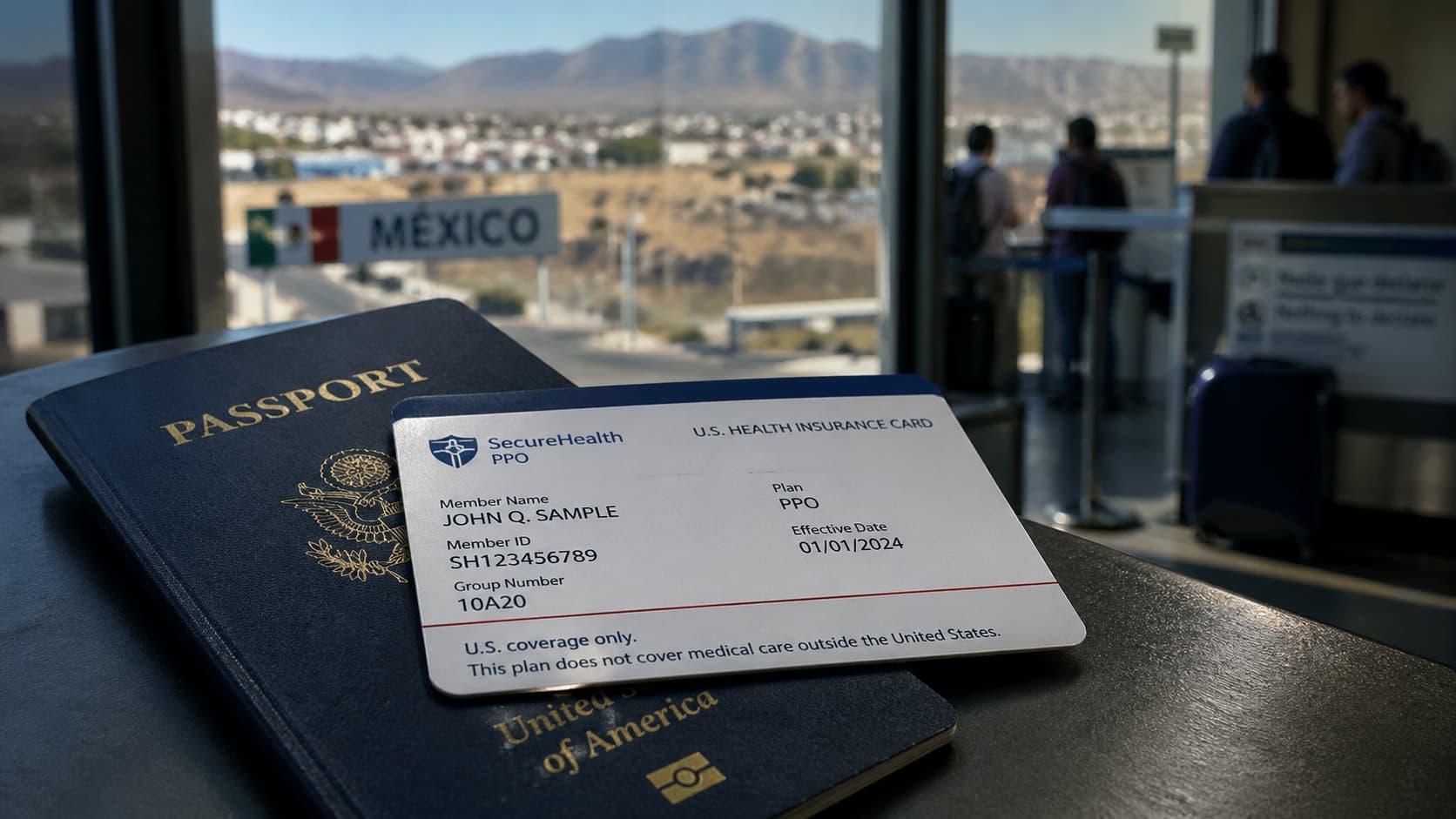
Planning around Medicare abroad? This article covers why US coverage: private plans, ACA, and Medicare, generally stops at the border. If Medicare is your main concern, start with our complete guide to Medicare for expats, then come back here for the fuller picture.
Introduction to Why Your US Health Insurance Stops at the Border:
Most Americans assume their health insurance follows them wherever they go. It feels like it should. You pay your premiums, you have a card in your wallet, and your insurance company is a household name. But the moment you cross into Mexico, Belize, or anywhere else outside US borders, that card in your wallet becomes about as useful as a gym membership in a city you no longer live in.
This is one of the most expensive misunderstandings we see at Expat Insurance. Retirees who assumed Medicare would travel with them. Working-age expats who thought their employer plan or Marketplace policy covered "emergencies anywhere." Snowbirds who learned the hard way that 60 days in Puerto Vallarta is not the same as a quick trip to the doctor in Phoenix.
Below, we walk through exactly why your US health insurance stops at the border, what each type of plan does and does not cover abroad, and what you should be doing instead. If you want the full breakdown specifically on Medicare, we have a dedicated guide on Medicare Coverage for Americans Living Abroad. This article is the broader picture for everyone, not just seniors.
Why US Health Insurance Stops at the Border – The Short Answer:
US health insurance is built around a network of US-licensed, US-enrolled providers, regulated under US federal and state law. None of that infrastructure exists in Mexico, Belize, Portugal, or Thailand. So when you walk into a hospital in Guadalajara or San Pedro, your insurer has no contracted relationship with that facility, no negotiated rates, and in many cases, no legal pathway to pay them at all.
There are three big reasons your coverage falls apart at the border:
– Network Restrictions –
Almost every US plan, whether it's an HMO, PPO, EPO, or Medicare Advantage, is built around a network of contracted providers. Foreign hospitals are not in that network. They cannot be in that network. Out-of-network coverage abroad, when it exists, is usually limited to true emergencies, and even then, you'll be paying upfront and fighting for reimbursement for months.
– Regulatory Limits –
Some types of US insurance, especially government programs like Medicare, are explicitly prohibited by law from paying for care delivered outside the United States. This isn't a network choice. It's federal statute.
– Residency and Enrollment Rules –
Many US plans require you to live in a specific service area. If you move abroad full-time, you may not even be eligible to maintain the policy, regardless of whether you keep paying premiums.
Let's break each type of coverage down.
Medicare – What Happens at the Border:
For seniors, this is the biggest shock. Medicare is the most generous federal benefit many Americans will ever receive, and abroad, it covers almost nothing.
– The Statutory Exclusion –
Section 1862(a)(4) of the Social Security Act explicitly excludes items and services furnished outside the United States from Medicare coverage. Only narrow exceptions exist for emergency situations and care at qualified foreign hospitals near US borders.
The official Medicare.gov publication puts it plainly: in most situations, Medicare will not pay for health care or supplies you get outside the US. The definition of "United States" under 42 CFR 411.9 includes only the 50 states, District of Columbia, Puerto Rico, US Virgin Islands, Guam, Northern Mariana Islands, and American Samoa. Mexico, Canada, and all other foreign countries are explicitly excluded.
– Medicare Advantage Doesn't Solve It –
Some expats are told that Medicare Advantage plans "include foreign coverage." This is one of the most dangerous pieces of misinformation in the expat space. Medicare Advantage plans require permanent residence within the plan's service area under 42 CFR 422.50(a)(3). If you live outside that service area for more than 6 months, the plan must disenroll you under 42 CFR 422.74(d)(4).
There are no CMS-approved Medicare Advantage plans for Americans living permanently abroad. Anyone telling you otherwise is either mistaken or attempting to enroll you in a fraudulent scheme. We cover the full breakdown of these schemes, including a real Florida-Nicaragua prosecution where defendants received prison sentences ranging from 15 months to 4 years, on our Medicare Coverage for Americans Living Abroad page.
– Medigap Has a Lifetime Cap –
Medigap Plans C, D, F, G, M, and N include a foreign travel emergency benefit. It sounds helpful until you read the fine print: $50,000 lifetime maximum (cumulative across all trips, never resets), $250 annual deductible, 80% coverage of billed charges, and only the first 60 days of any trip. Medical evacuation, often the most expensive piece of a foreign emergency, is not included.
A single serious hospitalization abroad could exhaust the entire $50,000 lifetime cap. For full-time expats, the 60-day trip limit makes Medigap fundamentally incompatible with permanent residence abroad.
Employer-Sponsored Health Insurance – What Happens at the Border:
If you have insurance through your job, here's what you need to know before you take that international assignment, sabbatical, or remote-work move.
– Most Plans Are State-Licensed –
Employer-sponsored plans are usually issued by US carriers regulated at the state level. Their networks are domestic. Coverage outside the US is typically limited to "emergency care," and the definitions of emergency vary widely by plan.
– Out-of-Network Reimbursement Abroad –
When your plan does pay for foreign emergency care, it almost always works as out-of-network reimbursement. That means you pay the foreign hospital upfront, in cash or by credit card, then submit documentation in English (or pay for translation), and wait weeks or months for partial reimbursement. Hospitals abroad will not bill your US insurance directly, because they have no contracted relationship with the carrier.
– No Routine Care –
Even the most generous employer plans almost never cover routine care abroad. No annual physicals, no dental cleanings, no specialist visits, no prescription refills, no chronic disease management. If you live abroad full-time, you are essentially uninsured for everything except emergencies, and even those are reimbursement headaches.
– What About COBRA? –
COBRA continues your former employer's plan after you leave the job, but it doesn't change the geography problem. It's the same domestic plan with the same network limitations. You're paying full premium plus a 2% admin fee for coverage that doesn't follow you abroad.
Marketplace and ACA Plans (Obamacare) – What Happens at the Border:
ACA plans are arguably the worst option for expats, despite being how many self-employed Americans get covered.
– Geographic Networks Are Tight –
Marketplace plans are sold by state, and many use narrow regional networks. Some don't even cover you in the next state over without out-of-network penalties, let alone in another country.
– No Foreign Coverage at All –
Most Marketplace plans provide zero coverage outside the US. Not even emergencies. The plan is designed to comply with US essential health benefits requirements, all of which assume care is being delivered domestically.
– You're Paying for Coverage You Can't Use –
This is the core insight: if you're living abroad and still paying ACA premiums "just in case," you're paying for a product that almost certainly will not pay a single foreign claim. We've written previously on Obamacare and the expat, and the math has not changed. For most expats, ACA coverage is dead money.
Tricare and VA Benefits – What Happens at the Border:
Military and veteran beneficiaries get a slightly better deal abroad than civilian programs, but it's still complicated.
– Tricare Overseas –
Active-duty military and certain Tricare plans do extend overseas through the Tricare Overseas Program. Coverage exists in most countries, but you'll need to find approved providers, navigate claims in a foreign language, and understand which Tricare plan you actually have. Tricare for Life, the supplement for Medicare-eligible retirees, generally requires Medicare Part A and B and inherits Medicare's geographic limits.
– VA Healthcare –
The VA Foreign Medical Program covers care for service-connected conditions only, in foreign countries, for eligible veterans. Non-service-connected conditions are not covered abroad. So if your bad back is service-connected, you may have coverage. If you develop a kidney issue years after discharge, you do not.
Travel Insurance – What Happens at the Border:
Travel insurance is what many people reach for as a stopgap. It can be excellent for short trips and a poor fit for full-time expat life.
– Travel Insurance Is For Trips –
Travel medical policies are designed for vacations and short stays. They cover emergencies during a defined trip, usually with strict trip-length limits (often 30, 60, or 180 days) and no coverage for routine or chronic care.
– It Is Not a Replacement for Health Insurance –
If you live abroad, travel insurance will not cover your annual checkup, your blood pressure medication, your dermatologist appointment, or the gallbladder surgery you've been putting off. We've broken this down in our guide on Travel vs Comprehensive Insurance and The Difference Between Health Insurance and Travel Insurance in Latin America.
– Pre-Existing Conditions Are Often Excluded –
Travel insurance commonly excludes pre-existing conditions, or only covers them under narrow circumstances. If you have a chronic condition, travel insurance is unlikely to be a real safety net.
Why This Matters – Real Costs Abroad:
It's tempting to think, "Healthcare is cheap in Mexico, I'll just pay cash." For routine visits and minor issues, that's often true. A GP visit in Mexico can cost $30 to $60 USD. A dental cleaning can cost $40. Medications are often a fraction of US prices.
The problem is the catastrophic event. The car accident, the cardiac issue, the cancer diagnosis. Major surgeries and ICU stays in Mexican private hospitals can run from $20,000 to well over $100,000 USD. A medical evacuation back to the US, or to a more equipped facility, can cost between $10,000 and $100,000 USD depending on distance and complexity. We've seen this clearly in our reporting on healthcare in Belize, where evacuations are routinely required because the local infrastructure cannot handle complex cases.
If your US health insurance does not cover any of that, and your travel insurance ran out at day 60, you are paying out of pocket at the worst possible moment.
What You Should Actually Do – Coverage That Works Abroad:
Here's the practical playbook we walk our clients through:
– Full-Time Expats –
If you live abroad permanently, you need international health insurance designed for expats. These are policies issued by global carriers that cover routine and emergency care worldwide, including in your country of residence and back home in the US for visits. We compare options in our guide to the best international health insurance for expats.
For Medicare-eligible retirees abroad, the layered approach we recommend is: keep Medicare Part A (it's free), consider keeping Part B to avoid permanent late enrollment penalties, add a Medigap plan for emergency coverage during US visits or short trips, add a medical evacuation plan, and carry a reserve of approximately $50,000 for unexpected medical costs that cannot be evacuated. Local government plans like IMSS in Mexico can serve as additional backup.
– Snowbirds –
If you split time between the US and abroad, keep your US coverage and add a travel medical policy or international plan for the foreign portion of the year. Original Medicare plus Medigap is usually a better fit than Medicare Advantage for snowbirds, because Medigap's emergency benefit (limited as it is) is more compatible with travel than Medicare Advantage's strict 6-month service area rule.
– Digital Nomads –
If you're moving every few months, look at international health insurance designed for nomads, or annual multi-trip travel medical plans. We've covered this in our guide to health insurance for digital nomads.
– Working Abroad with Employer Coverage –
If your employer provides international health coverage as part of your overseas assignment, read the fine print carefully. Confirm what happens when you're between assignments, what coverage extends to family members, and whether US visits are included. Group international plans vary widely in quality.
Frequently Asked Questions – US Health Insurance Abroad:
– Will my US insurance cover me on vacation in Mexico? –
Maybe, for emergencies only, and as out-of-network reimbursement. You'll pay upfront and submit for reimbursement after. For anything routine, no. We always recommend a separate travel medical policy for international trips, even short ones.
– Can I keep my US insurance and just pay cash for care abroad? –
Yes, and many expats do, for routine care. The risk is the catastrophic event. Cash works for $50 doctor visits. It does not work for a $60,000 hospital stay or a $40,000 medical evacuation.
– Does Medicare ever cover anything abroad? –
Only in three narrow exceptions involving foreign hospitals closer to your US residence than the nearest US hospital, or emergencies in the US where the closest hospital happens to be in Canada or Mexico. For practical purposes, treat Medicare as zero coverage abroad. The full breakdown is on our Medicare coverage page.
– What if I just don't tell my US insurance I moved? –
For private plans, this can lead to denied claims and policy cancellation if discovered. For Medicare Advantage specifically, misrepresenting your residence to maintain enrollment is federal fraud. We've documented real prosecutions on our Medicare page. Don't do it.
– Is international health insurance expensive? –
For expats living in Mexico and most of Latin America, comprehensive international plans often cost less than what Americans pay for ACA premiums in the US, while providing far better coverage abroad. Pricing depends on age, country of residence, and plan tier. We can run a quote in about a minute.
Conclusion – Why Your US Health Insurance Stops at the Border:
Your US insurance card is not a passport. The structural reality is simple: US health insurance is built for the US healthcare system, regulated under US law, contracted with US providers, and priced around US risk pools. None of that translates abroad.
If you're moving abroad, snowbirding for more than a couple of months, or just spending serious time outside the US, you need coverage that was actually designed for that life. That usually means an international health insurance policy, sometimes layered with a medical evacuation plan and, for retirees, a thoughtful Medicare strategy back home.
The worst time to figure this out is in the back of an ambulance. The best time is before you board the plane.
At Expat Insurance, we specialize in helping Americans abroad find coverage that actually works in the country they live in. We'll never sell you a product you're not eligible for, and we'll always explain the limitations of any option. Reach out for a free consultation about your specific situation.
Justin Barsketis
Insurance Expert & Writer
Justin is an insurance guru that loves digital marketing. As our founder Justin manages our business development programs and MGA network. Please don’t hesitate to contact him if you are not getting the attention you deserve.
