

November 28, 2025
•
5 min read
China Work Permit Visa Your Essential How To Guide
Navigate the China work permit visa process with confidence. This guide covers documents, employer roles, and the path to your residence permit.
Thinking about getting a work visa for China? It's not just one piece of paper. The whole process is actually a sequence of three key documents: the Work Permit Notification Letter, followed by the Z Visa, and finally, a Residence Permit. Think of it as a multi-stage approval that ultimately gives you the legal right to work and live in mainland China.
Understanding China's Work Visa Framework
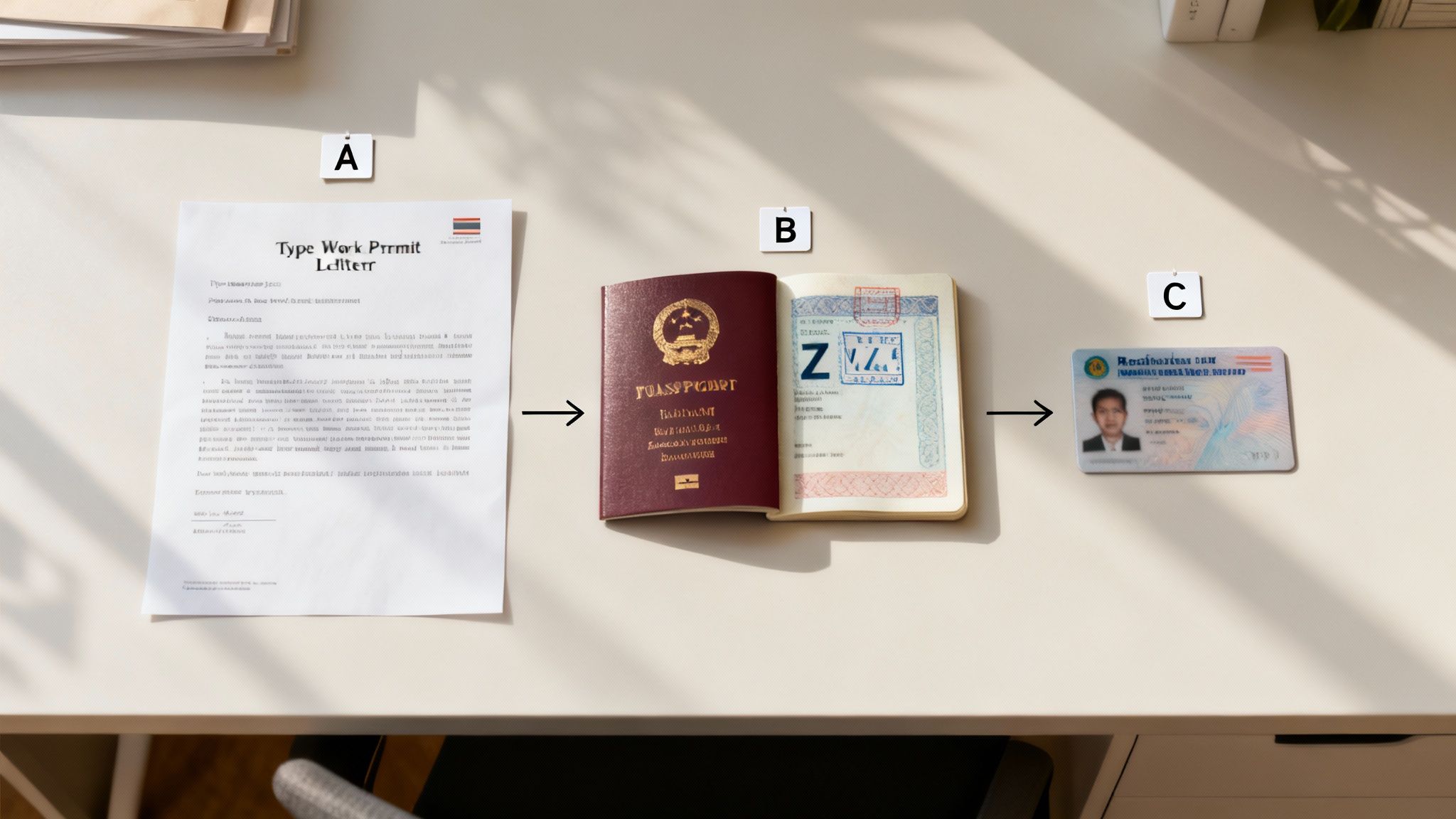
Before you get buried in paperwork, it’s really helpful to understand how China’s system for foreign workers is structured. It's a three-part journey, and each step unlocks the next. You can't skip ahead.
This process is designed to make sure both you and your employer meet the government's strict criteria. While every country handles work authorization differently, grasping the sequential nature of China’s requirements is the first real step to a smooth application. For context, you can see how this differs from various Canadian work visa types.
The Three Pillars of Your Legal Status
Your legal status in China is built on three distinct but interconnected documents. Each one serves a specific purpose at a different point in your relocation journey.
- Work Permit Notification Letter: This is the first green light. It’s a pre-approval from the Chinese authorities confirming you’re qualified for a specific job. Your employer handles this application for you while you're still in your home country.
- Z Visa: With the notification letter in hand, you can then apply for the Z Visa at a Chinese embassy or consulate. This is a single-entry visa that lets you enter China specifically for work. It’s usually only valid for 30 days after you arrive.
- Residence Permit: This is the final and most crucial piece. Once in China, you have to convert your Z Visa into a Residence Permit within that 30-day window. It's a sticker in your passport that allows you to live in China and travel in and out of the country freely for its duration, which is typically one year to start.
The A, B, and C Classification System
China sorts foreign workers into three tiers—A, B, and C. This classification is a big deal and directly impacts how your application is prioritized and scrutinized. It’s all based on a points system that looks at things like your salary, education, work experience, and age.
- Category A (Encouraged): This is for top-tier talent. Think senior executives, internationally recognized professionals, or anyone earning over six times the local average salary. These applications get fast-tracked.
- Category B (Restricted): This is where most foreign professionals land. You'll typically need a bachelor's degree and at least two years of relevant post-graduate work experience that matches the job description.
- Category C (Strictly Restricted): This category covers non-technical or service roles and is much, much harder to get approved for.
Your qualifications and salary offer will place you squarely in one of these streams, setting the tone for the rest of the process.
To give you a clearer picture, here's a quick breakdown of these categories.
China Work Visa Categories At A Glance
| Category | Target Professional | Key Eligibility Factors | Average Processing Time |
|---|---|---|---|
| A | Highly skilled & top talent | High salary (6x local average), international awards, senior management | 5-10 working days |
| B | Standard professionals | Bachelor's degree + 2 years of relevant work experience | 10-15 working days |
| C | Non-technical or service | For specific, non-specialized roles; very strict requirements | Varies greatly; longer processing |
This tiered system is a pretty clear signal of the kind of professionals China is looking to attract.
China is always tweaking its policies to draw in specific kinds of talent. It’s a dynamic environment, and it pays to stay aware of how global visa requirements are shifting. For a deeper look at the various visa policies around the world, our guide to https://www.expatinsurance.com/articles/visa-requirements-for-foreign-travel can be a useful resource.
Getting Your Documents in Order for a Successful Application

If there's one place you can't afford to cut corners, it's with your paperwork. A successful China work permit application is built on a foundation of flawless, meticulously prepared documents. Think of it like building a house—a single cracked brick can threaten the whole structure. Small errors here don't just cause minor delays; they can lead to outright rejection, forcing you to start the entire process from square one.
This is almost always the most time-consuming part of the whole journey, especially since you'll be dealing with various government agencies. This isn't something you can knock out in a weekend. Realistically, you should plan for this phase to take at least one to two months before your employer in China can even submit the application on their end.
The Core Document Checklist
Your employer will give you a specific list tailored to your situation, but nearly every applicant for a China work permit will need to gather the same core set of personal documents. Getting a head start on these will save you a lot of stress later.
Here's what you should start tracking down now:
- Valid Passport: This is obvious, but check the details. It needs at least six months of validity left and at least one completely blank visa page. You'll also need crisp, high-quality digital scans of the main photo page.
- Highest Degree Certificate: Dig out your original diploma. If the degree wasn't issued in English or Chinese, you'll need to get a certified translation.
- Non-Criminal Record Certificate: This is a big one. It's a formal document from your home country's police or a federal agency proving you have a clean record. Crucially, it must be issued within the last six months to be valid.
- Work Experience Verification Letter: You'll need letters from past employers that confirm your job titles and responsibilities. These details must align with the job you're about to take in China. Consistency is key.
- Digital Photo: A recent, passport-style photo with a plain white background.
Just collecting these items is step one. The next phase, authentication and legalization, is where many people run into trouble.
Navigating Authentication and Legalization
This two-part bureaucratic dance is non-negotiable. It’s how you prove to the Chinese government that your documents are the real deal. The exact steps you'll take depend on whether your home country is part of the Hague Apostille Convention.
If you're from a member country, your life is a bit easier. Your degree and criminal record check will just need an Apostille. This is a single, standardized certificate issued by a designated authority in your country that authenticates the document for international use.
If your country isn't a member, you'll follow the more traditional, multi-step legalization route:
- Notarization: A local notary public verifies your signature or the document's authenticity.
- State/Federal Authentication: A higher government body (like your state's Secretary of State or the U.S. Department of State) authenticates the notary's seal.
- Chinese Embassy/Consulate Legalization: The final step. You take the authenticated document to the Chinese embassy or consulate in your country, and they add their official seal. This makes it legitimate for use in China.
Pro Tip: Don't underestimate this process. A very common mistake is getting a document notarized and thinking you're done. You're not. An incomplete chain of verification—missing the state or embassy stamp—is an instant rejection.
The Official Medical Examination
You'll also need to get a full medical check-up using the official Chinese government form, sometimes called the "Physical Examination Record for Foreigner." Most people can have their regular doctor fill this out, but every single field must be completed. No blanks.
The exam screens for a range of conditions, including infectious diseases like tuberculosis and HIV, alongside a general health assessment. Make sure the final form is stamped by the clinic or hospital and signed by the physician. A missing stamp or signature is a classic rookie mistake that can cause major headaches after you land in China.
On a brighter note, the system is slowly modernizing. China's work visa system saw some big changes in December 2024, notably integrating the physical Foreigner's Work Permit into an electronic Social Security Card. This is part of a broader push to manage applications and renewals online, making things a bit more efficient. You can get more details on these policy shifts and China's efforts to create a more market-driven business environment. For a global perspective, you can also discover more insights about these migration management updates from the OECD.
Securing Your Z Visa From Your Home Country
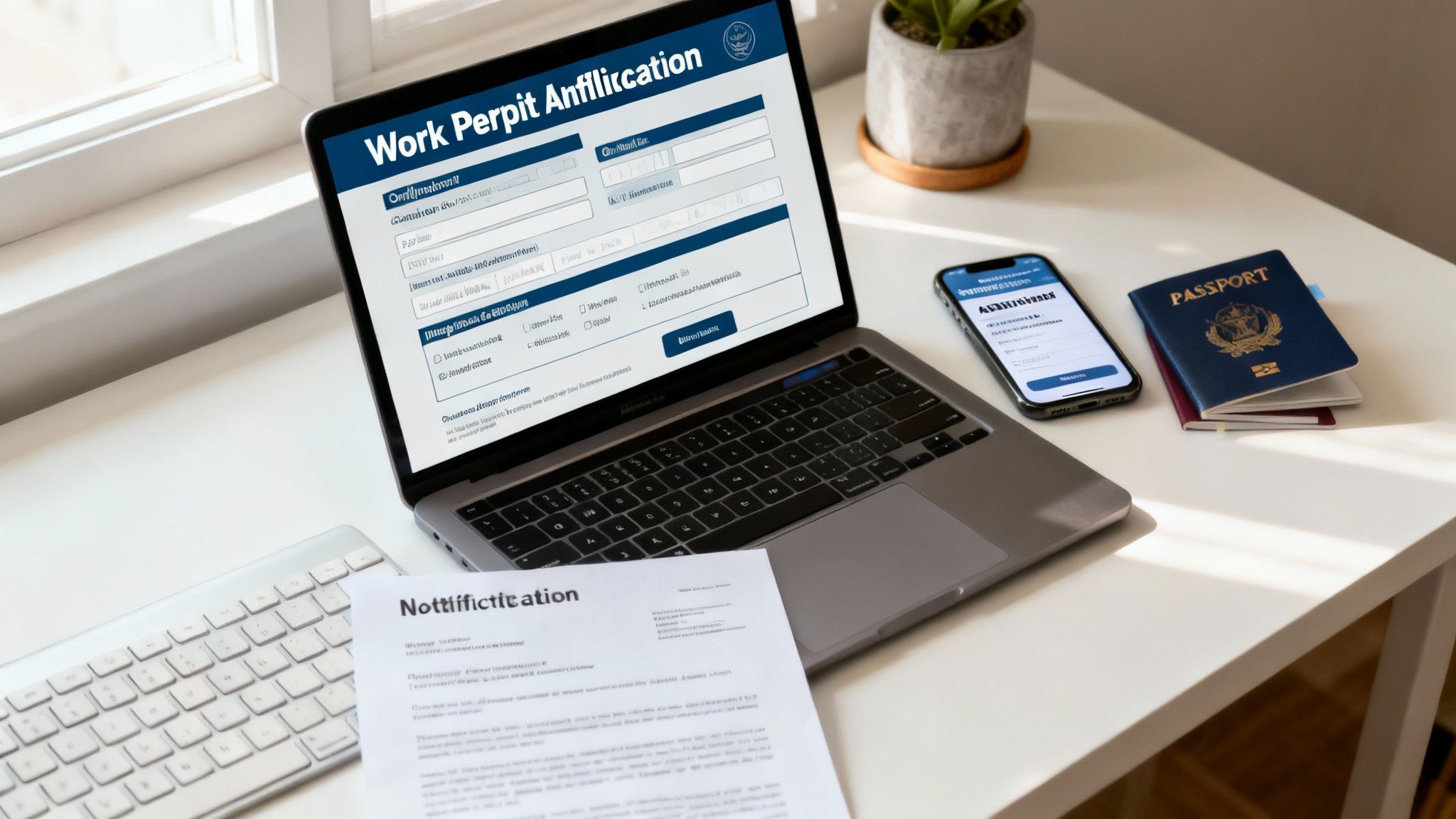
Alright, you’ve wrestled with the paperwork and have your authenticated documents in hand. Now, the ball gets passed to your future employer in China. This is where the official application for your China work permit visa really kicks into gear, and it all happens while you’re still in your home country.
Think of it as a two-act play. First, your employer secures the critical Work Permit Notification Letter. Once that’s approved, you take that letter and apply for your Z Visa at a local Chinese embassy. Getting this sequence right is everything—a mistake in the first act brings the whole show to a halt.
Your Employer Kicks Off the Work Permit Application
This first big move is mostly out of your hands, but your employer will need you to be on standby. They'll take the digital copies of your freshly authenticated documents and apply for a Work Permit Notification Letter. This is all done online through the government's official portal, the "Service System for Foreigners Working in China."
This isn't a simple upload-and-go process. Your employer has to submit a mountain of information about their company, the job they're hiring you for, and make a case for why you’re the perfect fit. Your documents are the hard evidence that backs up their application.
Your job here is to be incredibly responsive. It's almost guaranteed your employer or their agent will have a question or need a clearer scan of a document. Any delay on your part directly pushes back their submission date, so keep a close eye on your email and phone.
This online pre-approval is a huge deal. It’s where the authorities officially classify you as a Category A, B, or C worker. A clean, consistent application here makes everything that follows so much smoother.
Submitting Your Z Visa Application
Once your employer's application gets the green light, they’ll receive the electronic Work Permit Notification Letter. They’ll send this straight to you, and it instantly becomes the golden ticket for your Z Visa application. Now, it's your turn to act.
You’ll apply for the Z Visa at the Chinese embassy or a designated Chinese Visa Application Service Center (CVASC) in your country. Here’s what that looks like:
- Fill Out the Online Application Form: You'll need to complete the official visa application form online. It's a long one, covering everything from your personal history to your planned work in China.
- Get Your Documents Together: You’ll need the Work Permit Notification Letter, your original passport, the printed application form, a specific digital photo, and sometimes proof of your flight and hotel bookings.
- Book an Appointment: Most locations require you to book an appointment online to hand over your documents and provide biometrics (fingerprints). Don't just show up.
- Go to Your Appointment: On the big day, you'll submit everything in person, get your fingerprints scanned, and pay the visa fee.
This is the final step to getting that all-important visa sticker in your passport, which is your permission slip to enter China for work.
Preparing for a Smooth Embassy Visit
While getting the Z Visa is mostly a formality once you have the notification letter, being prepared saves a lot of headaches. Before you leave for your appointment, double-check that you have every single form printed out, along with both originals and photocopies of your documents as required.
Sometimes, the consular officer might ask you a few simple questions about your new job or employer. Just answer honestly and to the point. They’re not re-interviewing you for the job; they're just confirming the details on your application. Remember, your approved Work Permit Notification Letter has already done the heavy lifting.
The Z Visa processing time is usually pretty quick—around four to five business days. If you're in a hurry, you can often pay extra for an expedited service. Once you pick up your passport and see that new Z Visa inside, you're officially ready to book your flight and start the next chapter.
Application Timeline And Responsibilities
Understanding who does what and when can really demystify the process. Delays often happen simply because one party is waiting on the other without realizing it.
Here’s a practical breakdown of the key stages, who’s in the driver's seat, and a realistic timeframe for each step.
| Stage | Primary Responsible Party | Key Documents Involved | Estimated Duration |
|---|---|---|---|
| Document Authentication | Applicant | Diploma, TEFL, criminal record, passport | 4-8 weeks |
| Work Permit Notification | Employer | Authenticated docs, employment contract, company licenses | 2-4 weeks |
| Z Visa Application | Applicant | Notification letter, passport, visa application form | 1-2 weeks |
| Arrival & Registration | Applicant & Employer | Passport, Z Visa, lease agreement | Within 24 hours |
| Medical Check | Applicant | Passport, photos, official form | 1-2 days |
| Residence Permit | Applicant & Employer | Medical check results, passport, work permit card | 2-3 weeks |
This timeline should give you a solid idea of the entire journey, from gathering your first document to finally getting your residence permit in China. As you can see, the total process can easily take 2-4 months, so planning ahead is absolutely essential.
Finalizing Your Legal Status After Arriving In China
Touching down in China with your Z Visa is a massive win, but don't get too comfortable. The moment you clear immigration, a new clock starts ticking. Think of the Z Visa as the key to unlock the door—you still need to secure the room. You have a strict 30-day window to turn this temporary entry pass into a long-term Residence Permit.
This is where your employer's local HR team or a hired agent becomes absolutely indispensable. They've run this gauntlet countless times and know the specific quirks of the process in your city. Lean on them, but stay involved. Missing a deadline at this stage can have huge consequences, even forcing you to leave China and start the entire application from scratch.
Immediate Registration With Local Police
Your very first task, and it's a non-negotiable one, is registering your address with the local police station (派出所, pàichūsuǒ). You have to get this done within 24 hours of arrival. I'm not kidding—this is a hard deadline for all foreigners.
If you’re staying in a hotel, they handle this for you when you check in, so you're covered. But if you're moving straight into an apartment or crashing with a friend, you need to head to the police station that covers your neighborhood yourself.
You'll need to bring a few things:
- Your original passport with the Z Visa inside
- Your rental agreement or lease
- A copy of your landlord’s ID and their property ownership certificate
The police will issue a crucial piece of paper called the Registration Form of Temporary Residence. Guard this document with your life; you'll need it for the Residence Permit application.
The In-Country Medical Check Verification
Even if you went through a comprehensive medical exam back home, Chinese authorities almost always require a local health check. At the very least, they'll need to verify your foreign results. Your employer will point you to a government-designated medical center to get this done.
The check itself is pretty standard: a blood test, urine sample, chest X-ray, and a basic physical exam. They're mainly screening for serious communicable diseases. You'll usually get the results back in a few business days.
Insider Tip: Get this appointment booked for your first week. The medical report is a mandatory piece of the puzzle for your Residence Permit, and waiting for it can burn through your precious 30-day window faster than you think.
Having the right health coverage is also critical during this time. While your company might offer a local plan, many expats opt for their own international policies for more comprehensive protection. Solid health insurance for expats can be a real lifesaver when you're figuring out a new country's healthcare system.
Converting Your Z Visa to a Residence Permit
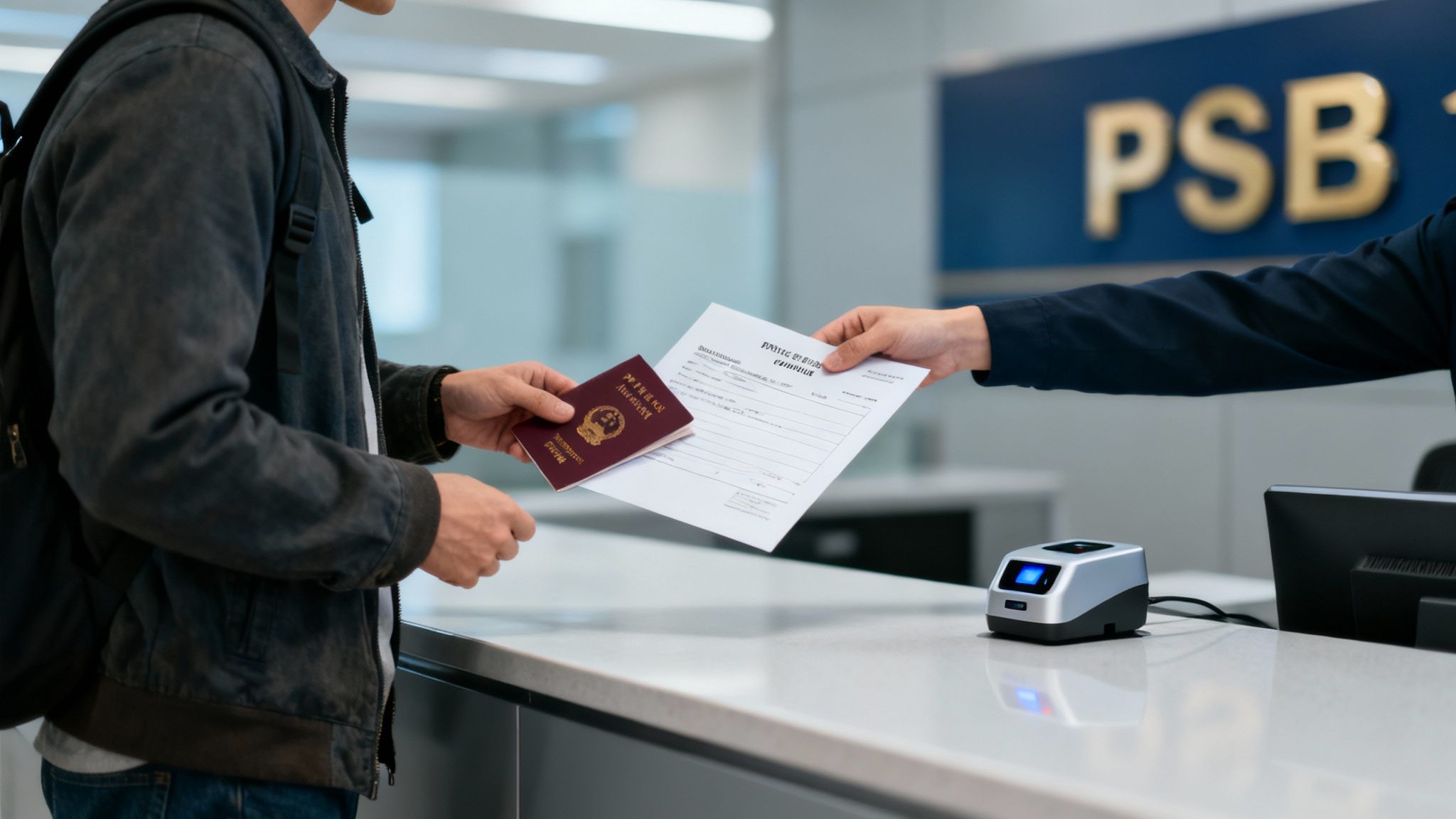
This is it—the final hurdle to lock in your legal status for your China work permit visa. Once you have your police registration and medical clearance, you and someone from your company will head to the local Public Security Bureau (PSB) Entry-Exit Administration office. This is where you officially apply to swap the Z Visa for a Residence Permit.
The Residence Permit is a sticker they place in your passport, which formally allows you to live and work in China. For first-time applicants, it's typically valid for one year. It also doubles as a multiple-entry visa, so you can travel in and out of China without any extra paperwork.
At the PSB, you'll hand over your entire document file—passport, temporary residence form, medical report, employment contract, and your company’s business license. They'll also take your biometrics, which just means a digital photo and your fingerprints.
Heads up: you'll have to leave your passport with the PSB while they process the application. This can take anywhere from 10 to 15 working days, and you can't travel outside mainland China during this time. They’ll give you a receipt that acts as your temporary proof of legal status.
Once it's approved, you’ll go back to collect your passport and find your shiny new Residence Permit inside. Congratulations—you are now officially and legally a resident worker in China.
Navigating Renewals And Common Application Hurdles
Even if you’ve prepared perfectly, the application process for a China work permit visa can hit unexpected snags. It happens. A tiny error on a form, a question about your employer's qualifications, or even an ambiguous result on your medical check can cause serious delays.
These hurdles are more common than you'd think, but they don't have to derail your plans. The key is knowing how to respond quickly and correctly.
Likewise, once you’re settled in China, your work and residence permits aren't permanent. They come with an expiration date, and staying on top of the renewal process is just as crucial as the initial application. You have to be proactive to keep your legal status intact.
Troubleshooting Common Application Problems
Let’s get into some of the most frequent issues applicants run into and, more importantly, how to fix them. These problems often seem small but can have big consequences if you don't handle them right.
-
Minor Document Errors: A classic mistake is a name inconsistency. For example, your passport says "Robert Jones" but your degree certificate says "Rob Jones." This kind of discrepancy will absolutely be flagged. The fix is usually to get an official affidavit or a clarifying statement from your university confirming that both names refer to the same person.
-
Company Qualification Issues: Sometimes, the problem isn't with you, but with your employer. Local authorities might question whether the company has a genuine need to hire a foreign national for the role. In this scenario, your employer needs to step up and provide a detailed justification letter, outlining why your specific skills are essential and can't be found in the local talent pool.
-
Unexpected Medical Results: A "grey area" result on your medical check, like an unclear chest X-ray, can bring your application to a grinding halt. The authorities will typically require you to undergo further tests at a designated hospital in China to get a definitive diagnosis before they'll move forward.
Responding to an official request for more information isn't a sign of failure; it's just part of the process. The authorities are simply doing their due diligence. Provide clear, direct answers and any extra documents they ask for as quickly as you can.
The Permit Renewal Process
Your first work and residence permits are usually valid for one year. You absolutely cannot let them expire. The renewal process should kick off 30 to 60 days before the expiration date. Starting late is a recipe for stress and potential legal trouble.
An expired residence permit is a huge deal in China, and the consequences can be severe.
Overstaying your visa is not taken lightly. While it might be tempting to compare situations, understanding how different countries handle this can underscore the seriousness of timely renewals in China. For instance, our article on what to do if you've overstayed your visa in Mexico shows different approaches, but China's rules are famously strict.
What You Need for Renewal
The good news? The renewal process is generally simpler than the initial application because you don't need to re-authenticate your degree or criminal record. You will, however, need a fresh set of documents.
Your employer will help you pull together the necessary paperwork, which typically includes:
- Your original passport and current residence permit
- The original Work Permit Card
- A new, signed employment contract or an official extension letter
- Updated business licenses and registration forms from your company
- Your temporary residence registration form from the local police station
The process itself mirrors the final steps of your initial arrival. First, your employer will apply online to renew the Work Permit. Once that's approved, you'll submit the application to renew your Residence Permit at the local Public Security Bureau (PSB) Entry-Exit Administration.
Just like the first time, you'll have to leave your passport with them for about 10-15 working days.
By planning ahead and working closely with your employer, you can ensure a smooth transition from one permit to the next, letting you continue your work and life in China without any legal hiccups.
Frequently Asked Questions
When you're navigating the China work permit process, a million questions pop up. It's totally normal. Here are some of the most common ones I hear from expats, with straightforward, no-nonsense answers.
Can I Bring My Family With Me?
Yes, absolutely. Once you’ve secured your own Residence Permit, bringing your spouse and children (under 18) is a standard procedure. They'll start by applying for an S1 visa in your home country to join you.
After they arrive in China, you'll convert their S1 visas into Residence Permits that are linked to yours. Just be ready with the right paperwork—you'll need officially authenticated marriage and birth certificates to prove your relationships. A lot of employers will help with dependent visas, so definitely ask your HR what kind of support they offer.
What Happens If I Change Jobs?
Switching jobs in China isn't just about giving notice and starting somewhere new. It involves an official transfer of your work permit, and you have to get this right to stay legal.
Here’s the basic flow:
- Your current company must officially cancel your work permit.
- They then need to give you a formal release letter.
- Your new employer takes that letter, your new contract, and other documents to apply for a new work permit under their company.
Crucial Timing: The timing here is everything. You cannot have a gap between the old permit being canceled and the new one being activated. Working for even a day without a valid permit tied to your current employer is illegal. You'll need to coordinate carefully between both your old and new HR departments to make sure the handover is seamless.
How Long Does the Entire Process Take?
Be prepared for it to take a while. A realistic timeline, from gathering your documents back home to getting your final Residence Permit in hand in China, is anywhere from two to four months.
Why such a big window? A few things can speed it up or slow it down. The authentication process in your home country is a huge variable; some governments are just faster than others. The local authorities in your specific city in China also work at their own pace. Even though Category A applicants might get through a bit quicker, if you're a Category B professional, you should definitely budget for at least three months. My advice? Start as early as you possibly can.
Can I Apply While Already in China?
Maybe, but don't count on it. This is only possible in very specific situations. For instance, if you're already in the country on a business (M) or student (X) visa, you might be able to switch to a work-type Residence Permit without leaving.
This isn't the standard route, though, and it really depends on the local rules in the city where you'll be working. It's an option usually reserved for high-level "Category A" talent and is never a guarantee. You absolutely must talk to your employer and the local Public Security Bureau (PSB) Entry-Exit Administration to see if this is even a possibility for you.
Navigating the complexities of international relocation is easier with the right support. For comprehensive health coverage tailored to your life abroad, the experts at Expat Insurance can help you compare plans from over 65 insurers to find the perfect fit. Get your free quote and personalized advice at https://www.expatinsurance.com.
