
January 18, 2026
•
5 min read
How to Retire Overseas A Practical Guide to Your Dream Life
Thinking about how to retire overseas? Our guide covers finances, visas, healthcare, and choosing the perfect country to make your dream a reality.
So, you're dreaming of retiring overseas. You'll need a practical roadmap: finding a destination that fits your lifestyle, securing the right visa, nailing down a detailed financial plan, and arranging solid international healthcare. This isn't just a fantasy; it's a completely achievable goal built on good research and careful preparation.
Is Retiring Overseas Right for You?
The idea of spending your golden years on a sun-drenched beach or in a historic European city is more within reach than ever. For a growing number of people, retiring abroad isn't just about escaping bad weather—it's a strategic move. In fact, some research shows that about one in three Americans are considering it, and their motivations go way beyond just a permanent vacation.

Defining Your "Why"
Before you even think about packing a single bag, you have to get clear on your core reasons for wanting to move. Are you chasing a lower cost of living? A better quality of life? Maybe a richer cultural experience? Your personal "why" is the compass that will guide every single decision you make from here on out.
A few common motivations I see all the time include:
- Financial Benefits: Many countries offer a significantly lower cost of living, which means your retirement savings can stretch much, much further. Imagine your Social Security check covering not just the necessities but also travel and hobbies. It's a game-changer.
- Lifestyle Upgrade: You might be drawn to a slower pace of life, healthier food, or just more opportunities for walking, hiking, and getting involved in a local community.
- New Adventures: For many, the thrill of learning a new language, exploring ancient ruins, or simply immersing themselves in a completely different culture is a powerful pull.
A successful international retirement is less about the destination and more about the preparation. Figuring out your "why" is the critical first step in turning that fuzzy dream into a concrete, actionable plan.
Building Your Foundational Plan
Once your motivations are crystal clear, the real work begins. Moving abroad is a massive life transition that demands a clear-eyed plan, not a blind leap of faith. This guide is designed to break down the entire process into manageable steps, moving beyond the romantic ideal to give you the practical framework you actually need.
Think of it like building a house. You need a solid foundation before you can even think about what color to paint the walls. The core pillars of your plan will involve navigating the biggest decisions you'll face: finding the right country, securing your visa, managing your finances, and arranging comprehensive healthcare. With thoughtful planning, you can confidently build a secure and fulfilling life abroad.
Finding Your Perfect Retirement Destination
Deciding where to spend your retirement is easily one of the most exciting parts of this whole adventure. But let's be real—it's about so much more than a pretty picture on a postcard. This is where the daydreams meet the pavement. A successful move hinges on a clear-eyed look at potential countries, focusing on the things that actually matter for a secure and happy life abroad.

The goal here isn't to find some mythical "perfect" country. That place doesn't exist. The real mission is to find the country that's perfect for you. And that whole process starts with some honest self-reflection to build a personal scorecard you can use to measure your options.
Create Your Personal Scorecard
Before you even think about spinning a globe, grab a pen and paper (or open a new doc) and list your absolute non-negotiables and your "nice-to-haves." Think of this as your personal filter. It'll help you quickly toss out places that just won't cut it and laser-focus on the ones that could be a real fit.
Here are the big categories to think through:
- Cost of Living: Seriously, how far will your retirement income go? Be brutally honest with your budget. Dig into resources that break down the most affordable places to live to get a realistic starting point.
- Healthcare Quality & Access: What are your health needs now, and what might they be in 10 or 20 years? You need to look at both public and private healthcare systems and find out if comprehensive international health insurance is a requirement for residents. It often is.
- Climate and Lifestyle: Do you see yourself thriving in year-round sunshine, or do you need the crisp air of four distinct seasons? Are you a big-city person who needs bustle and energy, or does a quiet village sound like paradise?
- Visa & Residency Requirements: This is a big one. Does the country have a clear, attainable path to legal residency for retirees? Some countries, like Portugal, have visas designed specifically for people with passive income, while others are notoriously complex.
- Proximity to Home: How important is it to be able to get back to see family and friends? A quick 3-hour flight feels a world away from a 15-hour haul across multiple time zones.
Researching Potential Countries
With your scorecard ready, it's time to build a shortlist of three to five countries. This is where you go from broad strokes to fine details. For example, the visa game can be wildly different from one country to the next. Portugal's famous D7 visa is a great option for folks with passive income, but Spain's Non-Lucrative Visa has similar—yet distinctly different—financial hoops to jump through.
You need to immerse yourself in the specifics. For instance, Greece has shot up the retirement rankings lately, and for good reason. It's got fantastic healthcare, that perfect Mediterranean climate, and a straightforward visa process. A couple can live quite well there on about $2,500 a month. You can find a sea-view apartment on an island like Corfu for around $800. Their Financially Independent Person permit requires proof of €3,500 in monthly passive income, making it accessible for retirees with solid pension income.
Here's a pro tip: Don't just rely on blogs and official government sites. Use your research to find and connect with actual expats living in your top-choice countries. Their on-the-ground stories about navigating banking, finding a good doctor, or just dealing with daily bureaucracy are worth their weight in gold.
Comparing Your Top Choices
Once you've got a few solid contenders, it's time for a head-to-head comparison. Seeing the data laid out visually in a simple table can bring a ton of clarity and make the right choice feel obvious.
To help you get started, here's a quick look at a few popular spots.
Top Retirement Destinations at a Glance
This is just a snapshot to compare some key factors side-by-side. You can build a more detailed version of this for your own top picks.
| Country | Estimated Monthly Cost for a Couple | Key Visa Option for Retirees | Healthcare System Highlights |
|---|---|---|---|
| Portugal | $2,500 - $3,000 | D7 Visa (Passive Income): Requires passive income like pensions or investments, around €870/month for an individual. | High-quality public system (SNS) is available to legal residents. Private insurance is affordable and widely used. |
| Mexico | $2,000 - $2,500 | Temporary Resident Visa: Can be based on monthly income (around $4,100) or savings (around $70,000). | Excellent, affordable private healthcare in major cities. Public systems (IMSS/INSABI) are also available. |
| Panama | $2,000 - $3,000 | Pensionado Visa: World-renowned; requires a lifetime pension of at least $1,000/month. Offers major discounts. | Top-tier private hospitals, many affiliated with U.S. institutions. Public system is also available. |
| Spain | $2,500 - $3,500 | Non-Lucrative Visa: Requires proof of sufficient funds to support yourself, around €28,800 annually for an individual. | One of the world's best public healthcare systems. Private options are also popular and inexpensive. |
This kind of systematic approach helps you look past the beautiful vacation photos and make a decision based on what truly matters for your retirement. By putting your top choices under the microscope, you can confidently zero in on the one or two destinations that really align with your vision.
For a deeper look into these and other great options, check out our guide to the best countries to retire.
Navigating Visas and Residency Pathways
This is where the dream of retiring abroad meets the reality of official paperwork. Securing the legal right to live in your chosen country can feel intimidating, a maze of complex forms and bureaucratic hurdles. But once you understand the main pathways available to retirees, you can break this daunting task into a manageable series of steps.
Think of a visa application not as a barrier, but as a country's formal invitation. You just need to show them you meet their criteria—primarily, that you can support yourself without becoming a burden on their system. This is why most retiree-friendly visas are built around proving your financial stability.
Decoding Common Retiree Visas
While every country has its own rulebook, the options for retirees usually fall into a few key categories. Knowing these helps you figure out the most likely path for your situation. It's less about finding a secret loophole and more about matching your financial profile to the right type of visa.
You'll generally come across three main avenues:
- Passive Income Visas: These are the most common and often the easiest to get. Countries want to see a steady, recurring income from sources like Social Security, pensions, investments, or rental properties. You aren't expected to work; you just have to prove you have enough money coming in each month to live on.
- Retirement-Specific Visas: Some nations have programs created specifically for retirees. Panama's famous Pensionado visa is a perfect example. It requires a lifetime pension of just $1,000 per month and offers incredible perks like discounts on travel, entertainment, and even healthcare.
- Investment or "Golden" Visas: If you have more significant capital, these visas offer residency in exchange for a substantial investment in the local economy. This could mean buying real estate, funding a business, or purchasing government bonds. For instance, Greece's program now operates on a tiered system: €800,000 minimum in high-demand areas like Athens, Thessaloniki, Mykonos, and Santorini; €400,000 in other regions; or €250,000 for specific commercial-to-residential conversions or heritage building restorations.
Real-World Scenarios & Financial Requirements
The financial thresholds for these visas vary wildly from one country to the next.
For example, to get Mexico's Temporary Resident Visa, you might need to show a monthly income of around $4,100 or prove you have a savings balance of about $70,000. The proof is straightforward, but the numbers are inflexible—you either meet the threshold or you don't.
Now, contrast that with a destination like Portugal, which has become a huge favorite for overseas retirement. Its D7 Passive Income Visa requires a monthly income of just €870 (about $960 USD). According to Social Security Administration data, over 10,700 retired Americans currently receive their Social Security benefits in Portugal.
It's worth noting that Portugal's formerly generous Non-Habitual Resident (NHR) tax regime, which offered a flat 10% tax on foreign pensions, ended for new applicants in 2024. However, visa processing times remain a consideration—with some applicants facing waits of up to six months. Planning way ahead is absolutely essential.
Crucial Tip: Never underestimate the timeline. The entire visa process, from gathering documents to receiving your approval, can easily take six months to a year. Start well in advance of your planned move to avoid stressful, last-minute delays.
Your Essential Document Checklist
No matter which visa you apply for, you'll need a core set of documents. Getting these organized early is one of the smartest things you can do. While the exact list varies, your file will almost certainly need to include:
- Valid Passport: Make sure it has at least one year of validity beyond your planned entry date.
- Proof of Financial Means: This means bank statements for the last 6-12 months, Social Security benefit letters, pension statements, and investment portfolio summaries.
- Proof of Health Insurance: Most countries require proof you have private health insurance that provides comprehensive coverage in their territory.
- Criminal Background Check: You'll typically need a national-level check (like an FBI background check in the US), often authenticated with an official apostille.
- Medical Certificate: A letter from your doctor confirming you're in good health and free of communicable diseases.
- Birth and Marriage Certificates: These may also need an apostille to be considered valid abroad. For more insights on popular destinations, check out this guide on the best countries to retire.
When to Call in the Experts
Can you handle the visa process on your own? Sometimes, yes. But for many, hiring an experienced immigration lawyer or consultant is a very wise investment.
These pros know the local system, understand the unwritten rules, and can help you avoid common mistakes that lead to costly rejections or long delays. If your situation is complex or the country's bureaucracy is notoriously tricky, getting professional help can provide invaluable peace of mind.
Managing Your Finances and Taxes from Abroad
A solid plan for retiring overseas is built on an equally solid financial strategy. It's not as daunting as it sounds, but moving abroad does bring new variables into play—things like currency fluctuations, international banking, and different tax laws that can really eat into your nest egg if you're caught off guard.
Getting a handle on your money is less about complex spreadsheets and more about smart, proactive planning.
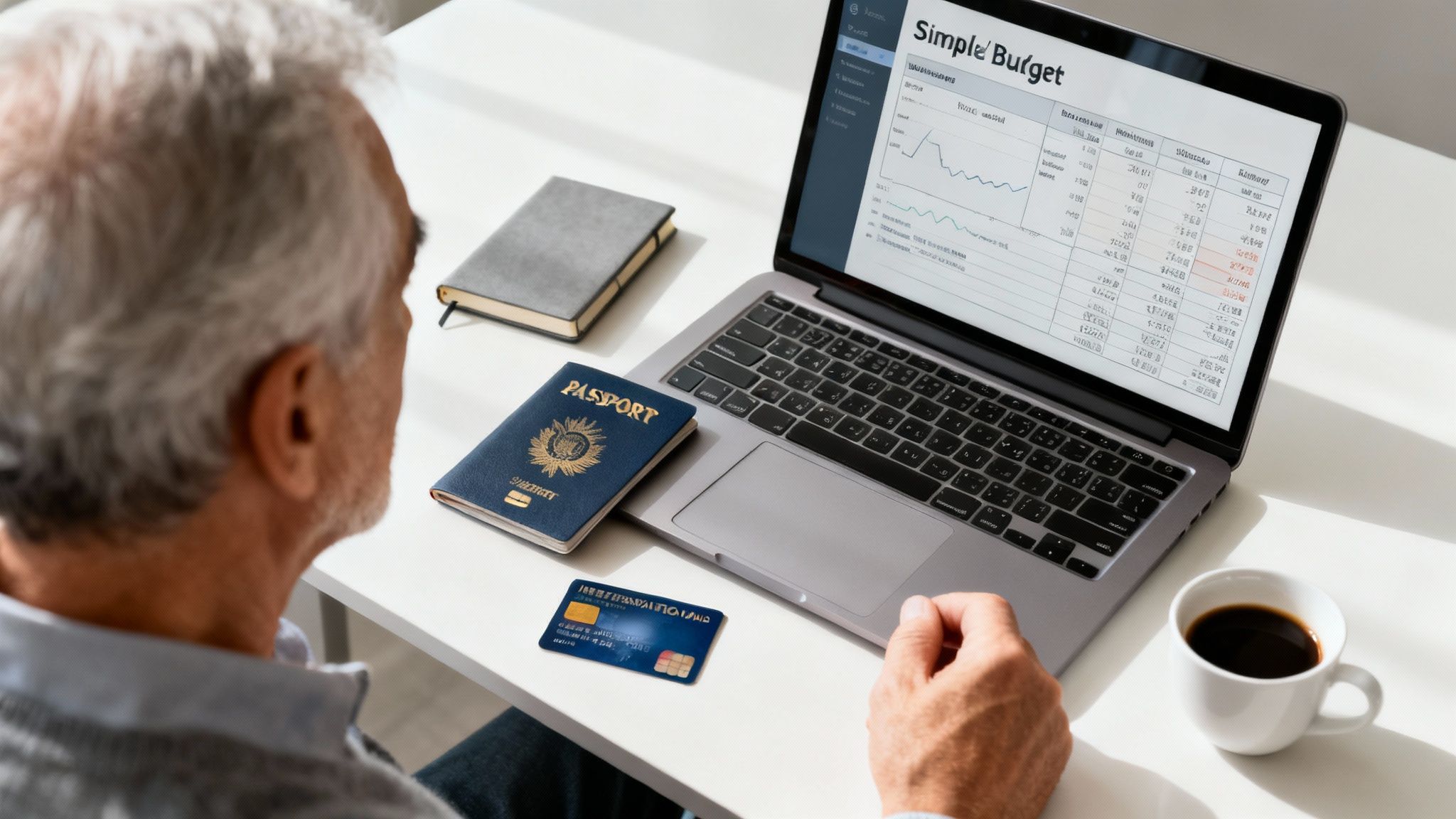
The first thing you need is a detailed, realistic budget for your new life. This isn't just about adding up your estimated rent and grocery bills; it's about building in a cushion for the things you can't predict. A good starting point is to add a buffer of 15-20% to your estimated monthly costs to absorb any currency swings and the one-time setup expenses that always pop up.
Building Your International Banking Strategy
Living like a local means banking like one. The simplest approach for most expats is a two-part system: keeping your US bank account while opening a new one in your host country. This dual setup is the key to keeping your financial life running smoothly.
Your US account will be the hub for receiving Social Security, pensions, and any investment income. Your local account, on the other hand, is for all your day-to-day expenses, like paying rent and utilities. The real trick is finding a cheap and easy way to move money between them.
- Your US Bank Account: Keep this for Social Security direct deposits and managing any US-based investments. Just be sure to notify your bank about your move to avoid having your account frozen due to fraud alerts.
- A Local Bank Account: Open this as soon as you have your legal residency sorted. It's a game-changer for paying local bills and dodging the high international transaction fees your US cards would otherwise rack up.
- Money Transfer Services: Forget expensive bank wire transfers. Services like Wise or Revolut almost always offer better exchange rates and much lower fees for sending money internationally.
This structure simplifies everything, cuts down on unnecessary fees, and makes sure you have your money right where you need it, when you need it.
By the way, receiving Social Security while living abroad is completely normal and straightforward. The Social Security Administration can deposit your funds directly into many foreign banks. It's worth exploring the specifics of Social Security benefits for US expats to see how the rules apply to your chosen country.
Understanding US Expat Tax Obligations
One of the biggest financial wake-up calls for new American expats is the reality of US taxes. Your US citizenship comes with a lifelong tax filing obligation, no matter where you live or where your income comes from. This is a non-negotiable part of retiring overseas.
Forgetting to file can bring on some serious penalties, so it's vital to get this right from the start. The good news? Thanks to a few key provisions designed to prevent double taxation, most retirees won't actually owe any US taxes.
The two most important tools you need to know about are:
- The Foreign Earned Income Exclusion (FEIE): This lets you exclude a huge chunk of your foreign-earned income from US taxes—it was $120,000 for the 2023 tax year. The catch is that it only applies to earned income from a job or self-employment, not to things like pensions, Social Security, or investments.
- The Foreign Tax Credit (FTC): This is a dollar-for-dollar credit for taxes you've already paid to a foreign government. For most retirees, this is the far more powerful tool, as it can be applied against passive income and often wipes out any US tax liability completely.
Leveraging Local Tax Advantages
While you have to file in the US, your new home country might offer its own tax perks that can significantly improve your financial situation. Many countries are actively trying to attract foreign retirees with some very appealing tax programs.
Countries like Panama offer complete tax exemptions on all foreign-sourced income for retirees on their Pensionado visa. Other countries may have tax treaties with the US that help prevent double taxation on pension income.
Because the way US and foreign tax codes interact can get incredibly complex, this is not a DIY project. Hiring a tax advisor who specializes in expat issues is one of the smartest investments you can make. They'll ensure you stay compliant in both countries while taking advantage of every credit and exclusion you're entitled to.
Securing Your Health and Well-Being Overseas
For most folks planning to retire overseas, healthcare is the single biggest question mark. It's a totally valid concern. The domestic plans you've relied on for years, including Medicare, generally won't provide any coverage once you move abroad.
This means putting together a new, solid health strategy isn't just a good idea—it's a non-negotiable step to protect both your health and your nest egg.

Here's where your research into specific countries gets really important. Your options typically fall into two main buckets: enrolling in the local public healthcare system or buying private international health insurance. In my experience, many retirees end up with a hybrid approach, using both to create a comprehensive safety net.
Public vs. Private Healthcare: A Look at Mexico
Let's use a real-world example to see how this plays out. Mexico has long been a top destination for North American retirees, and its healthcare system is a perfect illustration of the choices you'll face. The country has both a public system and a world-class private system.
Legal residents can often enroll in the public system, known as IMSS (Instituto Mexicano del Seguro Social). It's incredibly affordable, but it can come with longer wait times, crowded facilities, and potential language barriers—challenges you probably don't want to navigate during a health scare.
For this reason, many expats opt for private care. In cities like Guadalajara or Mexico City, you'll find modern, private hospitals with English-speaking doctors and standards that rival top US facilities. The cost is a fraction of what you'd pay back home, but paying out-of-pocket for a serious illness could still be financially devastating. This is precisely why a robust insurance plan is so important.
Many destinations offer a compelling mix of affordability and quality. For example, in Mexico, private hospitals rival US standards but often at 70-80% less cost. You can learn more about how retirees can leverage these systems by exploring in-depth videos on the topic.
The Critical Role of International Health Insurance
While relying solely on a local public system might seem like the cheapest route, it often leaves dangerous gaps in your coverage. This is where private international health insurance becomes essential. These plans are specifically designed for people living abroad and offer several key advantages you won't get from local or domestic policies.
Here's what you get with a good international plan:
- Choice of Doctors and Hospitals: You gain access to a broad network of private facilities, ensuring you can see the best specialists without long waits.
- English-Speaking Support: Most international providers offer 24/7 support lines with English-speaking staff, which is invaluable during a medical emergency.
- Global Coverage: Your plan isn't limited to just one country. It can cover you in your new home, back in the US for visits, and during travels to other parts of the world.
- Emergency Medical Evacuation: This is one of the most vital components. If you have a serious medical event in a location without adequate facilities, this coverage will pay for you to be transported to the nearest center of excellence—a cost that can easily exceed $100,000.
Finding the Right Plan for You
Choosing a policy isn't a one-size-fits-all process. The best plan for you will depend on your health, your lifestyle, and your budget. You'll need to carefully consider the policy's deductible, coverage limits, and any exclusions, especially regarding pre-existing conditions.
Navigating this can feel overwhelming, but you don't have to go it alone. Working with an insurance broker specializing in expat plans can make all the difference. They can help you compare options from various providers to find a policy that truly fits your needs.
You can get a better sense of what to look for by reading our complete guide on international health insurance for retirees.
Ultimately, sorting out your health coverage before you move is one of the most important investments you'll make. It provides the peace of mind of knowing you're prepared for whatever health surprises might come your way.
Common Questions About Retiring Overseas
Even with the best-laid plans, a few nagging questions always seem to pop up as your departure date gets closer. These are the practical, "what-if" details that can keep you up at night. Let's tackle these common worries head-on so you can move forward with confidence.
Can I Still Get My US Social Security Checks Abroad?
Yes, you absolutely can in most countries. This is one of the biggest questions on every future expat's mind, and thankfully, the answer is a reassuring one. The Social Security Administration (SSA) has no problem sending your benefits almost anywhere in the world.
What surprises many retirees is how easy it can be. The SSA can often set up direct deposits right into a foreign bank account, which simplifies everything. To be sure, they have a handy "Payments Abroad Screening Tool" on their website. It's the quickest way to confirm if any odd restrictions apply to your chosen country.
Just remember, it's your job to keep your address and bank info updated with the SSA. A simple oversight here could delay your payments. Also, while your benefit amount in USD stays the same, its actual value will ebb and flow with currency exchange rates.
What Happens to My Medicare Coverage When I Leave the US?
This is a critical point that trips up far too many people. Your Medicare provides virtually no coverage outside of the United States. You simply cannot count on it for your healthcare needs once you've moved.
While it's often a smart move to keep paying for your Medicare Part B (to avoid hefty penalties if you ever return to the US), you won't be able to flash your card at a doctor's office or hospital in your new home. This is precisely why securing a comprehensive international health insurance plan before you leave is non-negotiable. It's the only real way to protect both your health and your retirement savings.
Leaving the US healthcare system behind is a major step. Your Medicare plan is a domestic safety net, not a global one. Failing to replace it with a robust international policy is one of the biggest risks you can take when retiring overseas.
How Do I Handle Banking from Another Country?
A smart, two-part banking strategy is your key to a stress-free financial life abroad. It's all about having global access and local convenience.
First, keep a US-based bank account open. This will be your financial hub—the place where your Social Security, pension checks, and any investment income lands.
Second, open a local bank account in your new country as soon as you get your residency sorted. You'll use this for daily life: paying rent, buying groceries, and handling local bills without getting hammered by foreign transaction fees. To shuttle money between your two accounts, use a service like Wise. Their exchange rates and fees are vastly better than traditional bank wires. And don't forget to tell your US banks you're moving so they don't freeze your accounts due to "suspicious" foreign activity.
What's the Best Way to Tackle a Language Barrier?
You can probably get by with English in the big expat bubbles, but learning even a little bit of the local language will completely transform your experience. It's the difference between being a tourist and truly feeling at home. It opens doors to real friendships and makes you feel far more independent.
The best part? You can start long before you pack your bags.
- Use language apps: Tools like Duolingo or Babbel are great for building a basic vocabulary so you don't arrive completely cold.
- Sign up for local classes: Once you land, joining a language school is one of the best things you can do. You'll learn faster and meet other newcomers and locals.
- Practice everywhere, all the time: Don't be shy! Try out your new phrases at the local market, in cafes, and with your neighbors. People almost always appreciate the effort, even if you make mistakes.
For big official things like visa paperwork or real estate contracts, it's always wise to hire a professional translator at first. As you get more comfortable, you'll find yourself needing them less and less. For a deep dive into the entire process of moving your life overseas, check out this ultimate guide on how to retire abroad. It offers a fantastic roadmap for these and other practical hurdles.
Navigating the complexities of international healthcare is one of the most important steps in planning your retirement abroad. At Expat Insurance, our expert advisors—many of whom are expats themselves—specialize in finding the perfect plan to protect your health and your savings. We compare options from over 65 insurers to ensure you get the right coverage for your new life. Get your free quote today and move forward with confidence.
