

January 26, 2026
•
5 min read
International School Curriculums: A Complete Guide for Expat Families
Discover international school curriculums like IB, Cambridge, and American systems to help expat families pick the best path.
Justin Barsketis
Insurance Expert

When you hear the term "international school curriculum," what probably comes to mind are the big names: the International Baccalaureate (IB), Cambridge (IGCSE/A-Level), the American system, and the British system. At their core, these are just structured educational frameworks that schools around the world use to offer a consistent, globally-recognized education.
For globally mobile families, this consistency is everything. It offers a steady academic path for students and a clear route to universities in different countries.
Why Your Curriculum Choice Matters

Let's be honest: facing an international move is already a massive undertaking. Throw in choosing a new school, and the stress level skyrockets. Suddenly, you're wading through an alphabet soup of acronyms—IB, IGCSE, AP—and feeling the pressure of a decision that will genuinely shape your child's future. This isn't just about picking subjects; it's about committing to an entire educational philosophy.
Think of it like choosing a GPS for a long road trip. One system might be programmed for the scenic route, encouraging exploration and detours (like the IB). Another might calculate the most direct, efficient path to a specific destination (like A-Levels). Both will get you there, but the journey will feel completely different.
The Core Challenge for Expat Families
For any family on the move, the main goal is finding an educational path that provides stability, continuity, and keeps doors open to universities worldwide. A curriculum that's widely available and recognized is your best defense against academic disruption if another move is on the horizon. A student moving between two IB schools, for instance, will step into a familiar structure, which makes the academic and social transition that much smoother.
This guide is your practical, jargon-free roadmap. We’ll cut through the noise to explain the real philosophies behind the major international school curriculums, giving you the confidence to:
- Compare your options effectively: Understand the key differences in teaching styles, how students are assessed, and what subjects are emphasized.
- Match the curriculum to your child: Pick a system that plays to their unique learning style and academic strengths.
- Plan for what's next: Make sure the path you choose is recognized by the universities your child is aiming for.
A well-chosen curriculum does more than just prep a student for exams. It builds crucial life skills—time management, critical thinking, self-advocacy—that are the real foundation for success in university and beyond. The structure of programs like the IB, with its long-term projects and service requirements, instills habits of independence and perseverance.
What This Guide Will Cover
We’ll start by digging into this core challenge, helping you pinpoint an educational path that supports a mobile lifestyle. From there, we'll dive into what makes each curriculum tick—from its assessment style to its availability in different parts of the world. By the end, you'll be equipped to make an informed choice that sets your child up for success, no matter where your journey takes you. Let’s start demystifying the world of global education.
Decoding the Major Global Education Systems
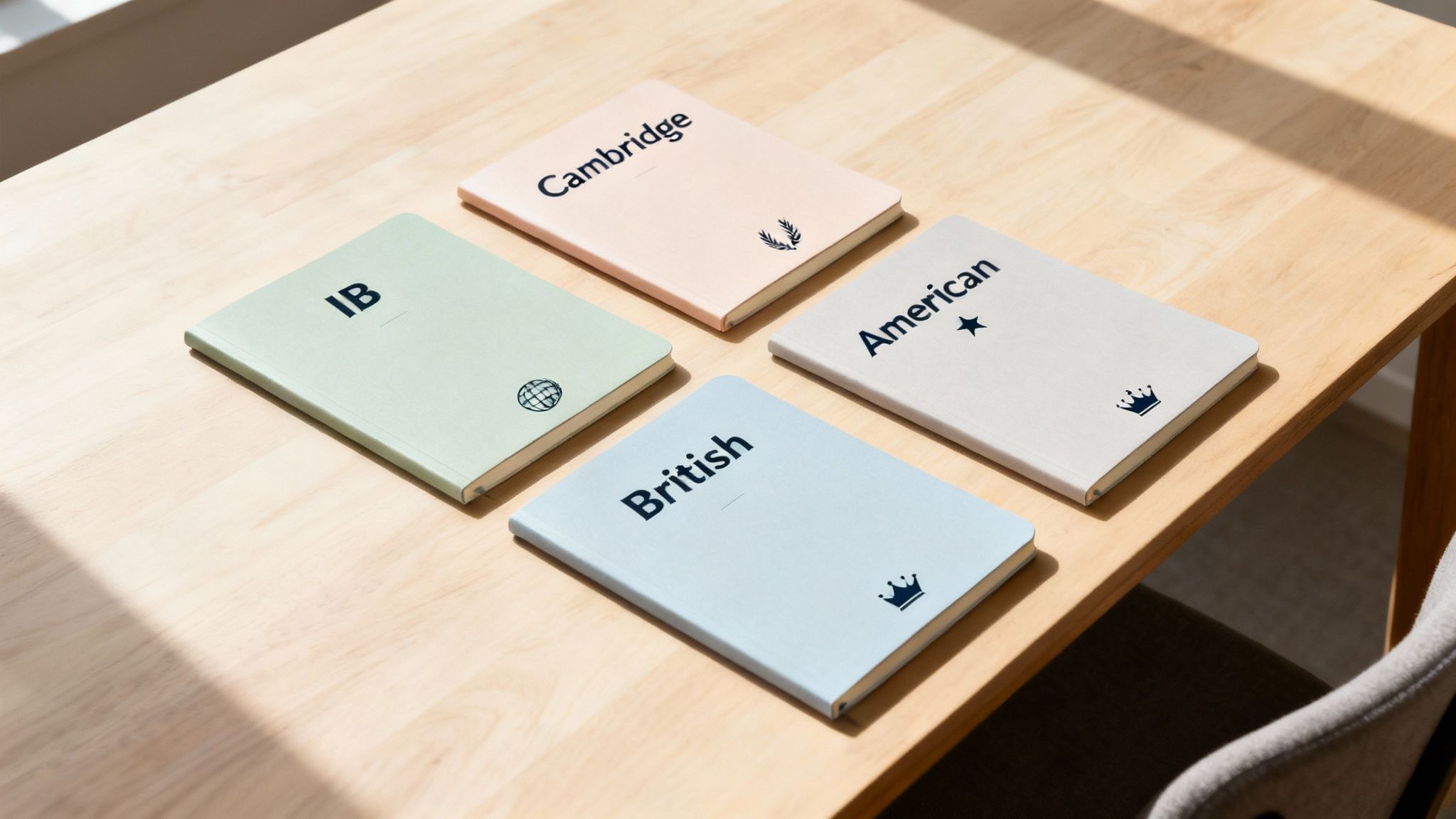
Diving into the world of international school curriculums can feel like trying to learn four new languages at once. The acronyms and philosophies can be a bit of a maze, but getting a handle on their core differences is the first real step toward making a confident choice for your child. Forget the dense academic definitions; let's break down the "Big Four" with some simple analogies to get a feel for what each educational journey is actually like.
And this isn't a niche decision anymore. As of July 2023, the international school market has exploded to 13,614 English-medium schools, serving nearly 7 million students. That's a whopping 53.5% jump in student numbers since 2013, showing just how many families are looking for a globally recognized education. You can explore the full breakdown of this market growth to see more of the trends.
The International Baccalaureate (IB) – The Holistic Explorer
Think of the International Baccalaureate (IB) as a guided expedition. It’s not just about getting to a destination; it's about understanding the terrain, the local culture, and your own place in the world. The whole philosophy is built on inquiry-based learning, constantly pushing students to ask "why?" and connect the dots between different subjects.
This approach is designed to cultivate independent, curious thinkers. The curriculum is intentionally broad, making sure students engage with languages, humanities, sciences, math, and the arts. This prevents them from specializing too early and helps them develop a much more well-rounded perspective.
The IB Programme isn’t just a checklist of courses. It’s a framework designed to develop intellectually, emotionally, and ethically engaged global citizens. Its famous Theory of Knowledge (TOK) course even challenges students to question how we know what we know.
The three main stages of the IB journey are:
- Primary Years Programme (PYP) for ages 3-12
- Middle Years Programme (MYP) for ages 11-16
- Diploma Programme (DP) for ages 16-19
The Cambridge Pathway – The Structured Specialist
The Cambridge curriculum, in contrast, is more like climbing a well-defined mountain path. Every stage is clearly marked, and the goal is to build a strong, deep foundation of knowledge in specific subjects. It offers a more structured, traditional route that's prized for its academic rigor.
The progression is logical and culminates in specialized exams. Students usually narrow their focus to fewer subjects at the advanced level, which lets them really become experts in their chosen fields. This makes it a fantastic prep for university systems that value deep subject mastery right from the get-go.
The main qualifications you'll hear about are:
- Cambridge Primary for ages 5-11
- Cambridge Lower Secondary for ages 11-14
- IGCSE (International General Certificate of Secondary Education) for ages 14-16
- A-Levels (Advanced Levels) for ages 16-19
The American Curriculum – The Flexible Innovator
Imagine the American curriculum as an open-world video game. It provides incredible flexibility, letting students explore different interests, mix and match subjects, and essentially design their own educational path. The big focus here is on continuous assessment, where grades come from a blend of coursework, projects, presentations, and smaller tests spread throughout the year.
This system encourages a broad, well-rounded education and often treats extracurricular activities as a core part of a student's development. While standardized tests like the SAT or ACT are important for university applications, they're just one piece of a much larger puzzle that includes a student's GPA (Grade Point Average).
The British Curriculum – The Rigorous Traditionalist
Closely related to Cambridge, the British National Curriculum is like an apprenticeship under a master craftsman. It’s highly structured, packed with content, and follows a systematic path that prepares students for tough, high-stakes final exams. The main goal is mastering a specific body of knowledge.
Just like the Cambridge pathway, it leads to GCSEs and then A-Levels, where students specialize in just three or four subjects. This depth is highly respected by universities, especially in the UK and Commonwealth countries, because it proves a student can handle university-level work in their chosen field.
At-a-Glance Comparison of Major International Curriculums
To pull all of this together, here’s a quick table to make the key differences pop.
| Curriculum | Core Philosophy | Typical Structure | Primary Assessment Style |
|---|---|---|---|
| International Baccalaureate (IB) | Develops inquisitive, globally-minded critical thinkers through a holistic, cross-disciplinary approach. | Broad and balanced subject requirements across all disciplines, culminating in a comprehensive program. | A mix of internal assessments and final examinations. |
| Cambridge (IGCSE/A-Levels) | Builds deep subject-matter expertise and strong academic skills through a structured, progressive pathway. | A wide range of subjects leading to specialization in the final two years. | Standardized final examinations at the end of each stage. |
| American | Fosters well-rounded individuals with flexibility to explore diverse interests and academic paths. | Credit-based system with core requirements and a wide choice of elective subjects. | Continuous assessment (GPA) supplemented by standardized tests (SAT/ACT). |
| British (GCSE/A-Levels) | Provides a rigorous, in-depth education focused on mastering specific subject content. | A nationally defined, structured curriculum leading to specialization in fewer subjects. | High-stakes final examinations that determine grades. |
At the end of the day, each of these international school curriculums offers a valid and well-respected path to higher education. The right choice isn't about which one is "better" in a vacuum. It's about which philosophy best clicks with your child's learning style, your family's lifestyle, and their future dreams.
How Assessment Styles Shape University Pathways
Picking an international school curriculum is a much bigger decision than just choosing your child's day-to-day classes. It’s a strategic move that can open certain doors to higher education—and make others harder to walk through.
Admissions officers around the world are pros at deciphering different academic transcripts. But the way each curriculum tests and grades students creates distinct advantages and disadvantages, depending on where your child ultimately wants to apply.
Think of it this way: an assessment model is like a language. A final transcript—whether it’s an IB Diploma score, a set of A-Level grades, or an American GPA—tells a specific story about your child's academic journey. While all these "languages" are respected, some are more fluently understood or even preferred in certain countries. The key is to work backward, aligning the curriculum you choose today with your child's university dreams for tomorrow.
The Power of Final Examinations
Curriculums like the British system (A-Levels) and the International Baccalaureate (IB) put a massive emphasis on high-stakes final exams. These tests are standardized, graded by external examiners, and built to provide a clear, objective snapshot of a student’s mastery over a subject.
For universities, particularly in the UK, Europe, and much of Asia, these final grades are the gold standard for admissions. An A-Level student's university offer will almost entirely depend on their performance in just three or four intense exams. In the same vein, an IB student's final score out of 45 points gives admissions teams a globally recognized benchmark of their academic abilities.
This intense focus on final exams is fantastic for teaching students how to manage pressure and pull together two years of learning. It’s a trial by fire that serves as excellent preparation for the demands of university-level study.
This system is a great fit for students who thrive under pressure and are good at demonstrating their knowledge in a formal, structured test. It creates a very transparent and predictable path, as universities often give conditional offers based on achieving specific grades.
Continuous Assessment and the Holistic View
The American curriculum plays a completely different game. Instead of hinging everything on a few big exams, it relies on continuous assessment. The final Grade Point Average (GPA) is a cumulative score built up over four years of high school.
This GPA is a blend of everything:
- Coursework: Quizzes, essays, and mid-term tests.
- Projects: In-depth research papers and group assignments.
- Presentations: Showing off public speaking and communication skills.
- Participation: How actively a student engages in class discussions.
This approach gives universities a holistic, long-term picture of a student’s consistency, work ethic, and engagement. It’s far less about one make-or-break performance and much more about sustained effort. US universities, especially, love this well-rounded story, which they supplement with standardized tests like the SAT or ACT, extracurriculars, and personal essays.
The specific assessment styles and the availability of accommodations on standardized tests can be a game-changer, making it a critical piece of the puzzle for any internationally mobile family.
How Universities Interpret Different Qualifications
So, how do admissions officers actually weigh these different systems? A classic question is how a UK university compares A-Levels to the IB Diploma. While A-Levels prove deep, specialized knowledge in a few areas, the IB is often praised for its breadth and its focus on critical thinking (through things like the Extended Essay).
Many top-tier universities see the IB Diploma as exceptional preparation for undergraduate life precisely because it forces students to learn independent research and time management.
On the flip side, US admissions teams are incredibly skilled at reading international transcripts. They know the rigor of A-Levels and the IB. They'll often grant university credit for high scores in Higher Level (HL) IB courses or top A-Level subjects.
However, they’ll still be looking for that classic, well-rounded American applicant profile—leadership roles, community service, and personal passions. Picking a curriculum that naturally speaks the language of your target university region can make the entire application process run that much more smoothly.
Finding the Best Curriculum for a Mobile Expat Lifestyle

For families living the expat life, the only constant is often change. When your next international move isn't a matter of if but when, the "portability" of your child's education suddenly rockets to the top of your priority list. It becomes one of the most critical factors in choosing between international school curriculums.
Think of a curriculum as an operating system for learning. If you switch between devices that run the same OS, everything just works. Your files, apps, and the whole user experience transfer almost seamlessly. But try moving from one system to another, and you’re in for compatibility issues, lost data, and a major learning curve.
That’s the core challenge for a mobile family. You're looking for an educational framework that provides real academic continuity, one that minimizes disruption and lets your child pick up right where they left off, no matter which country you land in next.
The Gold Standard for Global Mobility
When it comes to pure portability, the International Baccalaureate (IB) and Cambridge (IGCSE/A-Levels) programs are widely seen as the top contenders. Their superpower is standardization. An IB Middle Years Programme (MYP) in Singapore is built on the exact same core framework and learning goals as one in Switzerland.
This consistency is a huge advantage for families on the move:
- Seamless Academic Transfers: A student can shift between IB World Schools or Cambridge International Schools with minimal academic shock. The language, the assessment styles, and the whole educational philosophy will feel familiar.
- Predictable Progress: Teachers at a new school can instantly understand a student’s prior learning and place them in the right classes.
- Global Recognition: Universities worldwide know these qualifications inside and out because they are the same everywhere. This takes a massive amount of stress out of the application process.
Imagine a family moving a 16-year-old from Dubai to Copenhagen. They can transition from one IB Diploma Programme to another, confident that the core subjects and requirements are consistent. That continuity is a powerful anchor during an otherwise chaotic relocation. For families fully embracing this lifestyle, it's also worth looking into flexible options like worldschooling programs that can perfectly match their unique journey.
The standardized nature of the IB and Cambridge systems acts as a universal academic passport. It ensures that a student’s hard work and achievements are recognized and transferable across borders, providing stability in a life defined by movement.
Navigating Less Standardized Systems
While the American and British curriculums are found all over the globe, they can create more of a puzzle for highly mobile families. Their portability often hinges more on the specific school than on the system itself.
The American curriculum, for example, is famous for its flexibility—which can be both a blessing and a curse. You'll find thousands of "American" schools worldwide, but there's no single governing body that standardizes what they teach. A school in Mexico might have completely different graduation requirements or course offerings than one in Japan. If you're curious about the expat experience there, you might want to learn more about what it takes to live and work in Mexico as an expat and the educational landscape.
It's a similar story with the British curriculum. Although it's very structured, you can find variations between schools, especially when they blend the national curriculum with local requirements. A move might involve a headache of credit transfers and placement assessments just to make sure your child is on track.
This doesn't mean these are bad choices, but it does mean families need to do some extra homework. If you know another move is on the horizon, you have to be sure your child’s credits and coursework will be easily accepted by other schools following a similar system. Ultimately, the goal is to choose a curriculum that moves with you, providing a steady educational foundation no matter where your global adventure leads.
Your Actionable Checklist for Choosing the Right School

Alright, you've got the theory down on the different international school curriculums. Now it's time to turn that knowledge into confident action. A school's glossy brochure and polished website will always tell a great story, but the real fit for your family is hidden in the details you’ll only find by asking the right questions during a tour or interview.
This checklist is designed to help you do just that. Think of it as your guide to looking beyond the surface and doing a proper, practical evaluation. The goal is to find a school that truly clicks with your child's academic needs, personality, and your family's unique way of life.
The Academic Engine
Let's start by getting under the hood of the school's educational offering. These questions are all about the teaching staff and the support systems that actually make learning happen. A great curriculum is only as good as the people who teach it and the resources students have access to.
-
Teacher Qualifications and Turnover: What percentage of your teachers have advanced degrees or specific certifications for the curriculum they teach (like formal IB training)? And, what’s your annual staff turnover rate? A high number can be a red flag for underlying issues.
-
Class Size and Ratios: For my child's age group, what's the average class size? What's the absolute maximum? More importantly, what's the student-to-teacher ratio?
-
Language and Learning Support: What do you have in place for kids who need English as an Additional Language (EAL) support? And how do you help students with different learning needs?
A school's commitment to its staff is a direct reflection of its commitment to students. Low turnover and consistent professional development are strong indicators of a healthy, stable, and supportive learning environment.
University and Career Pathways
It’s crucial to look ahead to your child’s future. How well a school prepares students for what comes next is a massive measure of its success. Good, solid guidance can make all the difference in the crowded world of university admissions.
-
University Placement Success: Where have your recent graduates been accepted? It’s fair to ask for a list or some stats from the last three years.
-
Counseling Support: What’s the student-to-counselor ratio for university guidance? And at what age does that formal counseling actually start?
-
Alumni Network: Is there an active alumni network that current students can tap into for mentorship or a bit of career advice down the line?
These questions should give you a crystal-clear picture of the school’s track record in helping students get to where they want to go.
Community and Student Life
A school is so much more than classrooms and textbooks; it's a community where your child will grow up, make friends, and figure out who they are. The school's culture is every bit as important as its curriculum. This is also where your own family will build a support network—something that can be just as critical as getting help from a reliable nanny when you’re in a new country.
Here are a few key things to ask about:
-
Transition Support: What's your process for helping new students settle in, both in the classroom and socially? Do you have a buddy system or a proper orientation program?
-
Extracurricular Activities: What kinds of sports, arts, and clubs are on offer? How do you get kids to participate and try new things?
-
Parent Community: How does the school help parents connect and build a community? Are there active parent-teacher groups or regular social events?
-
School Culture: How would you describe the vibe here—is it more competitive or collaborative? What do you do to promote student well-being and mental health?
Using this checklist helps you move past a general impression and gather the specific facts you need to make a solid, well-informed decision. This structured approach is your best bet for finding the right educational home for your child’s global journey.
Common Questions About International School Curriculums
Even after you've gotten your head around the big curriculum systems, a bunch of practical "what-if" questions always pop up for expat families. It's totally normal. This section tackles some of the most common worries head-on, aiming to clear up any lingering doubts you might have.
Our goal is to give you clear, straightforward information so you can feel genuinely confident about this huge decision for your family's future.
Can We Transfer Mid-Year Between Different Curriculums?
Jumping between different curriculums in the middle of the school year sounds daunting, but it's often more doable than you'd think. The absolute golden rule here is early and open communication with both your child’s current school and the one you’re looking at.
Seasoned international schools have seen it all before and usually have systems in place. For instance, if your child is moving from a flexible American system to a more structured IB or British curriculum, the new school will likely want to do an academic assessment. This isn't a pass/fail test; it's just to make sure they're placed in the right spot to succeed.
A mid-year move is a big adjustment, but the right school can make all the difference. Prioritize finding an institution with a proven track record of integrating new students. Ask specifically about their bridging programs or academic support services designed to help children catch up on different content or adapt to new teaching styles.
Mentally prepare for an adjustment period for your child. When you talk to potential schools, focus your questions on how they support a child’s social and academic integration—that's just as important as the curriculum itself.
Are Hybrid or Dual Curriculums a Good Option?
Hybrid curriculums, which blend the host country's national curriculum with an international one (think a Japanese curriculum taught alongside the IB Diploma), can be a fantastic choice. This setup is especially great for families who want deep local cultural immersion while keeping a globally recognized academic qualification in their back pocket.
The biggest win here is the potential for true bilingualism and biculturalism, giving students a pretty unique educational edge. Be warned, though: this path can be incredibly demanding. Students essentially have to meet the rigorous standards of two different systems at the same time.
This option really shines for families planning a long-term stay who want their kids to have the choice of attending either a local or an international university down the road. Before you jump in, it's crucial to check the school's accreditation and look at their university placement track record to make sure that dual qualification is as powerful as it sounds.
What Is the Real Difference in Cost?
Interestingly, the specific curriculum isn't always the main driver of the school fees. More often, the price tag is set by the school’s location, the shininess of its facilities, its reputation, and what it pays its teachers. That said, you can spot some general cost patterns.
IB World Schools often sit at the higher end of the price scale. This is largely because the IBO has strict, non-negotiable requirements for ongoing teacher training, programme authorization, and specific resources. The IB Diploma Programme, in particular, can be one of the more expensive routes for the final two years of high school.
American and British curriculum schools tend to offer a much wider range of price points. When you're building your budget, remember to look way beyond the headline tuition fee. Always ask for a full fee schedule that includes all the extras:
- Uniforms and technology fees
- Extracurricular activities and sports team costs
- Mandatory school trips
- External exam fees (a big one for IGCSE, A-Levels, and IB)
Which Curriculum Best Accommodates Special Educational Needs?
This is a question that hinges far more on the individual school's resources, funding, and philosophy than on the curriculum itself. However, some frameworks are naturally a bit more adaptable.
The International Baccalaureate (IB), with its built-in focus on inquiry-based learning and tailoring instruction to individual students, can be wonderfully flexible. In the same vein, the American curriculum's broad subject range and varied ways of assessing students can work really well for many different learning styles.
On the surface, the British system (IGCSE/A-Levels) might seem more rigid with its heavy focus on content and final exams. But don't be fooled—many top-tier British international schools have outstanding and well-funded learning support departments.
The most critical step you can take is to have a direct, detailed conversation with each school's Special Educational Needs (SEN) coordinator. Ask about their specific programs, staff qualifications, and how they would create an Individualized Education Plan (IEP) for your child within their curriculum. Just as you would carefully compare health insurance plans for your family's needs, you need to investigate a school's support systems with the same level of detail.
Choosing the right school and curriculum is just one piece of the puzzle. Ensuring your family has the right protection and support for life abroad is just as critical. The team at Expat Insurance specializes in helping families like yours find the perfect international health insurance plan, offering peace of mind no matter where your journey takes you. Get your free quote today.
Justin Barsketis
Insurance Expert & Writer
Justin is an insurance guru that loves digital marketing. As our founder Justin manages our business development programs and MGA network. Please don’t hesitate to contact him if you are not getting the attention you deserve.
