

August 4, 2026
•
5 min read
What Is an Apostille? How to Get Your Documents Ready Before You Move Abroad
Learn what an apostille is, why the process exists, and how to get your birth, marriage, and business documents authenticated before you move abroad.
Justin Barsketis
Insurance Expert
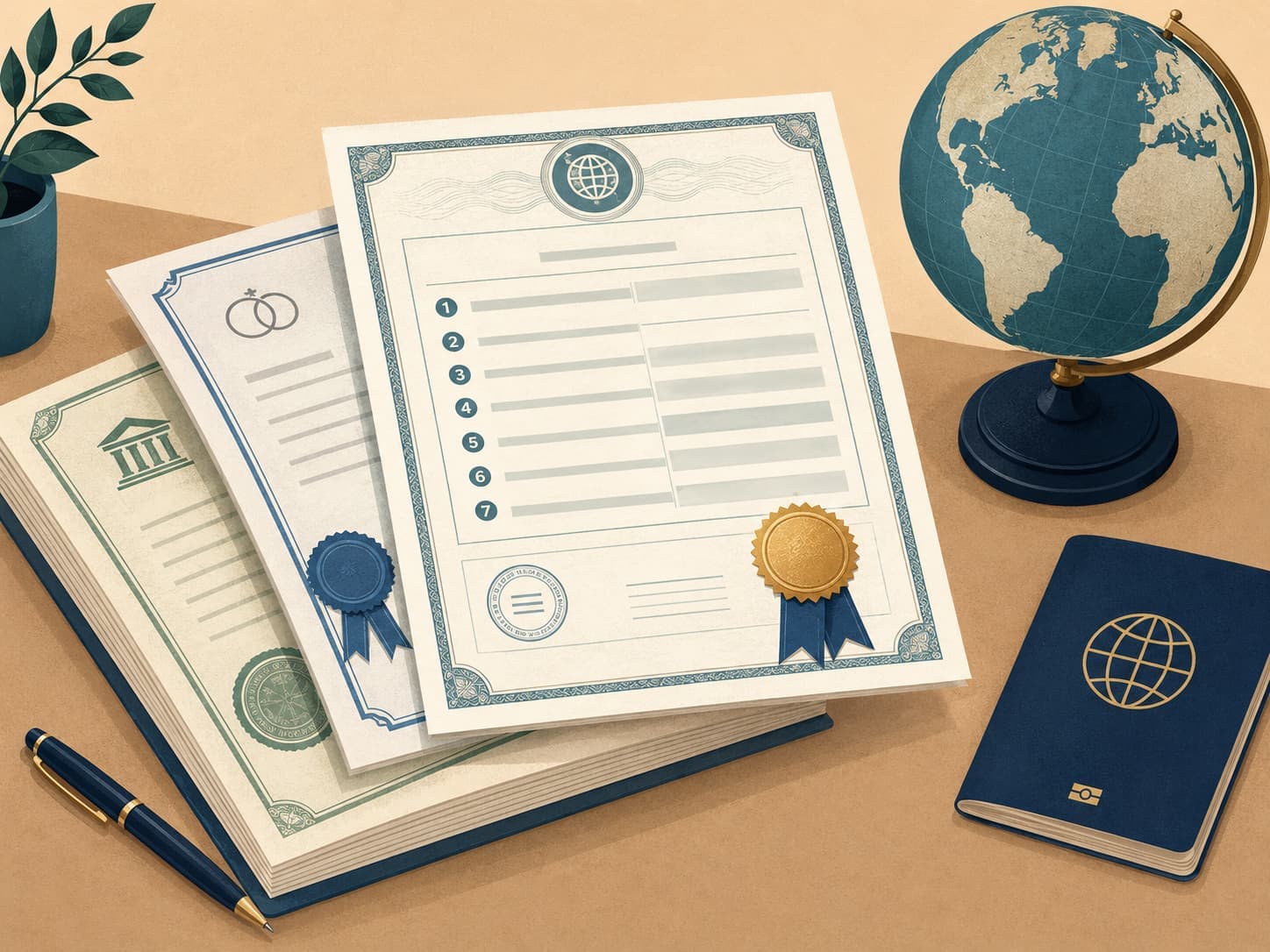
If you are planning to move abroad, there is one piece of paperwork we wish every expat knew about before they packed a single box: the apostille. It is not glamorous, and most people have never heard the word until a foreign government office asks for it. But getting your key documents apostilled before you leave can save you a very expensive, very inconvenient trip back to the United States down the road.
In this guide, we will walk you through what an apostille actually is, why the whole system was invented in the first place, how to get one, and which documents you should prioritize before you go. We will also cover what business owners need to know if there is any chance you will expand your company into another country.
Not sure which of your documents need apostilles for your specific destination and situation? This is exactly the kind of thing our team helps expats sort out. Book a free consultation and we can point you in the right direction before you make any expensive mistakes.
Throughout this article, whenever you see text in blue, that is a link to another one of our guides with more detail on that topic. Click through whenever you want to go deeper.
What Is an Apostille?
What Is an Apostille? – The Basics:
An apostille is a standardized certificate that proves a public document is genuine so that it can be accepted in another country. Think of it as an internationally recognized stamp of authenticity. Instead of a foreign government having to figure out whether your American birth certificate is real, the apostille does that verification for them in a single, universally understood format.
The name comes from an old French word meaning a marginal or bottom note, which traces back to the Latin post illa. In practice, it is a printed form or stamp, either placed directly on your document or attached to it, with ten numbered fields that identify who signed the document, in what capacity, and which seal it bears.
Here is the most important thing to understand about what an apostille actually certifies: it only confirms that the signature, the signer's authority, and the seal or stamp on the document are legitimate. It does not verify or vouch for the contents of the document itself. An apostille on a birth certificate confirms the certificate is a real government record, not that the facts printed on it are true. That distinction matters, and we will come back to it.
Why the Apostille Process Was Created
What Is an Apostille? – Why the Process Was Created:
To appreciate how much easier an apostille makes your life, it helps to understand the mess it replaced.
– The Old Way: Chain Legalization –
Before 1961, getting a document accepted in a foreign country meant going through a slow, multi-step process called legalization. Each authority in the chain certified the one before it. A single document might need a local notary, then the county clerk, then the state, then the U.S. State Department, and finally a stamp from the destination country's embassy or consulate. Every step meant another office, another fee, and another opportunity for something to go wrong. A mistake at any stage often meant starting the entire chain over again.
– The Post-War Paperwork Explosion –
After World War II, international trade and travel took off. Companies were manufacturing in one country, incorporating in another, and selling everywhere. At the same time, huge numbers of people were crossing borders for work, study, marriage, and resettlement. Governments were suddenly drowning in cross-border requests for birth certificates, marriage licenses, diplomas, and corporate records, and the old embassy legalization chain simply could not keep up.
There was also a deeper absurdity to the old system. Each stamp in the chain did not actually confirm that the underlying document was real. It only confirmed that the previous official's signature was real. Countries were spending enormous time and money on a bureaucratic loop that offered very little genuine protection against fraud.
– The 1961 Solution –
To fix this, the Hague Conference on Private International Law drafted a treaty formally known as the Convention Abolishing the Requirement of Legalisation for Foreign Public Documents. It was adopted on October 5, 1961, and entered into force on January 24, 1965. The idea was elegant: replace the entire multi-step chain with one standardized certificate, the apostille, issued by a single designated authority in the country where the document originated. Once a member country issues that apostille, every other member country agrees to accept it without any further legalization.
As of 2026, roughly 129 countries are members, and the list keeps growing. Most of the destinations expats actually move to, including Mexico, Spain, Portugal, France, and the rest of Europe, are members. A shrinking number of countries are not yet part of the convention, and for those you would still need the older embassy legalization process. Because membership changes over time, it is always worth confirming your specific destination's current status before you start.
What an Apostille Does and Does Not Do
What Is an Apostille? – What It Covers:
A quick summary, because this is where people get tripped up:
An apostille does certify that the signature, the official's capacity, and the seal on your document are authentic, and it removes the need for any further certification by the destination country.
An apostille does not validate the actual content of the document, translate it into another language, or last forever in the sense that the destination office will always accept it. The apostille itself never expires, but the document underneath it may have its own freshness requirements, and the receiving office may want it presented within a certain window.
How to Get a Document Apostilled in the United States
What Is an Apostille? – The U.S. Process:
The United States has what is essentially a dual system, which reflects how the country is governed. Getting this part right is the single biggest way to avoid delays.
– Step 1: Figure Out If Your Document Is State or Federal –
This is the step that trips most people up, and submitting to the wrong office means an automatic rejection.
State-level documents are apostilled by the Secretary of State (or equivalent office) in the state where the document was issued. This covers the vast majority of personal documents expats need: birth certificates, marriage licenses, divorce decrees, diplomas, and notarized documents. A birth certificate issued in California, for example, gets its apostille from the California Secretary of State.
Federal documents are apostilled only by the U.S. Department of State's Office of Authentications in Washington, D.C. This covers documents issued or signed by a federal agency, such as an FBI background check, IRS records, or documents bearing a federal official's signature.
– Step 2: Get It Notarized First, If Required –
Documents already issued by a government official (like a certified birth certificate) can usually go straight to the apostille authority. But a document signed by a private individual, such as a business power of attorney or an affidavit, typically needs to be notarized first. In some states, the notary then needs to be certified by the county or court before the state will attach the apostille. Check your state's specific requirements before you send anything.
– Step 3: Submit to the Right Authority –
Once you know whether your document is state or federal and it is properly prepared, you submit it (in person or by mail) to the correct office along with any required form, payment, and the name of the destination country.
– Step 4: Budget for Fees and Timelines –
Fees are modest but vary widely. The U.S. State Department charges around $20 per federal document, and state fees range from as little as a dollar to around $40 depending on the state. Timelines are the bigger variable. State apostilles often come back within several business days to a couple of weeks, while federal apostilles processed by mail can take several weeks. If you are on a deadline, plan generously, because rushing this at the last minute is exactly how people end up stuck.
Many member countries, including the United States, are also rolling out electronic apostilles through a program launched to make issuance and verification faster and paperless, so this process is gradually becoming more convenient.
Why You Should Apostille Your Documents Before You Move
What Is an Apostille? – Do This Before You Leave:
Here is the practical heart of this article, and the advice we give again and again: if you are moving abroad, get your crucial documents apostilled while you are still in the United States.
In our experience helping expats and drawing on what our own families have run into, the two documents most frequently requested by foreign governments are an apostilled birth certificate and an apostilled marriage certificate. These come up constantly for residency applications, for registering a marriage, for enrolling children in school, for citizenship applications, and sometimes even for getting a local driver's license.
The problem is that ordering a fresh certified copy and getting it apostilled is far easier to arrange while you are physically in the country that issued it. Once you are settled abroad, tracking down a certified vital record from your home state, mailing it to the right Secretary of State, and coordinating the return can turn into a genuine ordeal. We have seen expats forced to book a flight back to the United States simply because a document they could have prepared in an afternoon before leaving was suddenly required by a local office.
A little foresight here pays off enormously. Before you go, we recommend pulling certified copies of your birth and marriage certificates and having them apostilled, even if you are not certain you will need them yet. For more on getting your affairs in order before a move, see our guide on the secret tips you need to know before moving to Mexico and our overview of Mexican immigration law.
Living abroad means protecting yourself in ways you never had to at home. While you are organizing your documents, it is worth making sure your health coverage travels with you too. Get a free quote in about a minute and cross one more thing off your list.
Apostilles for Business Owners Expanding Abroad
What Is an Apostille? – For Businesses Going Global:
If there is any chance you will do business in another country, the apostille conversation gets even more important. Foreign governments, banks, and registries routinely require apostilled corporate documents before they will let you register a company, open a business bank account, or operate locally.
The corporate documents that most commonly need apostilles include:
- Articles of incorporation or organization, which establish that your company legally exists
- A certificate of existence or good standing (some states call it a certificate of status), which proves your company is active and compliant. Note that these often need to be recently issued, frequently within the last 30 to 90 days, so timing matters
- Board resolutions and corporate resolutions, especially ones that authorize a specific person to act, sign, or do business on the company's behalf abroad
- Any amendments to your formation documents
- Powers of attorney and bylaws, which are frequently requested for banking and registration
A resolution granting someone authority to do business abroad usually needs to be notarized and then apostilled, since it is a document signed in a private capacity. Certificates of good standing and articles of incorporation are typically apostilled by the Secretary of State in the state where your company is registered. If your business operates in more than one state, you may need a separate certificate from each.
Getting these prepared in advance means that when a real opportunity to expand comes up, your paperwork is not the thing holding you back. If you are exploring international structures, our introduction to offshore tax structures for online businesses is a useful companion read.
Apostilles and Mexico: What Expats Need to Know
What Is an Apostille? – The Mexico Angle:
Because so many of the people we work with are headed to Mexico, it is worth a dedicated section. Mexico has been a member of the apostille convention since 1995, so U.S. documents with a proper apostille are accepted without any embassy legalization.
There are a few Mexico-specific points to keep in mind:
Mexico's immigration authority, the Instituto Nacional de Migración (INM), regularly requires apostilled foreign documents for temporary and permanent residency applications, and it will reject a submission that is missing a required apostille. You can read more about the appointment process in our guide on booking a Mexican visa appointment.
Translation is where people get caught out. An apostille does not translate your document. Mexican authorities will typically require a certified Spanish translation done by a perito traductor, an officially recognized translator, and that translation generally needs to happen after the document is apostilled, so that the apostille itself is included. Doing it in the wrong order can mean paying twice.
For real estate, powers of attorney are commonly apostilled so that a buyer or seller who cannot be physically present in Mexico can still sign. If you are buying property, this pairs directly with our guides on buying property in Mexico and what a fideicomiso is.
One more note on how apostilles are issued within Mexico, in case you ever need a Mexican document authenticated for use elsewhere: federal documents are apostilled by the Secretaría de Gobernación, while state documents are apostilled by the respective state government.
A Few Things That Commonly Trip People Up
What Is an Apostille? – Avoid These Mistakes:
- Sending a state document to the federal office, or vice versa. This is the number one cause of rejection. Confirm which category your document falls into first.
- Translating before apostilling. In most cases the apostille should come first, then the certified translation. Verify the order your destination expects.
- Letting a good-standing certificate go stale. Business certificates and background checks often have a short shelf life at the receiving office, even though the apostille itself never expires.
- Assuming your destination is a member. Most popular expat destinations are, but not all countries have joined. For a non-member country you will still need the older embassy legalization process, so check current membership before you begin.
- Waiting until you are already abroad. By far the most avoidable mistake. Prepare your vital records before you leave.
Frequently Asked Questions
How long does an apostille take to get?
It depends on the office and the document. State apostilles often come back within a few business days to a couple of weeks. Federal apostilles from the U.S. Department of State can take several weeks by mail. Expedited options exist in some cases, but the safest approach is to start well ahead of any deadline.
Does an apostille expire?
The apostille itself does not expire. However, the document it is attached to may have its own validity window, and the office receiving it may require that the document be recent. Certificates of good standing and background checks are common examples of documents with short shelf lives.
Do I need to translate my document before or after getting the apostille?
Generally after. The apostille should usually be attached first, and then a certified translation is prepared that includes the apostille. Always confirm the specific order and translator requirements for your destination, since getting it backward can mean redoing the work.
Is an apostille the same as notarization?
No. Notarization verifies the identity of a signer. An apostille authenticates the authority of the official or notary who certified the document, so that it is recognized internationally. Many documents need to be notarized first and then apostilled.
What if my destination country is not a member of the convention?
Then the apostille does not apply, and you will need to go through the traditional embassy or consular legalization process instead. This is the older, multi-step chain, so it takes more time and coordination.
Which documents should I prioritize before moving abroad?
For most expats, an apostilled birth certificate and marriage certificate are the two most frequently requested. If you own a business you may plan to operate abroad, add your formation documents, a certificate of good standing, and any relevant board resolutions or powers of attorney.
Final Thoughts
What Is an Apostille? – Final Thoughts:
An apostille is a small piece of paper that solves a genuinely big problem. It replaced a slow, expensive, fraud-prone chain of embassy stamps with one certificate that member countries around the world accept. For an expat, understanding it comes down to one practical habit: prepare your key documents before you move, not after.
Get your birth and marriage certificates apostilled while you are still in the country that issued them. If you run a business with any international ambitions, do the same for your corporate paperwork. That small bit of preparation can spare you an expensive flight home and weeks of frustration at a foreign government office later on.
If you would like help figuring out exactly what your situation requires, we are here for it. Get a free insurance quote in about a minute, or schedule a phone consultation with one of our brokers to talk through your move and make sure nothing important gets left behind.
Related Articles:
Justin Barsketis
Insurance Expert & Writer
Justin is an insurance guru that loves digital marketing. As our founder Justin manages our business development programs and MGA network. Please don’t hesitate to contact him if you are not getting the attention you deserve.
