

May 26, 2026
•
5 min read
Can I Get Insured for Riding a Scooter in Thailand?
Can you get insured for riding a scooter in Thailand? Yes, but it takes a stacked policy. Here's exactly what's required, what's available, and what's not.
Justin Barsketis
Insurance Expert
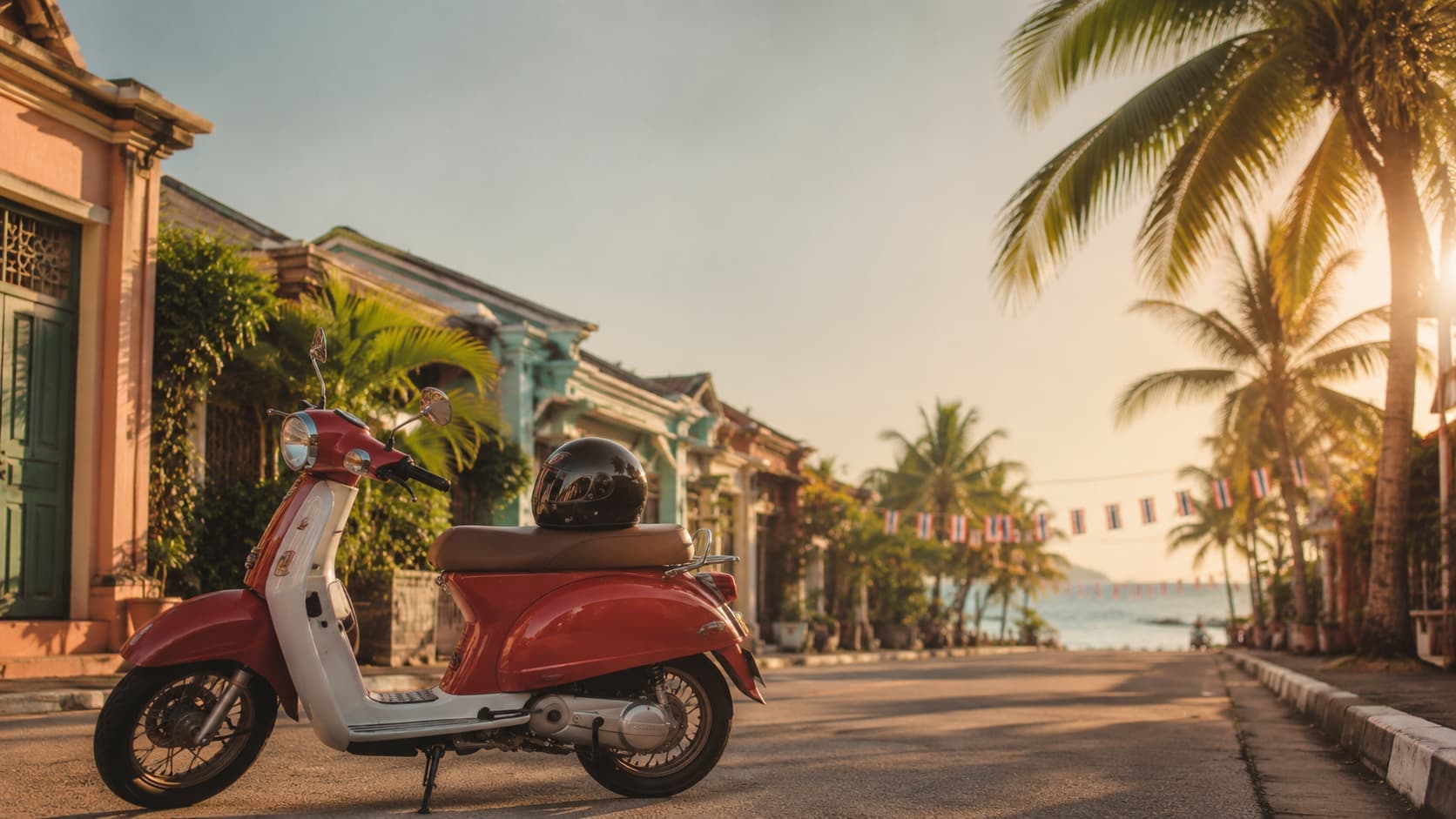
It's one of the most asked questions we get from travelers heading to Thailand: can I actually get insured for riding a scooter over there? The short answer is yes, but with a lot of asterisks. There isn't a single tidy product that bundles everything you need into one package. Instead, you end up stacking several layers of coverage together, and the strength of that stack depends entirely on the bike, the rental shop, your license, and the fine print of your travel policy.
We've put together this guide to walk you through exactly what's available, what's required, and where most riders get tripped up.
*NOTE! Whenever you see a text in blue, this is a link that will lead you to another one of our articles so that you can get more information.
Scooter Insurance in Thailand – The Short Answer:
For most tourists who fly into Thailand and rent a scooter at a beach town shop, no Thai insurer publicly offers a clean daily comprehensive policy in your name for that rented bike. What does exist is a layered system that includes the bike's mandatory compulsory insurance, any voluntary policy the owner has attached to it, the rental shop's contract or damage waiver, and your separate travel or travel-medical policy. If you want to ride legally and be financially protected, you need each of those layers working together. Skip one, and you could be on the hook for everything from a hospital bill to the full repair cost of the bike.
Scooter Insurance in Thailand – Thai Law and the Insurance Baseline:
Before we get into the insurance options, it's worth knowing what Thai law actually requires of you. These rules aren't just about avoiding fines, because insurers routinely tie your coverage to local-law compliance. Break the law, and your insurer may have grounds to deny the claim.
– Helmet Laws –
Thailand's Road Traffic Act requires both the rider and the passenger on a motorcycle to wear a helmet. The same Act also forbids a driver from carrying a passenger who isn't wearing one. Older English translations of Thai law list fines up to 500 baht for helmet violations, but a Thai government Public Relations Department announcement in June of 2025 reported an enforcement campaign with fines up to 2,000 baht. Whatever the current fine, the obligation itself is clear: helmets are mandatory, no exceptions.
– Licensing Requirements –
Thailand's Department of Land Transport recognizes driving licenses from ASEAN member states and International Driving Permits issued under the 1949 Geneva or 1968 Vienna conventions. The catch is that an International Driving Permit only mirrors the classes already on your home license. If your home license only authorizes you to drive a car, an IDP does not magically grant you motorcycle entitlement abroad. This is one of the most common misunderstandings we see, and it's the exact gap insurers look for when reviewing a claim.
UK government travel advice also warns that scooters and motorcycles rented in Thai tourist areas are often unregistered, which means they cannot legally be used on public roads. An unregistered bike is bad news for both the legality question and the insurance question.
– Por Ror Bor: Thailand's Compulsory Motor Insurance –
Every motorcycle registered in Thailand is required to carry compulsory insurance, called Por Ror Bor. It's regulated by Thailand's Office of Insurance Commission (OIC), and the annual premium for a motorcycle is regulated at roughly 161 to 645 baht depending on engine size. That's not a typo. It's cheap because it covers very little.
Here's what Por Ror Bor pays out:
-
Up to 80,000 baht per person for bodily injury -
Up to 500,000 baht per person for death or total permanent disability -
Between 200,000 and 500,000 baht for permanent disability or dismemberment -
200 baht per day for inpatient hospitalization, up to 20 days -
Combined cap of 504,000 baht per person and 20,000,000 baht per accident
The catch most travelers miss is the driver rule. Por Ror Bor expressly states that when the victim is the driver of the insured vehicle, the policy only pays out preliminary compensation. That preliminary compensation is currently capped at 30,000 baht for bodily injury and 35,000 baht for death or permanent disability. So if you crash your rented scooter and you're the one injured, Por Ror Bor gives you a small first-dollar payment, not the full schedule.
Also crucial: Por Ror Bor does not cover property damage at all. Not your bike, not the other guy's car, not the wall you hit. None of it.
Scooter Insurance in Thailand – What's Actually Available:
So what can you buy? The Thai voluntary motor insurance market is real, but the products available are mostly built for owners of Thai-registered bikes, not short-term tourists. Let's look at the main options.
– Voluntary Thai Motor Insurance (Types 1, 2+, 3+, and 3) –
For travelers who own or have long-term control of a Thai-registered motorcycle, insurers like Roojai sell annual policies divided into four classes:
Type 1 is the closest to full comprehensive cover. It pays for damage to your own bike whether or not a third party was involved, and it also covers theft, fire, and natural disasters. Roojai's published Type 1 page lists third-party property damage up to 1,500,000 baht per incident, third-party bodily injury up to 500,000 baht per person, and optional medical and personal accident cover up to 200,000 baht per person. Starting premiums begin around 2,419 baht per year.
Type 2+ is partial own-damage plus liability. It covers damage to your bike only if you collided with an identified third-party vehicle. Own-bike loss is capped at 100,000 baht, and theft, fire, and flooding are each covered up to 100,000 baht.
Type 3+ covers your own bike only when it collides with an identified third-party vehicle, up to 100,000 baht. Otherwise it functions mainly as third-party liability with small medical and personal accident benefits.
Type 3 is the bare-bones liability-only option. It's cheap, but it doesn't cover your own bike at all.
The major catch for tourists is in the eligibility criteria. Roojai requires the motorcycle to be legally registered in Thailand, the rider to generally be between 25 and 65 years old, and the rider to hold a valid license issued in Thailand or their home country. The rider must also have no more than three at-fault claims in the prior 12 months. In other words, this is real insurance, but it's geared toward long-stay foreigners who own or control a Thai-registered bike, not someone renting a scooter for a week in Phuket.
– Foreign Vehicle Permit Insurance –
If you're bringing your own foreign-registered motorcycle into Thailand, the Department of Land Transport has a formal route called the Foreign Vehicle Permit system. The DLT requires you to obtain a Thai compulsory insurance schedule and a Thai third-party liability insurance schedule with minimum coverage of at least 1,000,000 baht per person for loss of life or bodily injury, plus at least 1,000,000 baht for property damage per accident.
The permit itinerary is capped at 30 days per application, with a 60-day annual quota per vehicle. This is the cleanest short-term legal insurance pathway in the official Thai system, but it only applies to people entering Thailand with their own bike, not someone renting on arrival.
– The Tourist Gap –
Here's the truth about renting a scooter as a fly-in tourist in Thailand. We could not find a mainstream Thai insurer publicly offering a standardized daily or weekly comprehensive policy in the tourist's own name for a locally rented scooter. The available products are annual policies for Thai-registered bikes, Foreign Vehicle Permit insurance for self-driven imported vehicles, or separate personal-accident and travel products. That leaves most short-term tourists depending on three things: the Por Ror Bor already attached to the rental bike, whatever voluntary cover the rental fleet carries, and their own travel-medical policy.
This is why the rental shop's word that "you're insured" isn't always reassuring. Their insurance may only refer to the compulsory layer, which doesn't even cover the bike itself or the damage you might do.
Scooter Insurance in Thailand – Travel and Travel-Medical Insurance:
This is the layer most tourists actually rely on, and it's where the wording really matters. A good travel-medical policy can pay for your hospital bills, emergency evacuation, and repatriation after a scooter accident. A bad one will deny your claim because you weren't properly licensed, or because you didn't have a helmet on, or because the engine size exceeded the limit.
Here are the main options to consider.
– Expat Insurance –
We work with travelers heading to Thailand every week, and we'll be straight with you: there's no single off-the-shelf plan that covers every angle of scooter riding cleanly. What we can do is match you to a travel-medical policy whose wording explicitly tolerates motorcycle and scooter accidents, has meaningful emergency medical and evacuation limits, and won't leave you stuck on a licensing technicality after a crash. We've spent years reading the fine print on these policies so you don't have to. Some plans we work with offer engine-size limits up to 250cc, network hospital access in Bangkok and Chiang Mai, and direct claims handling. If you want to skip the comparison-shopping headache, click here for a 1-minute quote and we'll put options in front of you that actually cover scooter accidents in Thailand.
– World Nomads –
World Nomads says all four of its plans (Standard, Explorer, Epic, and Annual) cover losses resulting from motorcycling, though not the motorcycle itself. Only the Epic plan covers motorcycle racing. Their published U.S. benefit summary shows Explorer plan emergency medical coverage of $150,000 USD and emergency evacuation of $500,000 USD. They emphasize that travelers should have the proper motorbike license for the destination before leaving home.
– SafetyWing –
SafetyWing's Nomad Insurance Essential plan currently runs $62.72 USD per four weeks for ages 18 to 39. It includes an overall medical limit of $250,000 USD and evacuation coverage up to $100,000 USD. Their public wording says motor accidents are covered, but only if the insured is properly licensed, is wearing all safety equipment, and is not intoxicated. That trio of conditions is exactly what gets enforced after a crash.
– Viriyah Inbound Tourist Insurance –
Thailand-based inbound travel policies are also worth considering. Viriyah's Inbound Tourist Travel Insurance covers emergency medical expenses, loss of life or dismemberment, emergency medical evacuation and repatriation, repatriation of mortal remains, and personal liability. Importantly, their endorsement page includes an "Extended Clause Motorcycle," which suggests motorcycle coverage can be added. Compensation is paid within 15 days after complete proof of claim.
– MSIG Say Hi 10 –
MSIG's Say Hi 10 is a Thai inbound product for non-Thai nationals visiting Thailand. It offers personal accident coverage up to 1,000,000 baht, accident and sickness medical expenses up to 400,000 baht, outpatient limits of 5,000 baht per day up to 30 days per trip, and personal liability up to 800,000 baht. The catch is that the public marketing page does not clearly state that scooter or motorcycle accidents are covered. We'd recommend asking for the full wording before assuming it covers motorcycle riding.
Scooter Insurance in Thailand – What to Look For in Policy Wording:
The clauses that actually matter aren't hidden. You just have to know what to look for. When you're shopping for a travel policy, hunt for these exact phrases or close equivalents in the wording:
-
"Motorcycle / moped / scooter accidents covered" -
"Properly licensed" -
"Wearing all safety equipment" -
"Not intoxicated" -
"International Driving Permit where required" -
"Engine size limit" (commonly 125cc or 250cc) -
"Emergency medical evacuation and repatriation" -
"Personal liability" -
"The motorcycle itself is not covered" (a common limit in travel policies)
The safest wordings are the ones that explicitly mention scooter or motorcycle coverage. If your policy is silent on it, that silence will not work in your favor when you submit a claim.
For more on what travel insurance typically covers, click here to read our full guide.
Scooter Insurance in Thailand – Why You Need Medical Evacuation Coverage:
Scooter accidents in Thailand are not rare, and the medical bills can add up fast. Bangkok and Chiang Mai have excellent private hospitals (some of which we cover in our guide to the best hospitals in Chiang Mai for expats), but care at international-standard facilities is expensive. If you're seriously injured on a beach island like Ko Pha-ngan or Ko Tao, the local clinic may not be equipped to handle a major head injury, severe road rash, or compound fractures.
This is where medical evacuation coverage saves you. An air ambulance from a Thai island to Bangkok can run into the tens of thousands of dollars. From Thailand back to the United States, the cost can easily climb past $100,000 USD. Without evacuation coverage, that bill is yours.
For more on the costs and how this coverage works, read our article on medical evacuation insurance and our guide to medivac insurance for living abroad.
Scooter Insurance in Thailand – At the Rental Counter:
Before you take possession of any scooter in Thailand, ask the rental shop to show you three things:
-
The bike's registration document or copy -
Proof that Por Ror Bor is active on the bike -
The exact rental terms for bike damage, deposits, and loss of use
Then photograph the bike thoroughly. Get pictures of every scratch, dent, and scuff. Walk around it slowly. Take videos. Some rental shops in tourist areas are notorious for charging foreigners for damage that was already there. Documentation is your best defense.
You should also confirm whether the shop is asking you to leave your passport as a deposit. We strongly recommend you do not. Some shops use this leverage to manufacture damage charges. Offer a cash deposit instead, or take your business to a shop that takes a photocopy.
Scooter Insurance in Thailand – What to Do if You Crash:
A scooter accident in Thailand becomes a multi-insurer event. Here's the order of operations:
-
Get medical care first. This is non-negotiable. -
Notify the Thai police. You'll need a police report for any insurance claim. -
Notify the rental shop or the bike's insurer. -
Call your travel insurance assistance line. They can direct you to a network hospital and authorize evacuation if needed. -
Preserve documentation. Keep your passport, license, IDP, rental contract, registration evidence, photos of the accident, medical records, hospital bills, and the police report all in one place. -
Submit your claim within the policy timelines.
Por Ror Bor pays preliminary compensation within seven days of receiving the request, which makes it useful for immediate hospital cashflow. Voluntary Thai motor insurers like Roojai advertise mobile-app claims and a 30-minute accident-scene response. Travel insurers like Viriyah and MSIG generally process claims within 15 days of receiving complete documentation. SafetyWing markets a "simple claims process" through its dashboard and says reimbursement can come back within a few days.
The key is that timely reporting and complete documentation are required by every insurer. If you wait three weeks to file, or if you can't produce the police report, you're inviting denial.
Scooter Insurance in Thailand – Common Misconceptions:
Several beliefs we hear from travelers are simply wrong, and they can cost you a claim.
– "The rental shop said I'm insured." –
Not enough. The shop may mean the bike has Por Ror Bor, which doesn't cover much. Many tourist-area rental bikes are unregistered and shouldn't legally be on the road in the first place. Always ask to see the documentation.
– "Por Ror Bor is full insurance." –
False. It doesn't cover property damage, and if you're the at-fault rider, you only get preliminary compensation. You can still be sued personally for damages beyond the limits.
– "Travel insurance covers the scooter." –
Usually false. World Nomads expressly states their coverage is for losses resulting from motorcycling, not the motorcycle itself. Damage to the rental bike is almost always your problem unless the rental shop offers a separate damage waiver.
– "A car license plus an IDP is enough for a scooter." –
Dangerous. An IDP only mirrors your home license classes. If you don't have motorcycle entitlement at home, you don't have it abroad either, and your claim is likely to be denied on licensing grounds. (Read more about international driving permits here.)
Scooter Insurance in Thailand – Frequently Asked Questions:
– Can a tourist get a Thai motorcycle license? –
For travelers entering Thailand with their own foreign-registered motorcycle under the Foreign Vehicle Permit system, the DLT allows you to obtain a 30-day temporary Thai driving license at the border-area land transport office. You'll need your passport, a medical certificate, a translated foreign license, and an address letter from the agency facilitating your travel. This is a real mechanism, but it's tied to the FVP process, not a general workaround for tourists renting locally.
– What engine sizes are typically excluded by travel insurance? –
Engine size limits vary by insurer, but 125cc is a common ceiling for some U.S. plans, while others allow up to 250cc. A few permit higher displacements with motorcycle-specific endorsements. Always check the exact wording of your specific plan.
– Does Por Ror Bor cover me if I'm hit by another vehicle? –
Yes, in part. As the victim of another vehicle, you can access the full Por Ror Bor bodily-injury schedule (up to 80,000 baht for bodily injury, up to 500,000 baht for death). However, if you're the driver of the insured vehicle in an at-fault crash, you only get preliminary compensation.
– What if the rental bike isn't registered? –
You have a serious problem. Unregistered bikes can't legally be on the road, your Por Ror Bor coverage is likely void, and your travel insurance may invoke the "local law compliance" clause to deny the claim. Always verify registration before taking the keys.
– Is helmet wearing actually enforced? –
Yes. Thai police periodically conduct enforcement campaigns with fines up to 2,000 baht. More importantly, your travel insurer will almost certainly deny a claim if you weren't wearing a helmet. SafetyWing's wording requires "all safety equipment," which is interpreted broadly.
– Do I need to bring an International Driving Permit before leaving home? –
Yes. You can only obtain an IDP in your home country before you leave. They are not issued abroad. The IDP simply translates your existing license; it does not grant you any new driving privileges. For more on IDPs, click here.
– Can I add scooter coverage to a Thai health insurance policy? –
Some Thai health insurance policies allow motorcycle accident endorsements, but most do not by default. If you're a long-term resident, check our guide to medical insurance in Thailand and ask your broker specifically about motorcycle exclusions and endorsements.
Scooter Insurance in Thailand – Conclusion:
Can you get insured for riding a scooter in Thailand? Yes, but only by stacking the right layers together. The bike needs to carry valid Por Ror Bor. The rental shop needs to be reputable and the bike needs to be registered. You need a license that actually authorizes motorcycle riding (not just a car license with an IDP). And you need a separate travel or travel-medical policy with explicit motorcycle coverage, plus emergency evacuation, plus personal liability.
It's not the simplest setup, but it works. The travelers who get burned are almost always the ones who skipped a layer, rented from a sketchy shop, or assumed their travel policy would cover them by default. Don't be that traveler.
If you're planning a trip to Thailand and want help finding a travel-medical policy that explicitly covers scooter accidents, we'd love to walk you through your options. We've helped thousands of expats and travelers find the right coverage, and we're happy to help you do the same.
For more reading on insurance options in Thailand, check out our guide to health insurance in Thailand and our article on why long-stay visas in Thailand now require insurance.
We would like to invite you to join our Facebook discussion.
If you would like a quick quote on travel insurance for your trip to Thailand, click below!
Talk to a broker on the phone!
Justin Barsketis
Insurance Expert & Writer
Justin is an insurance guru that loves digital marketing. As our founder Justin manages our business development programs and MGA network. Please don’t hesitate to contact him if you are not getting the attention you deserve.
