
January 28, 2026
•
5 min read
Teaching english abroad requirements: Your path to global classrooms
teaching english abroad requirements: A concise guide to TEFL, degrees, visas, and how to start a rewarding global teaching career.
Justin Barsketis
Insurance Expert

So, you're thinking about teaching English abroad? Awesome. The first step is figuring out what you actually need to make it happen. Generally, the magic trio is a bachelor's degree, a TEFL certification, and a passport from a native English-speaking country. While there's wiggle room depending on where you want to go, those three things will open the most doors.
Decoding the Requirements to Teach English Abroad
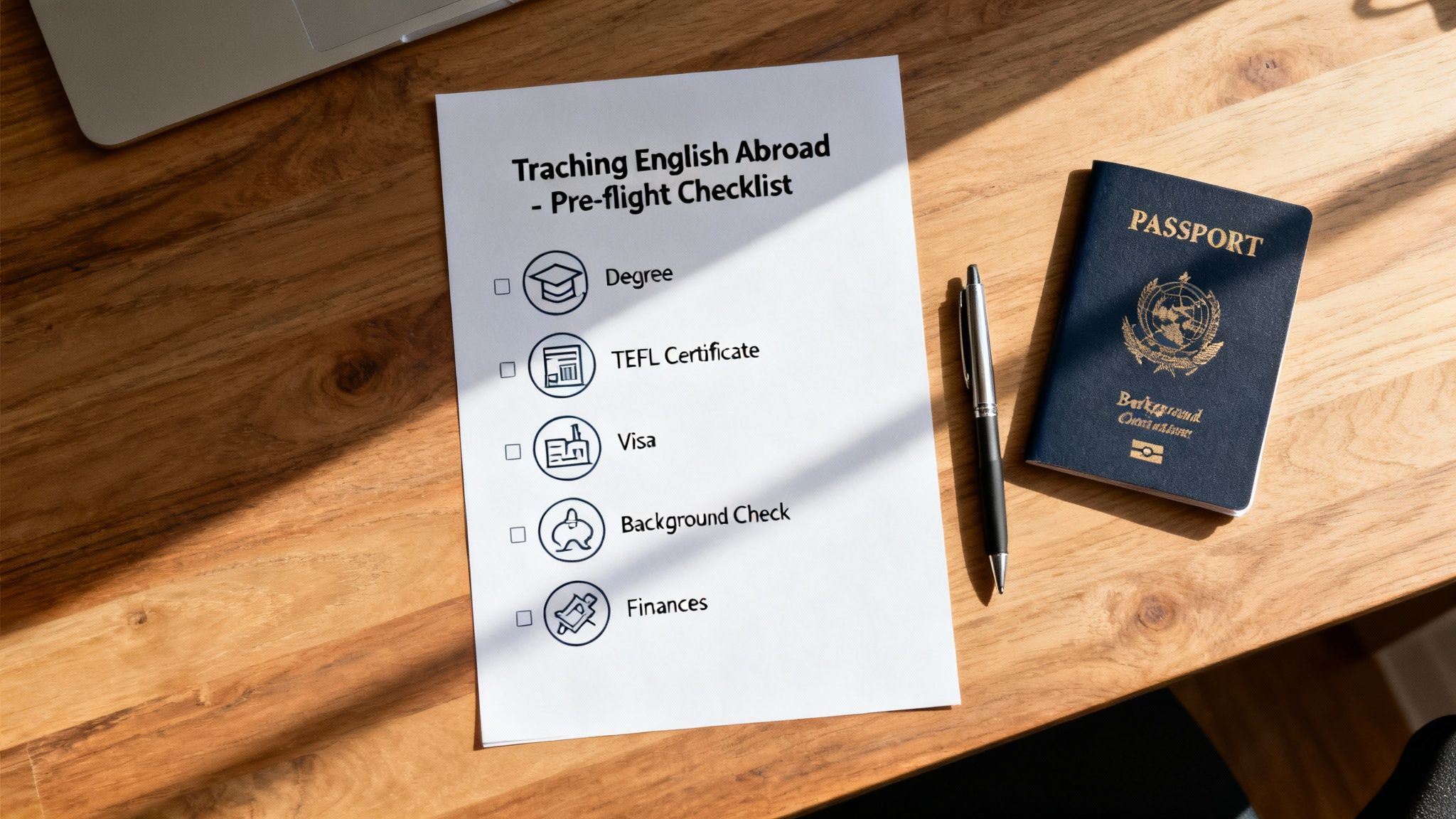
Before you start picturing yourself sipping coffee in a Roman piazza or navigating the subways of Tokyo, let's get the paperwork sorted. It's best to think of these requirements not as hurdles, but as a pre-flight checklist. Each item is there for a reason, whether it's to satisfy a government's visa laws or to prove to a school that you know your way around a classroom.
Getting hired to teach English abroad really comes down to ticking five key boxes that schools and immigration officials care about.
The Five Pillars of Eligibility
Your journey starts here, by seeing how you stack up in these five core areas. Get these sorted, and you'll be in a much stronger position to land a great job in the country you're dreaming of.
- Academic Credentials: This is almost always about your bachelor's degree. For a huge number of countries, particularly in Asia and the Middle East, having a degree—in any subject—is a non-negotiable legal requirement to get a work visa.
- Teaching Certification: This is your proof that you can actually teach. A TEFL (Teaching English as a Foreign Language), TESOL, or CELTA certificate shows employers you've been trained in lesson planning, grammar theory, and how to manage a classroom full of eager students.
- Legal & Visa Status: This bucket includes your nationality, age, and your ability to pass a criminal background check. These are often black-and-white rules set by a country's immigration department.
- Personal & Financial Readiness: You'll need to be in good health and have some savings tucked away. A good rule of thumb is to have $2,000–$3,000 to cover your apartment deposit, flights, and living expenses before that first paycheck lands in your account.
The number one question I hear is, "How can I teach students if I don't speak their language?" A good TEFL course is the answer. It teaches you immersive techniques that show why translating everything isn't just unnecessary, but often less effective for learning.
Understanding these pillars gives you a clear roadmap. To give you a head start, I've put together a quick comparison of how these requirements play out in popular regions around the world.
Quick Glance Regional Requirements for Teaching English Abroad
This table gives you a high-level look at what to expect in different parts of the world. It's a great starting point to see where your current qualifications might be the best fit.
| Requirement | Asia (e.g., South Korea, Japan) | Europe (e.g., Spain, Czech Republic) | Latin America (e.g., Mexico, Colombia) |
|---|---|---|---|
| Bachelor's Degree | Almost always mandatory for visa. | Often required; EU citizenship is a major factor. | Frequently preferred but not always mandatory. |
| TEFL Certificate | Highly preferred; minimum 100-120 hours expected. | Essential, especially for non-EU citizens. | Crucial; often valued more than a degree. |
| Native Speaker | Strong preference for specific nationalities. | Varies; high fluency is key for non-natives. | More flexible, with an emphasis on fluency. |
| Background Check | Mandatory and must be apostilled. | Required for visa/work permit applications. | Often required by employers. |
As you can see, the "must-haves" can change quite a bit from one continent to another. Asia is often the most rigid with its degree and nationality rules, while Latin America can offer a bit more flexibility if you've got a strong TEFL and great fluency.
Your Degree and TEFL Certificate Explained
When it comes to teaching English abroad, your qualifications are everything. Think of them as two separate keys needed to unlock the same door. The first key is your bachelor's degree, and the second is a specialized teaching certification.
For many of the world's most popular teaching destinations, these two items are the foundational teaching English abroad requirements. Without them, you'll find a lot of doors will stay firmly shut. So let's break down what each one is and why it matters so much.
The Bachelor's Degree: Your Passport to Opportunity
In the world of international teaching, a bachelor's degree often functions as your passport to a work visa. Many governments, especially in sought-after regions like Asia and the Middle East, have made a four-year degree a non-negotiable legal requirement for pretty much all foreign workers.
It's a common myth that your degree needs to be in education or English. The truth is, for most teaching gigs, the subject of your degree doesn't matter one bit. A school in Seoul or Tokyo just cares that you have a degree in anything—be it history, engineering, or art—because it's the checkbox the immigration office needs to tick.
This requirement has less to do with your teaching ability and more to do with a country's labor and immigration laws. It's their baseline for academic achievement.
Your TEFL Certificate: The Proof of Your Skills
If your degree gets you through the immigration door, your TEFL certificate proves you actually belong in the classroom. TEFL, which stands for Teaching English as a Foreign Language, is the industry-standard qualification that schools everywhere look for on a resume.
A solid TEFL course gives you the practical, hands-on skills needed to teach English effectively to people who don't speak it as their first language. It covers all the essential stuff that a standard bachelor's degree simply doesn't touch.
Key things you'll learn in a quality TEFL course include:
- Lesson Planning: How to structure engaging and effective lessons for different ages and skill levels.
- Classroom Management: Techniques for keeping students focused, motivated, and participating.
- Grammar for Teachers: Learning how to explain tricky English grammar rules in simple, easy-to-understand ways.
- Language Theory: A peek into the science behind how people actually learn a second language.
This certification tells an employer you've invested in learning the craft of teaching. It immediately separates you from the applicants who just show up hoping their native-speaking ability is enough. Of course, once you have both, it's crucial to know how to effectively list your education on a resume to stand out to employers.
Choosing the Right TEFL Course
Heads up: not all TEFL courses are created equal. The international standard that most employers recognize is a course with at least 120 hours of training. Anything less might not be taken seriously, especially in the more competitive job markets.
You'll generally run into three main types of TEFL courses:
- Online Only: These are super flexible and usually the most affordable. You can study at your own pace from anywhere in the world.
- In-Person/On-site: These courses offer hands-on teaching practice with real students, which is an absolutely invaluable experience.
- Hybrid/Combined: These offer the best of both worlds—online coursework to cover the theory, followed by a practical, in-person teaching component.
The best option really depends on your budget, timeline, and how you like to learn. But I'll say this: a course that includes a practicum (live teaching practice) will always give you a leg up on the competition.
The gold standard for a TEFL certificate is a 120-hour course that includes a practical teaching component. This combination demonstrates both theoretical knowledge and real-world application, making you a much more attractive candidate to schools worldwide.
What If You Don't Have a Degree?
While a degree is a hard requirement in many places, it's not necessarily the end of the road if you don't have one. In this scenario, your TEFL certificate becomes even more critical. Certain regions, particularly in parts of Latin America and some countries in Europe, prioritize a high-quality TEFL certification and proven fluency over a university diploma.
For example, looking ahead to 2026, major Asian hubs like South Korea, Japan, China, Vietnam, and Thailand all demand a bachelor's degree as a non-negotiable for getting a visa. In these same countries, TEFL certification is just as important. A minimum 100-hour course is required by programs like EPIK in South Korea and strongly preferred in Japan, where salaries can range from $1,600-$2,500 a month, often with benefits like flights and housing for the right candidates.
At the end of the day, having both a degree and a TEFL certificate opens the widest range of opportunities. It gives you the flexibility to choose from the highest-paying and most reputable positions across the globe.
Navigating Visas and Work Permits
Think of getting your visa like building a house. You can't start without a solid foundation (your job offer), the right materials (your official documents), and a clear blueprint (the embassy's rules). The legal paperwork might seem like the most intimidating part of the whole adventure, but it's a completely manageable piece of the puzzle.
Here's the single most important rule to live by: never, ever work on a tourist visa. You'll hear stories of people who've done it, but it's a massive gamble. Working illegally can get you hit with huge fines, deported, and even blacklisted from the country for years. It's just not worth it. Always go the official route and get the proper work visa.
The Foundation: Your Job Offer and Sponsorship
Before you can even think about a work visa, you almost always need one thing: a job offer. Your school is more than just your future employer; they're your sponsor. They provide the signed contract and invitation letters that prove to the government you have a legitimate job waiting for you.
This sponsorship is the cornerstone of your entire application. Without it, immigration officials have no reason to let you work in their country. This is why the bulk of the visa process happens after you've been officially hired. Your employer will usually walk you through the specific documents they need from you to get the ball rolling on their end.
Gathering Your Essential Documents
Once you have that signed contract in hand, it's time to gather your documents. This is where your attention to detail really matters. A single missing paper or a form filled out incorrectly can cause major delays—or worse, an outright rejection of your visa application.
Here's a look at the usual suspects you'll need to round up:
- Your Passport: It needs to be valid for at least six months beyond your contract's end date and have plenty of blank pages for stamps and visas.
- A Signed Employment Contract: This is your official proof of employment from the school sponsoring you.
- University Degree and Transcripts: These documents prove you meet the country's educational standards.
- TEFL Certificate: Your teaching qualification is often a non-negotiable requirement.
- Criminal Background Check: A standard security measure for just about every country hiring foreign teachers.
- Medical Exam or Health Certificate: Some nations require this to make sure you're in good health before you arrive.
But just having these documents isn't enough. They often need to be officially authenticated to be considered valid overseas. This special certification is called an apostille.
An apostille is a specialized certificate that authenticates your public documents for use in foreign countries. It verifies that the signature and seal on your document—like your degree or background check—are genuine. Think of it as a notarization for international use.
The Apostille Process Explained
For your degree or background check to be legally recognized in another country, it often needs this official stamp of approval. Before you do anything else, you need to check if your destination country is part of the Hague Apostille Convention. You can consult the latest Hague Apostille country list to confirm if this process applies to you.
If your destination country is a member, you'll need to get an apostille for key documents. This process is handled by a specific authority in your home country, like the Secretary of State's office. It's a mandatory step for many popular teaching spots, so don't even think about skipping it. For example, navigating the paperwork for a how to get a China work permit and visa involves multiple layers of document legalization, and the apostille is a critical part of that.
How Your Profile Affects Visa Eligibility
Not everyone's visa journey looks the same. A few personal factors can significantly influence your eligibility and the specific rules you'll need to follow. It's smart to research how these things might impact your chances in your target country.
Your nationality is usually the biggest factor. Some countries have special agreements or streamlined visa processes for citizens of certain nations. EU citizens, for instance, can work in other EU countries with relative ease compared to non-EU citizens. Similarly, popular programs in places like South Korea often give preference to passport holders from a short list of native English-speaking countries.
Your age can also play a role. Some countries have upper age limits for their work visa programs, often somewhere between 35 and 60. Always check for any age restrictions before you get too far into the application process. Understanding these details from the start helps you focus your job search on countries where you're a strong legal candidate.
A Spotlight on Top Teaching Destinations
It's one thing to talk about degrees, visas, and TEFL certificates in the abstract. It's another thing entirely to see how they actually play out on the ground. Let's make this real by looking at some of the most popular hubs for teaching English abroad.
Think of it this way: the teaching English abroad requirements in any given country are a direct reflection of its economy, immigration laws, and what it demands from its educators. A high-end restaurant in Tokyo will have a stricter dress code than a laid-back cafe in Cancún. In the same way, the most competitive teaching markets have the tightest rules.
Asia: High Standards, High Rewards
Countries in East Asia—especially places like South Korea and Japan—are legendary for offering some of the best teaching packages out there. We're talking competitive salaries, free housing (or a healthy stipend), and sometimes even your flight costs covered. But this generosity comes with a very strict set of requirements.
For starters, a bachelor's degree is a non-negotiable legal requirement for a work visa. Your passport is also critical. There's a huge preference—often a legal mandate—for citizens from one of the seven designated native English-speaking countries.
- South Korea: The government's EPIK (English Program in Korea) is a massive program that places teachers in public schools. The rules are ironclad: you need a bachelor's degree and a passport from the UK, USA, Canada, Australia, New Zealand, Ireland, or South Africa. No exceptions.
- Japan: The JET (Japan Exchange and Teaching) Programme is similarly prestigious but accepts applicants from over 50 participating countries—not just native English-speaking nations. While a bachelor's degree is required, the nationality requirements are less restrictive than EPIK. Private language schools, known as eikaiwas, will almost always require a bachelor's degree to sponsor your visa. If you're curious about the day-to-day, our guide on what it's like living and working in Japan offers a great window into the culture.
In Asia's top-tier markets, your degree and your passport are the keys that unlock the door. Without them, you can't even get past the first checkpoint of the visa process. From there, a 100-120 hour TEFL certificate is the next critical piece that shows you actually know how to teach.
Europe: The Citizenship Divide
Europe is a bit more complicated, and it all boils down to one simple question: do you have an EU passport? If you do, teaching in another EU country like Spain or Italy is a breeze. You're free from the mountain of visa paperwork that everyone else has to deal with.
For non-EU citizens, the path is much steeper. Getting a job often means finding an employer willing to sponsor you, which involves a complex process of proving that no other suitable EU candidate was available for the job.
- Spain: For Americans, Canadians, and other non-EU folks, the most common way in is a student visa, which lets you work part-time while you study Spanish. Getting a full-blown work visa from the get-go is incredibly difficult unless you have a highly specialized skill.
- Czech Republic: This country has long been one of the more welcoming spots in Europe for non-EU teachers. Many are able to get a long-term business visa (a Zivno) and teach legally as freelancers.
Latin America: Flexibility and Opportunity
If Asia is the exclusive club with a velvet rope and a strict guest list, Latin America is the lively festival where your skills and enthusiasm get you in. The approach to hiring English teachers here is much more flexible, making it a fantastic destination if you don't quite fit the rigid mold of the Asian markets.
A quality TEFL certification often speaks louder than a bachelor's degree in this part of the world, particularly at private language academies. Schools are hunting for energetic, well-trained teachers who can captivate a classroom, and a solid TEFL is the best proof of that.
This flexibility is pretty common across the region. As of 2026, Mexico prefers a bachelor's degree for many positions but is also open to TEFL-certified teachers who can prove their English fluency with a test like the IELTS or TOEIC. Colombia, a rising star in the TEFL world, often doesn't require a degree at all for private school jobs, though public schools now mandate TEFL certification thanks to recent education reforms.
Globally, dozens of countries—a significant portion of them in Latin America—will hire teachers without a degree as long as they are TEFL-trained. It's a completely different world from Asia's strictness.
Matching your qualifications to a country's specific needs is the secret to a smooth, successful job hunt.
Document Checklist for Top Teaching Destinations
Navigating the paperwork can feel overwhelming, but it helps to see what a typical application process looks like. Below is a checklist of the documents you'll likely need for three popular, but very different, teaching destinations.
| Document/Requirement | South Korea | Spain (Non-EU) | Mexico |
|---|---|---|---|
| University Degree | Required (Apostilled copy) | Not always for the job, but often helps with certain visa types. | Preferred for most formal positions (Apostilled copy). |
| TEFL/TESOL Certificate | Required (100+ hours) | Highly Recommended (often essential to get hired). | Highly Recommended (can sometimes substitute for a degree). |
| Passport | From 7 designated native English-speaking countries only. | Any nationality, but EU passport holders have a massive advantage. | Any nationality. |
| Criminal Background Check | Required (National level, Apostilled) | Required for visa (National level, Apostilled). | Required for visa (National level, Apostilled). |
| Health Check/Medical Exam | Required (Both for visa and upon arrival). | Required for visa application. | Required for visa application. |
| Visa Type | E-2 (Foreign Language Instructor) Visa sponsored by the employer. | Typically Student Visa (allows part-time work) or EU work permit. | FM3 Visa (Temporary Resident with work authorization). |
| Proof of Funds | Not typically required, as the job provides income. | Required for visa (must show sufficient funds to support yourself). | Required for visa (must show proof of financial solvency). |
Keep in mind, this table is a general guide. Immigration laws and school requirements can change, so always double-check with the specific consulate and your potential employer for the most current information before you start gathering your documents.
Preparing Your Health, Safety, and Finances
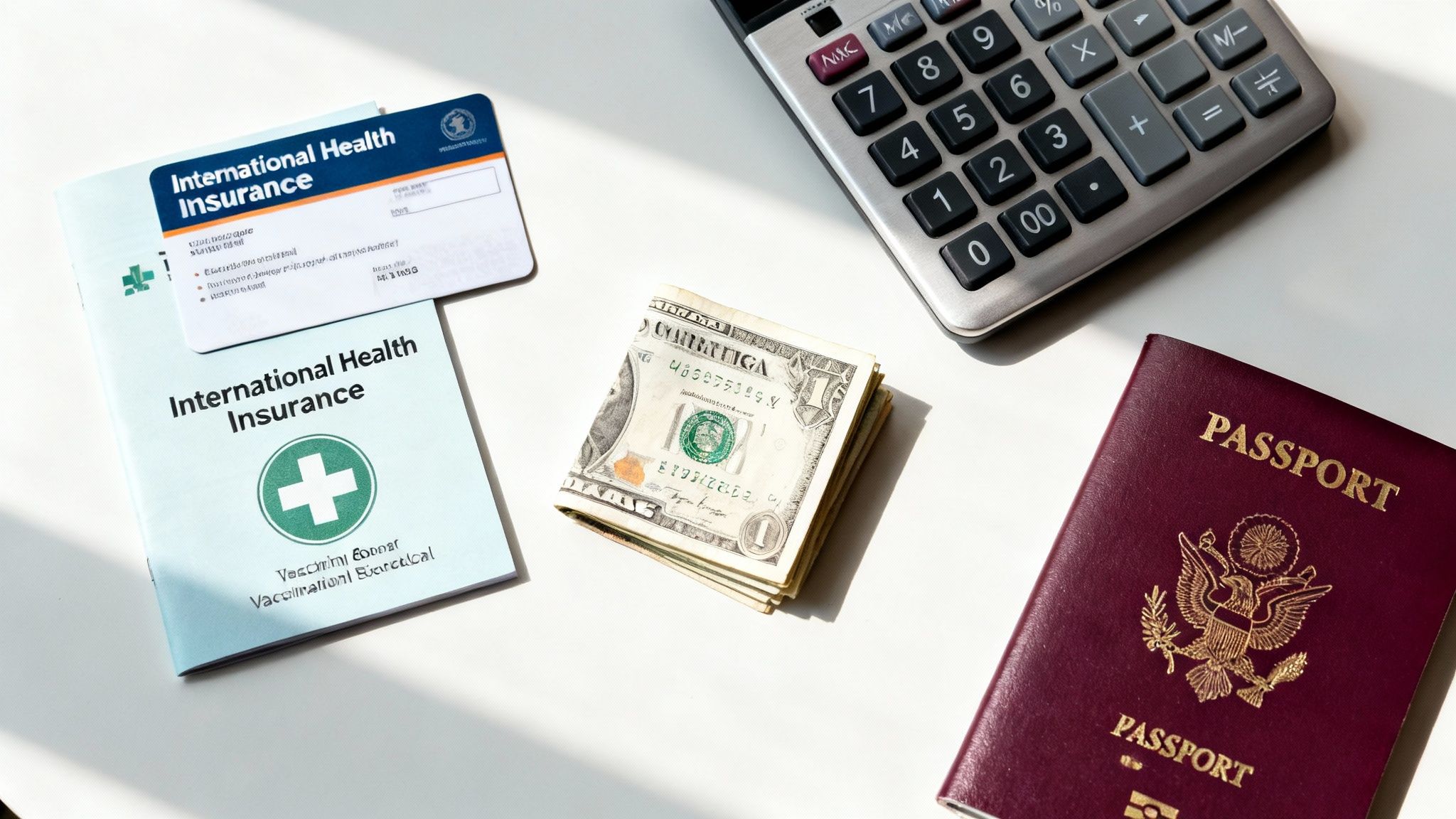
Having the right qualifications is only half the battle. Your personal and financial readiness is what truly sets you up for success—and peace of mind—once you land.
Before you even think about boarding that plane, you need a solid safety net for your finances, health, and legal standing. Honestly, this is one of the most overlooked parts of the process, but it's absolutely one of the most critical teaching English abroad requirements.
Think of it like packing three essential bags: one for your money, one for your health, and one for your security. Each one needs to be carefully sorted so you can handle anything that comes your way, from covering your first month's rent to dealing with an unexpected doctor's visit.
Building Your Financial Runway
One of the biggest mistakes I see aspiring teachers make is underestimating their startup costs. Your first paycheck might not show up for four to six weeks, and you absolutely need a financial cushion to bridge that gap. This isn't just "emergency" money; it's the operational fund for launching your entire new life.
A safe target to aim for is somewhere between $2,000 and $3,000 USD. This amount gives you a solid runway to cover all your initial expenses without breaking a sweat.
So, what does that startup fund actually cover?
- Flights: Even if your school promises reimbursement, you almost always have to pay for the ticket upfront.
- Visa and Document Fees: Apostilles, embassy appointments, and courier services all add up.
- First Month's Rent and Deposit: This is usually your biggest initial hit, sometimes requiring two months' rent right away.
- Daily Living Expenses: Think food, transportation, and a local SIM card until your salary finally kicks in.
Having this fund ready means you won't start your adventure in a state of financial panic. It lets you focus on what matters: settling in and being a great teacher from day one. It's the difference between thriving and just scraping by.
Clearing Health and Security Hurdles
Before any country hands you a work permit, they need to know two things: that you're healthy and that you don't pose a security risk. This means a couple of non-negotiable checks are on your to-do list.
First, you'll need a criminal background check. This is a standard requirement for anyone planning to work with children. The check typically has to be done at a national level (like an FBI background check in the U.S.) and then authenticated with an apostille to be legally recognized overseas.
Second, a medical examination is almost always mandatory. This can range from a simple health form signed by your doctor to a full-blown exam with blood tests and X-rays. These requirements are there to protect the local population and make sure you're physically fit for the job. Get started on these early—gathering the right documents can take weeks.
The Non-Negotiable Safety Net: International Health Insurance
Your school might offer a basic, local health plan, but these often come with major limitations, language barriers, and big gaps in coverage. Relying only on a local plan is a gamble you don't want to take.
Real peace of mind comes from a comprehensive international health insurance policy designed specifically for people living abroad.
Think of expat health insurance as your universal adapter for global healthcare. It ensures that no matter where you are, you can plug into a reliable network of high-quality medical care—from routine check-ups to serious emergencies—without facing devastating costs.
This kind of insurance is your ultimate safety net. It covers major medical events, emergency evacuations, and gives you access to private hospitals where English is more likely to be spoken. For example, understanding the details of medical insurance for expats in Thailand shows how a dedicated plan offers far better protection than local options.
It ensures a minor illness doesn't snowball into a financial crisis, making it an essential piece of your pre-departure puzzle.
Common Questions About Teaching English Abroad
Even after you've done your research, a few questions are bound to pop up. The world of teaching English overseas is filled with little details and regional quirks, so it's smart to get clear on the things that matter most.
Think of this as the final once-over. We're tackling some of the most common questions that aspiring teachers have, with straightforward answers to help you feel confident about your next move.
Can I Teach English Abroad Without a Degree?
Yes, you definitely can, but where you can go will be a bit different. Your options will mostly be concentrated in specific regions. While the big markets in Asia and the Middle East almost always require a bachelor's degree to even get a work visa, many countries in Latin America and some in Europe are hungry for skilled teachers, degree or not.
In places like Mexico, Costa Rica, and Colombia, a top-notch TEFL certification often carries more weight than a university diploma, especially when you're applying to private language academies. For these jobs, your TEFL, your fluency, and any teaching experience you have are your golden tickets. Your path might look different from a university grad's, but it's absolutely doable.
Do I Have to Be a Native English Speaker?
Not always, but you'll need to prove you have a high-level command of the language. It's true that many countries and premier programs give a strong preference to passport holders from a small group of native English-speaking countries—this just makes their visa paperwork simpler.
However, more and more schools are opening up, particularly in Europe and Latin America. They are actively hiring non-native speakers who can show off their fluency, usually by scoring a C1 or C2 level on a standardized test like the IELTS or TOEFL. If you're a non-native speaker, a professional TEFL certificate and a clear, easy-to-understand accent are crucial for landing the best positions.
The most common question I get from anyone asking about my work life… is "How do you teach or even communicate with your students if you do not speak the same language?" Thanks to the TEFL course, I know that translation is not necessarily the easiest or best way to teach a new language.
This little insight shows that solid teaching methods, the kind you learn in a TEFL course, are often far more valuable than simply sharing a first language with your students.
How Much Money Should I Save Before Moving?
A safe, realistic number to shoot for is somewhere between $2,000 and $3,500 USD. This gives you a comfortable financial cushion to handle all your start-up costs without the stress.
Think of this as your "get settled" fund. It's meant to cover everything you'll need before that first paycheck lands, which could easily be four to six weeks after you arrive.
- Round-trip flight: Even if your school offers reimbursement, you almost always have to pay for the ticket yourself first.
- TEFL course and visa fees: These administrative costs can add up faster than you think.
- Initial living expenses: This covers your apartment deposit, first month's rent, groceries, and getting around town.
- An emergency fund: It's just smart to have extra cash tucked away for any surprises.
Even if a job in Asia offers perks like flight reimbursement or a housing allowance, you still need the cash on hand to get yourself there and set up your new life.
What Is an Apostille and Why Is It Required?
An apostille is an official sticker or certificate that makes your documents legit for use in other countries. Think of it as an international notarization. It's only for countries that are part of something called the Hague Convention.
It basically verifies that the signature and seal on your important papers—like your university degree or a criminal background check—are the real deal. This is a non-negotiable step for getting a work visa in many popular teaching spots, including South Korea and Spain.
How you get an apostille depends entirely on where your documents were issued, so you'll have to look up the specific steps for your home country or state. Skip this, and your visa application will be dead in the water.
Planning your big move abroad is about more than just paperwork; you need a solid plan for your health and well-being, too. At Expat Insurance, we specialize in finding the perfect international health insurance to give you peace of mind on your journey. Compare plans from over 65 insurers and get a quote in just 24 hours. Protect your adventure by visiting https://www.expatinsurance.com to learn more.
Justin Barsketis
Insurance Expert & Writer
Justin is an insurance guru that loves digital marketing. As our founder Justin manages our business development programs and MGA network. Please don’t hesitate to contact him if you are not getting the attention you deserve.
